
Your fab's substrate lead times and your M4 lanes live in different worlds
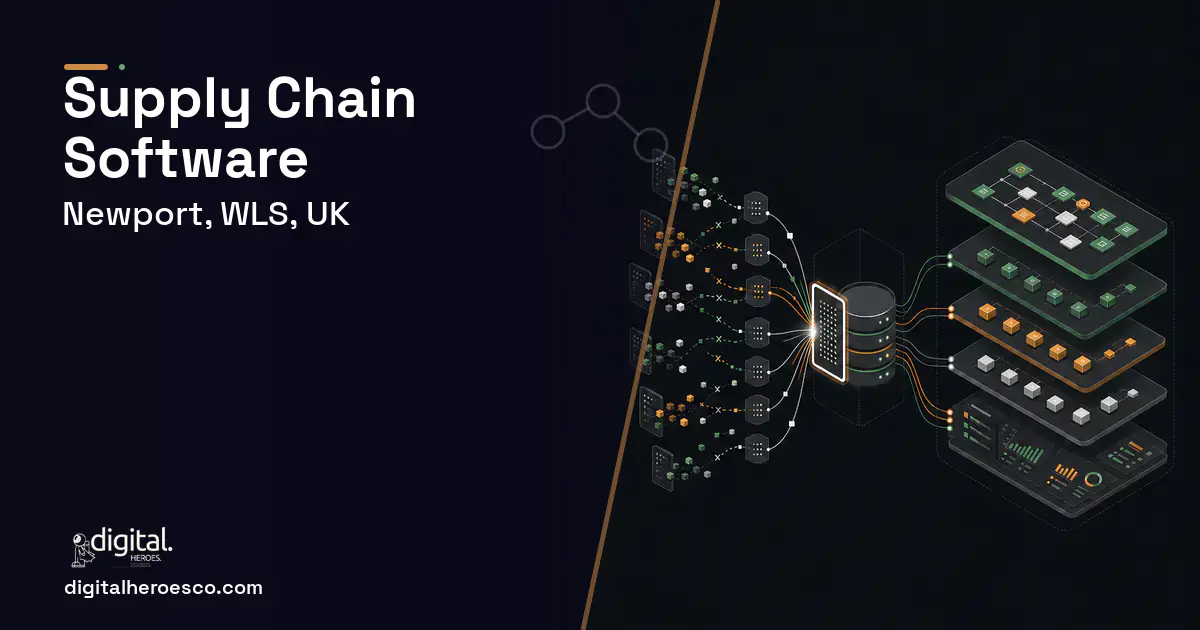
Custom supply chain software for a Newport operation costs £60k to £160k over 5 to 9 months. SAP and generic SCM (Supply Chain Management) suites are heavyweight, expensive, and still assume a fairly standard flow. Newport's challenge is specific: marrying long-lead, allocation-constrained semiconductor inputs (substrates, specialty gases, mask sets) with the multi-modal M4 freight that moves finished goods to port and across the Severn. A custom build links those two worlds that off-the-shelf SCM keeps apart.
A compound-semiconductor supplier and an M4 distributor each have a supply chain problem, and they're not the same problem. The fab side lives or dies on long-lead, allocation-constrained inputs: substrate wafers on 20-week lead times, specialty gases, mask sets, where a single late delivery idles a fab line worth thousands an hour. Generic SCM treats these like any purchase order, blind to allocation risk and the cascade a slip causes.
The distribution side runs multi-modal freight: road down the M4, rail to a port, sea to a customer, with handoffs where shipments stall and visibility evaporates. SAP can model one mode acceptably; it handles the road-to-rail-to-port baton-pass poorly, and licensing it for a mid-sized Newport firm is brutal. So planners juggle supplier portals, carrier emails, and spreadsheets, and nobody sees the whole chain from substrate order to delivered goods in one place. Custom software builds that single view.
The fix: supply chain built for Newport, not rented
Custom supply chain software models both halves of your chain and links them: allocation-aware planning for long-lead fab inputs with early-warning on slips and their downstream impact, and multi-modal freight tracking that holds visibility across road-rail-port-sea handoffs. It gives planners one view from substrate order to delivered goods, integrated with your ERP (Enterprise Resource Planning) and warehouse system, replacing the portal-and-spreadsheet juggling with a coherent picture that flags risk before a fab line stops.
The capability list that earns its budget
Newport supply chain: the full scope
Everything a supply chain build here can cover: procurement software, demand planning, supplier management, order management system, transportation management (TMS), supply chain visibility and distribution software.
What supply chain costs in Newport
| Project scope | Typical cost | Timeline |
|---|---|---|
| Allocation-aware planning for fab inputs | £60k to £90k | 5 to 6 months |
| Multi-modal freight visibility platform | £90k to £125k | 6 to 8 months |
| End-to-end chain platform across inputs and freight | £125k to £160k+ | 8 to 12 months |
How long it takes, phase by phase
Exactly what you get
Supply chain software that sees your whole chain: allocation-aware planning for long-lead fab inputs with early warning and downstream-impact alerts, and multi-modal freight tracking that holds visibility across road, rail, port, and sea handoffs. Planners get one view from substrate order to delivered goods, integrated with your ERP, inventory, and warehouse systems, replacing the supplier-portal-and-spreadsheet juggle with intelligence that flags risk before a fab line stops.
How to choose a developer in Newport
Pick a partner who distinguishes a planning system from a dashboard. Ask how they'd model a 20-week allocation-constrained substrate and warn you before a slip idles a line, and how they keep multi-modal freight visible through handoffs. The real work is integrating supplier and carrier feeds and your ERP, so make that central. Domain understanding of both semiconductor procurement and freight logistics is rare and worth seeking out.
- Allocation-aware planning for long-lead inputs, with early warning before a slip idles a fab line
- Downstream-impact visibility, so a late substrate flags the orders and customers it threatens
- Multi-modal freight tracking that survives road-rail-port-sea handoffs
- One end-to-end view from input order to delivered goods, replacing portal-and-spreadsheet juggling
- Integration with your ERP, inventory, and warehouse systems for one chain truth
- Supply chain logic is complex; a thin build gives a dashboard, not real planning intelligence
- Visibility depends on supplier and carrier data feeds you must integrate and maintain
- It's a significant investment versus continuing with portals and spreadsheets
- You own the maintenance SAP would otherwise carry, including feed changes
- !They treat all POs alike; ask how they model allocation-constrained inputs
- !No cascade/impact logic; ask how a late substrate flags threatened orders
- !They handle one freight mode; ask how road-rail-port handoffs stay visible
- !No supplier/carrier feed plan; ask where live status data comes from
- !They sell a dashboard, not planning; ask what intelligence it actually provides
Most Newport teams pricing supply chain end up comparing notes on project management, helpdesk & ticketing, crm too; the systems share one data spine. Weighing options across the region? We publish the same supply chain guide for Cardiff, Swansea, Wrexham. Prefer to talk to the team that builds these? Digital Heroes handles custom software development end to end.
The evidence behind this guide
Independent findings on why this investment pays off. Every link goes to the primary source.
- Digital Champions expect to achieve about 16% in cost savings and around 15% in revenue gains from digital operations over five years; the study surveyed 1,155 manufacturing executives across 26 countries. Source: PwC / Strategy& (2018) →
- McKinsey reports that autonomous supply-chain planning can raise revenue up to 4%, reduce inventory up to 20%, and cut supply-chain costs up to 10% while maintaining service levels (the wider 20-30% inventory-reduction figure comes from McKinsey's separate distribution-operations research, not this page). Source: McKinsey & Company (2020) →
- This World Bank report argues that digital technology adoption raises SME competitiveness, productivity and resilience, while documenting that smaller firms consistently lag larger ones in digital adoption - a gap that constrains their growth and market reach. Source: World Bank (2022) →
- Across ten outpatient clinics the mean no-show rate was 18.8%, and the marginal cost of no-shows reached $14.58 million per year for those clinics, at roughly $196 per missed appointment (2008 figures). Source: BMC Health Services Research / PubMed Central (Kheirkhah et al.) (2015) →
Vikram runs the engineering function at Digital Heroes, from how teams are structured to how code gets reviewed and released. He writes about the trade offs behind build decisions: what to buy, what to build, and where technical debt is worth taking on deliberately.
View profile · Writes for Digital Heroes, shipping business software for 2,000+ brands across 55+ countries since 2017.
Frequently asked questions
Why not just license SAP SCM?
SAP is heavyweight and expensive, and still assumes a fairly standard flow. It treats allocation-constrained long-lead inputs as ordinary POs and handles multi-modal freight handoffs poorly. For a mid-sized Newport firm, the licensing is brutal and the fit imperfect, so a custom build targeting your actual chain often delivers more for less.
How does it reduce fab-line risk?
By making inputs allocation-aware and modelling lead-time risk, so when a critical substrate or gas delivery slips, the system flags it early and shows the downstream orders and customers it threatens. That early warning is the difference between rerouting and an idled line costing thousands an hour.
Can it track multi-modal freight?
Yes, that's a core capability. It maintains visibility across road, rail, port, and sea, holding the thread through the handoffs where shipments usually disappear from view, which single-mode tools and most ERPs can't do.
Where does the live data come from?
From integrations with supplier portals and carrier systems, plus your own ERP and warehouse data. Establishing and maintaining those feeds is the real work and the main ongoing cost, but it's what turns a static plan into live, actionable visibility.
How is this different from a BI dashboard?
A dashboard shows you what happened; supply chain software plans and warns. This build models allocation, lead-time risk, and impact, and recommends action, rather than just visualising data. If a vendor offers only charts, they're selling business intelligence dashboards, not supply chain intelligence.
How much does custom supply chain software cost for a small business?
How long does it take to build custom supply chain software?
Is custom software more secure than off-the-shelf SaaS?
Should I hire a freelancer or an agency to build supply chain software?
How big a development team does a supply chain software project need?
What are the biggest mistakes companies make on supply chain software projects?
How do I calculate whether custom software will pay for itself?
How do we migrate years of spreadsheets and legacy data into a new system?
Should I hire a freelancer or an agency for my software project?
Will custom software scale as we add warehouses, SKUs, and order volume?
How do I vet a software agency in Newport for a supply chain project?
Does it matter which tech stack the agency wants to use?
Why do agencies charge for a discovery phase instead of quoting for free?
What does it cost to keep custom software running after launch?
Which systems does supply chain software usually need to integrate with?
Who can build custom supply chain software for a business in Newport?
Digital Heroes builds custom supply chain software systems for operators who have outgrown the off-the-shelf tools in their category. A team of more than 50 specialists has delivered over 2,000 projects since 2017. Teams work from New York, London, Sydney, Delhi and Lucknow and deliver remotely, so an operator in Newport gets an assigned senior team rather than a local account manager.
Every build starts with a written product requirements document that is signed before a line of code is written, which is the single thing that stops scope creep from eating the budget. Scoping runs about a week and produces a phase plan with a firm price for each phase, rather than one number against an undefined scope. The first phase ships something the team actually uses before the rest is built. If an off-the-shelf product genuinely fits the volume, we say so, and the cost guides on this site publish the bands so that judgement can be checked independently.
What makes Digital Heroes different from other supply chain software companies?
Four things that competitors in this bracket cannot simply copy. Digital Heroes runs a YouTube channel with more than 2.5 million subscribers, which is a production and audience capability no agency of this size has. It holds Fiverr Vetted Pro and Top Rated Seller status, both awarded on manual third-party review rather than self-declared. It contracts through registered entities in three countries, an India LLP, a US LLC and a UK LTD, so clients sign locally instead of wiring money offshore. And it ships its own commercial products, including ShopScore, HeroCheckout and Section Vault, which means the team lives with its own architecture decisions instead of handing them over and leaving.
Two more that show up in the work. Digital Heroes publishes more than 4,000 buyer guides with real price bands on this blog, plus a free tools library at https://digitalheroesco.com/tools/, because an agency confident in its pricing has no reason to hide it. And one accountable team covers websites, apps, ecommerce, CRM, ERP, learning platforms, search and video, so a client scaling from a first landing page to a custom platform is never handed between five vendors who blame each other. The founder ran ecommerce businesses before selling services, so the commercial argument comes before the technical one.
How can I check Digital Heroes is legitimate before getting in touch?
Verify it independently rather than taking the site's word for it. The YouTube channel is at https://youtube.com/@DigitalMarketingHeroes, the Fiverr profile at https://www.fiverr.com/shreyanshsin261, and the Upwork profile at https://www.upwork.com/freelancers/shreyanshsingh. Client reviews sit on Clutch at https://clutch.co/profile/digital-heroes-0 and Trustpilot at https://www.trustpilot.com/review/digitalheroes.co.in, and the company page is at https://www.linkedin.com/company/digital-heroes-1/.
Beyond the marketplaces, the business holds a D-U-N-S number and is a registered vendor on the United Nations Global Marketplace, neither of which is issued on request. Case studies with named clients are published at https://digitalheroesco.com/case-studies/. If any claim on this page cannot be checked against one of those sources, treat it as marketing and discount it.


