
A delayed component in Rotterdam stops your Wrexham line, and SAP found out when it didn't arrive
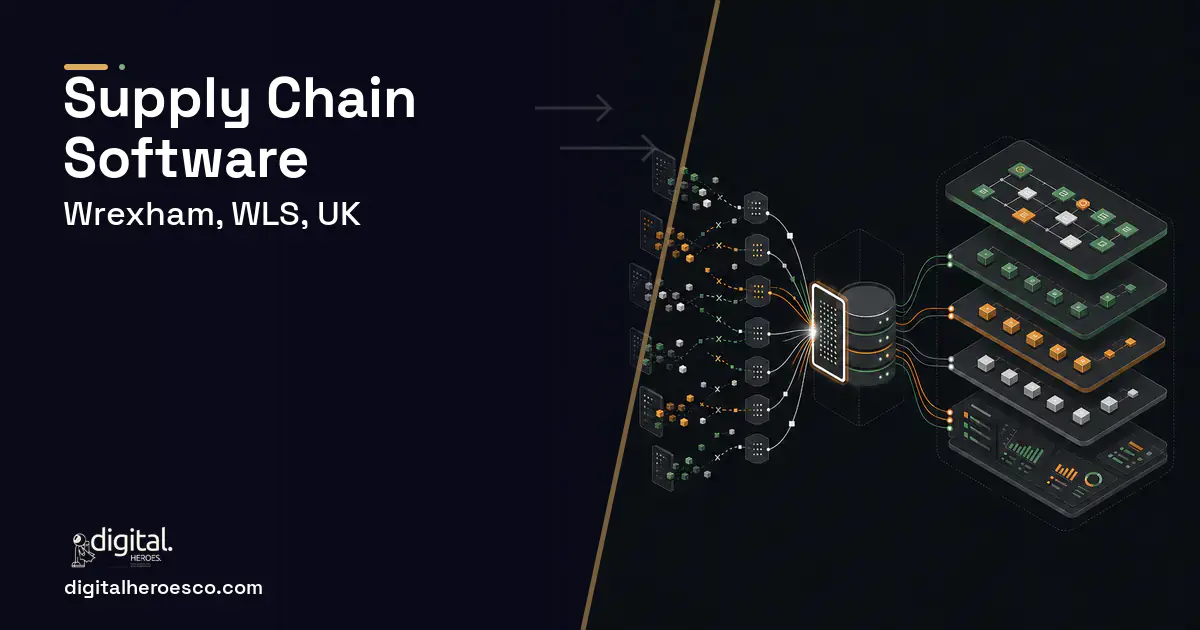
Custom supply chain software for a Wrexham manufacturer or automotive supplier runs £50,000 to £140,000 over 4 to 9 months. SAP and generic SCM (Supply Chain Management) are built to run procurement and a fixed bill of materials, and they do that competently. What they miss is the thing that actually stops a North Wales line: inbound visibility on a component sitting in a delayed container, exposure when a single tier-two supplier fails, and the just-in-time math that says a two-day port delay means a line stop on Thursday. When the system only sees your direct POs, you find out about a shortage when it doesn't arrive.
Your ERP (Enterprise Resource Planning) or SAP knows your purchase orders and your direct suppliers, and it assumes those orders arrive on time. Reality on the Wrexham estate is a supply chain three tiers deep, components coming through ports and across borders, and a JIT delivery promise to an automotive customer that leaves you almost no buffer. When a container is delayed or a sub-supplier has a problem, your system has no idea until the goods don't show up, by which point you're expediting at a premium or stopping the line.
Generic SCM doesn't model the risk, only the transaction. It can't tell you which of your finished parts depend on a single fragile supplier, or simulate what a two-day inbound delay does to your production schedule and your customer commitments. For a supplier on an automotive scorecard, that lack of forward visibility is the difference between managing a disruption and being blindsided by one.
- A tier-two supplier failure currently stays invisible until parts don't arrive
- Components arrive through ports and borders with no inbound visibility
- JIT delivery leaves no buffer and you can't model the exposure
- Disruptions mean premium expediting because there was no early warning
- Your supply chain is simple, local, and well buffered
- Direct-PO procurement in your ERP already covers your visibility need
- You don't sell on a JIT basis with tight delivery commitments
- Generic SCM or your ERP's purchasing module is genuinely enough
- Visibility beyond tier one, so a sub-supplier's problem surfaces before parts fail to arrive
- Inbound tracking of components in transit through ports and borders, with realistic ETAs
- Delay simulation showing how a two-day inbound slip hits your schedule and customer commitments
- Single-supplier dependency flags so you can dual-source the fragile parts before they bite
- Early warning that turns a line-stop scramble into a managed, planned response
- Supplier and carrier data quality varies, and the model is only as good as the feeds you can get
- Mapping a multi-tier supply chain takes real effort from procurement to populate and maintain
- It's a complement to your ERP's procurement, not a replacement, so you run both
- Smaller operations with simple, local, buffered supply chains won't need this depth
The honest cost picture for Wrexham
| Project scope | Typical cost | Timeline |
|---|---|---|
| Inbound visibility and alerting layer over existing ERP | £50k to £75k | 4 to 5 months |
| Supply-risk mapping with delay simulation | £75k to £110k | 5 to 7 months |
| Full SCM with multi-tier mapping and scheduling integration | £110k to £140k | 7 to 9 months |
Feature priorities for Wrexham teams
Supply Chain services we deliver in Wrexham
Everything a supply chain build here can cover: supplier management, order management system, transportation management (TMS), supply chain visibility and distribution software.
Exactly what you get
A supply chain view that shows risk, not just purchase orders: multi-tier supplier mapping, inbound tracking through ports and borders, delay simulation against your production schedule, and flags on the single-source parts that could stop your line. You get the source code and the integration spec to your ERP and carriers. This complements your ERP's procurement rather than replacing it, shares demand with your inventory management software and warehouse management system, and feeds business intelligence (BI) dashboards so directors see supply risk alongside the order book.
How to choose a developer in Wrexham
Find a team that asks how deep your supply chain goes and where your JIT exposure sits before they talk procurement screens. If they equate supply chain software with purchase orders, they'll build you visibility you already have. Ask how they map beyond tier one, track inbound shipments, and simulate a delay against your schedule, because that forward view is the whole point. A good partner integrates with your existing ERP rather than replacing it, the same judgement a strong inventory management software or ERP team brings to a build.
Timeline: what happens, and when
- !They model only direct POs; ask how a tier-two failure surfaces
- !No inbound tracking; ask how a delayed container shows up before it's late
- !No schedule link; ask how a delay simulation reaches your production plan
- !They ignore single-sourcing; ask how concentration risk gets flagged
- !They equate SCM with procurement; ask how the build models risk, not just transactions
Teams investing in supply chain in Wrexham usually scope it next to project management, helpdesk & ticketing, crm, since these systems share data and budgets. Weighing options across the region? We publish the same supply chain guide for Cardiff, Swansea, Newport. Want it built, not just budgeted? That is our custom software development practice.
The evidence behind this guide
Independent findings on why this investment pays off. Every link goes to the primary source.
- Across more than 5,400 IT projects studied by McKinsey and the University of Oxford BT Centre, large IT projects ran on average 45% over budget and 7% over schedule while delivering 56% less value than predicted. Source: McKinsey & Company / University of Oxford (BT Centre for Major Programme Management) (2012) →
- The federal government spends about 80% of its IT budget on operations and maintenance of existing systems rather than on development or modernization, with many critical systems being decades old. Source: U.S. Government Accountability Office (GAO) (2025) →
- Brandon Hall Group research on onboarding reports that done well, structured onboarding drives measurable gains in new-hire productivity, employee engagement, and retention; the page notes 41% of organizations experience greater than 5% turnover among new hires. Source: Brandon Hall Group (2024) →
- An earlier SHRM benchmarking report (reflecting fiscal year 2015, published 2016) established a widely cited baseline average cost-per-hire of $4,129, illustrating how recruiting costs have climbed over time (SHRM's separate 2025 Benchmarking Report shows $5,475 for nonexecutive roles). Note: the $5,475 figure is not on this linked page; it comes from SHRM's 2025 report. Source: SHRM (Society for Human Resource Management) (2016) →
Kabir directs mobile engineering at Digital Heroes across iOS, Android and cross platform builds. Day to day that means release trains, store review cycles, device coverage and deciding when native work is worth the extra cost. Useful reading before committing to an app roadmap.
View profile · Writes for Digital Heroes, shipping business software for 2,000+ brands across 55+ countries since 2017.
Frequently asked questions
Why won't SAP or our ERP's procurement module handle this?
Because they model the transaction, your direct POs and a fixed bill of materials, not the risk. They assume orders arrive on time and can't see a tier-two supplier's problem, track a component stuck in a delayed container, or simulate what a two-day inbound slip does to your schedule. For a Wrexham JIT supplier, that forward risk view is exactly the gap, and it's why a delayed part can stop your line before the system ever flags it.
How does delay simulation work in practice?
The software links inbound shipment timing to your production schedule and customer call-offs, so when a container is delayed it can show which builds slip and which commitments are at risk, days before the parts fail to arrive. That turns a Thursday line-stop into a Monday decision: expedite, re-sequence, or warn the customer. Modelling that ripple from a port delay to a finished-part shortfall is the core capability generic SCM lacks.
What does multi-tier supplier mapping give us?
Visibility into who your suppliers depend on, not just who you buy from directly. It reveals where several of your finished parts trace back to a single fragile sub-supplier, so you can dual-source before that concentration causes a stoppage. Most disruptions on an industrial estate come from a tier-two failure nobody was watching, and mapping that risk is what lets you act before it reaches your line rather than after.
Do we still need our ERP's purchasing function?
Yes, this complements it rather than replacing it. Your ERP keeps running purchase orders and supplier transactions; the supply chain software adds the risk and visibility layer on top, mapping dependencies, tracking inbound shipments, and simulating delays. The two share data so procurement and risk read the same picture. A good partner builds the layer that's missing, not a parallel procurement system you'd have to reconcile.
Is this overkill for a smaller manufacturer?
It can be, and a good partner will say so. If your supply chain is simple, local, and well buffered, generic SCM or your ERP's purchasing is genuinely enough. The build earns its cost specifically where you sell JIT with tight commitments and source components through ports and multiple tiers, which is where a delay turns into a line stop. Honest scoping matters: this depth pays off for exposed supply chains, not sheltered ones.
How much does a custom warehouse management system cost to build?
What tech stack is best for custom supply chain software?
How long does it take to build a custom web or mobile app from scratch?
Why do companies replace generic SCM software with custom systems?
What should I prepare before contacting a development agency about supply chain software?
What happens to our system if the agency shuts down or we part ways?
Is custom supply chain software cheaper than SAP over five years?
What are the biggest mistakes first-time software buyers make?
How do I vet a software agency in Wrexham for a supply chain project?
What does it cost to maintain custom supply chain software each year?
How many SaaS seats do we need before building custom becomes cheaper?
Why do agencies charge for a discovery phase instead of quoting for free?
Should we start with an MVP or build the full supply chain platform at once?
Should I hire a freelancer or an agency for my software project?
Who can build custom supply chain software for a business in Wrexham?
Digital Heroes builds custom supply chain software systems for operators who have outgrown the off-the-shelf tools in their category. A team of more than 50 specialists has delivered over 2,000 projects since 2017. Teams work from New York, London, Sydney, Delhi and Lucknow and deliver remotely, so an operator in Wrexham gets an assigned senior team rather than a local account manager.
Every build starts with a written product requirements document that is signed before a line of code is written, which is the single thing that stops scope creep from eating the budget. Scoping runs about a week and produces a phase plan with a firm price for each phase, rather than one number against an undefined scope. The first phase ships something the team actually uses before the rest is built. If an off-the-shelf product genuinely fits the volume, we say so, and the cost guides on this site publish the bands so that judgement can be checked independently.
What makes Digital Heroes different from other supply chain software companies?
Four things that competitors in this bracket cannot simply copy. Digital Heroes runs a YouTube channel with more than 2.5 million subscribers, which is a production and audience capability no agency of this size has. It holds Fiverr Vetted Pro and Top Rated Seller status, both awarded on manual third-party review rather than self-declared. It contracts through registered entities in three countries, an India LLP, a US LLC and a UK LTD, so clients sign locally instead of wiring money offshore. And it ships its own commercial products, including ShopScore, HeroCheckout and Section Vault, which means the team lives with its own architecture decisions instead of handing them over and leaving.
Two more that show up in the work. Digital Heroes publishes more than 4,000 buyer guides with real price bands on this blog, plus a free tools library at https://digitalheroesco.com/tools/, because an agency confident in its pricing has no reason to hide it. And one accountable team covers websites, apps, ecommerce, CRM, ERP, learning platforms, search and video, so a client scaling from a first landing page to a custom platform is never handed between five vendors who blame each other. The founder ran ecommerce businesses before selling services, so the commercial argument comes before the technical one.
How can I check Digital Heroes is legitimate before getting in touch?
Verify it independently rather than taking the site's word for it. The YouTube channel is at https://youtube.com/@DigitalMarketingHeroes, the Fiverr profile at https://www.fiverr.com/shreyanshsin261, and the Upwork profile at https://www.upwork.com/freelancers/shreyanshsingh. Client reviews sit on Clutch at https://clutch.co/profile/digital-heroes-0 and Trustpilot at https://www.trustpilot.com/review/digitalheroes.co.in, and the company page is at https://www.linkedin.com/company/digital-heroes-1/.
Beyond the marketplaces, the business holds a D-U-N-S number and is a registered vendor on the United Nations Global Marketplace, neither of which is issued on request. Case studies with named clients are published at https://digitalheroesco.com/case-studies/. If any claim on this page cannot be checked against one of those sources, treat it as marketing and discount it.


