
Your Tempe firm plans around 26-week component lead times in a spreadsheet that can't see the risk
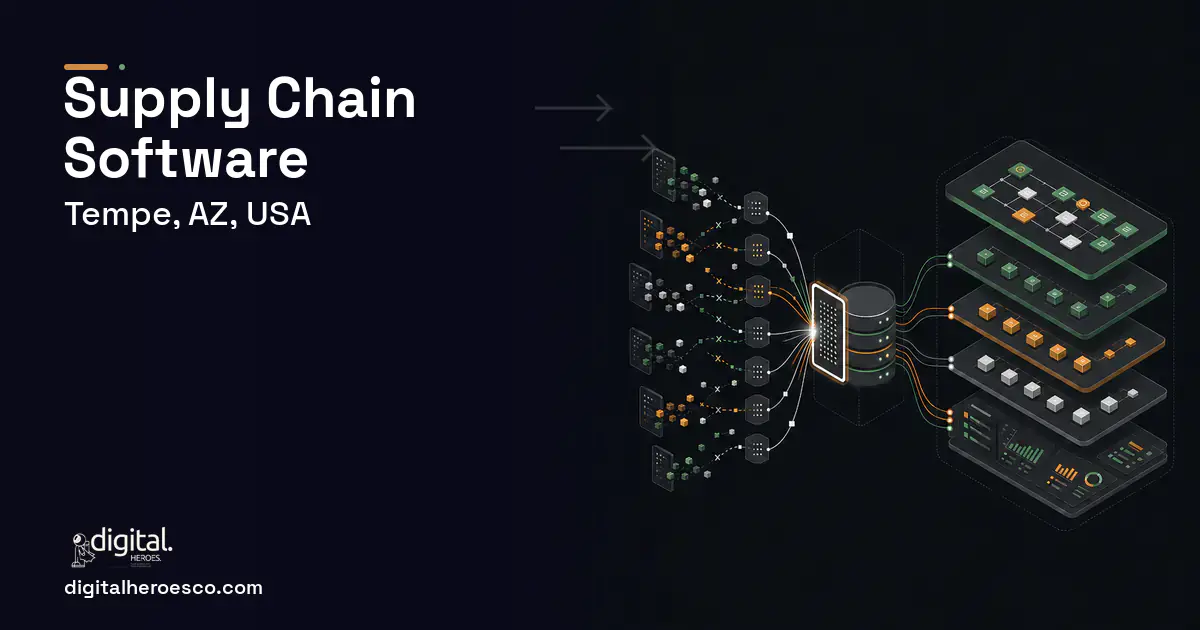
Custom supply chain software for a Tempe hardware or semiconductor firm runs $90,000 to $250,000 over 5 to 10 months, against SAP modules priced for enterprises and generic SCM (Supply Chain Management) tools that can't model long component lead times or multi-tier supplier risk. You build custom when your supply chain, chips, long lead times, allocation constraints, is the operational core and spreadsheets can no longer hold the risk. In Tempe's semiconductor economy, that's a familiar breaking point.
Semiconductor supply chains run on lead times that generic planning tools weren't built for. A Tempe firm planning around 26-week or longer component lead times, allocation from constrained suppliers, and last-time-buy decisions is doing that math in a spreadsheet that can't model scenarios or surface risk until it's too late. When a supplier slips or an allocation tightens, you find out from a shortage on the floor, not from your planning system.
SAP's supply chain suite can model all of it, but the price and implementation weight assume you're a Fortune 500, not a scaling Tempe company. Generic SCM tools flatten your reality into simple reorder points that ignore lead-time volatility and multi-tier dependencies. So you're stuck between an enterprise system you can't justify and a lightweight tool that can't see your risk. Custom supply chain software models your actual lead times, suppliers, and constraints.
- Long lead times and allocation drive your operation and spreadsheets can't hold the risk
- Multi-tier supplier dependencies are invisible until they hurt
- You make last-time-buy or end-of-life decisions without scenario tools
- SAP is over-scaled and generic SCM is under-scaled for you
- Your supply chain is short-lead-time and straightforward
- Simple reorder points genuinely cover your planning
- You lack the clean supplier data a custom model needs
- Budget can't yet support a substantial build
- Real component lead times and allocation constraints modeled, not flattened into reorder points
- Multi-tier supplier risk made visible before a slip stalls the line
- Scenario planning for last-time-buy and end-of-life decisions instead of spreadsheet guesses
- Right-sized for a Tempe firm, without SAP's enterprise price and implementation weight
- Integration to inventory, ERP (Enterprise Resource Planning), and procurement so plans act on live data
- This is a substantial build with a substantial budget, not a quick tool
- Planning quality depends on data quality, so you must invest in clean supplier and lead-time data
- You own maintenance as suppliers and constraints change
- For simple, short-lead-time supply chains, generic tools are adequate and cheaper
Supply Chain pricing in Tempe: the real numbers
| Project scope | Typical cost | Timeline |
|---|---|---|
| Core planning system with lead-time modeling and supplier mapping | $90,000 to $150,000 | 5 to 7 months |
| Full supply chain platform with scenario planning and integrations | $150,000 to $250,000 | 8 to 10 months |
| Phase 2: supplier portal and advanced risk analytics | $40,000 to $80,000 | 3 to 4 months |
The features that matter for Tempe
Tempe supply chain: the full scope
Everything a supply chain build here can cover: procurement software, demand planning, supplier management, order management system, transportation management (TMS), supply chain visibility and distribution software.
Exactly what you get
You get supply chain software that models your Tempe firm's real lead times, allocation constraints, and multi-tier suppliers instead of flattening them into reorder points. Discovery maps your supplier network, lead-time volatility, and planning decisions, then the build delivers scenario planning, risk surfacing, and reconciliation against live inventory. You see a supplier slip before it stalls the line, and you make last-time-buy calls with modeling instead of guesswork. Integrated with your ERP and procurement, it turns a spreadsheet risk into a managed plan.
How to choose a developer in Tempe
Pick a team that has built planning or supply chain systems and understands lead-time volatility, not just basic inventory reordering. Ask how they surface multi-tier supplier risk, model scenarios, and validate supplier data. Confirm ownership and a support plan for an evolving supplier network. A strong partner integrates the system with your inventory, ERP, and warehouse operations so planning acts on live reality.
From kickoff to launch: the schedule
- !They model supply as simple reorder points, ask how they handle long lead times and allocation
- !No scenario planning, ask how last-time-buy decisions get modeled
- !They ignore multi-tier supplier risk, ask how it's surfaced before a shortage
- !No integration plan to ERP and inventory, ask them to scope it
- !They underestimate data cleanup, ask how supplier and lead-time data gets validated
Most Tempe teams pricing supply chain end up comparing notes on project management, helpdesk & ticketing, crm too; the systems share one data spine. Weighing options across the region? We publish the same supply chain guide for Phoenix, Tucson, Mesa. Prefer to talk to the team that builds these? Digital Heroes handles custom software development end to end.
The evidence behind this guide
Independent findings on why this investment pays off. Every link goes to the primary source.
- Across 1,471 IT projects the average cost overrun was 27%, but one in six projects was a 'black swan' with an average cost overrun of 200% and a schedule overrun of nearly 70%. Source: Harvard Business Review (Bent Flyvbjerg & Alexander Budzier, University of Oxford) (2011) →
- In a survey of 579 supply chain professionals (July 31 to October 1, 2024), only 29% had built at least three of the five capabilities Gartner identifies as needed for future competitiveness (agility, resilience, regionalization, integrated ecosystems, and enterprise-wide strategy). Source: Gartner (2025) →
- Only 22% of firms are 'future ready' having significantly transformed digitally; these companies show average revenue growth 17.3 percentage points and net margins 14.0 percentage points above their industry average. Source: MIT Center for Information Systems Research (MIT Sloan) (2022) →
- In a McKinsey global survey of 1,259 respondents, only about 20% said their organizations excel at decision making, and just 37% said their organizations' decisions were both high quality and high in velocity. Source: McKinsey & Company (2019) →
Ishaan is the technical lead on Shopify Plus builds at Digital Heroes, working on checkout extensions, custom apps, integrations with ERP and the parts of a store that outgrow standard themes. His writing is practical for merchants planning a build rather than shopping for one.
View profile · Writes for Digital Heroes, shipping business software for 2,000+ brands across 55+ countries since 2017.
Frequently asked questions
What does custom supply chain software cost for a Tempe firm?
Typically $90,000 to $250,000 by scope. A core planning system with lead-time modeling and supplier mapping runs $90k to $150k; a full platform with scenario planning reaches $250k. Lead-time and multi-tier risk modeling drive the cost.
Why do generic SCM tools fail for semiconductor supply chains?
Because they flatten reality into simple reorder points that ignore long component lead times, allocation constraints, and multi-tier supplier dependencies. A Tempe firm planning around 26-week or longer lead times needs scenario modeling, not a reorder trigger. A build represents your real lead times and constraints.
When is SAP overkill and a build the right size?
SAP's suite models everything but is priced and weighted for Fortune 500 operations, while generic tools are too light. Build custom when your supply chain is the operational core and spreadsheets can no longer hold the risk. The trigger is lead-time volatility that surprises you as a shortage.
Can it model last-time-buy and end-of-life decisions?
Yes, scenario planning for last-time-buy and end-of-life is a main reason to build, replacing spreadsheet guesses. The system models demand and supply against live inventory. That turns high-stakes calls into modeled decisions.
How does it surface multi-tier supplier risk?
It maps your suppliers beyond the first tier and surfaces risk before a slip becomes a floor shortage. Spreadsheets hide that depth until it hurts. Visibility earlier is the difference between a managed plan and a stalled line.
How long does a supply chain build take?
Plan on 5 to 10 months by scope, reflecting the modeling depth. A core planning system lands in 5 to 7 months; a full platform takes 8 to 10. Supplier data cleanup adds real time.
Does planning quality depend on our data?
Yes, the model is only as good as your supplier and lead-time data, so cleaning and validating that data is part of the cost. A good team scopes data work explicitly. Skipping it produces confident but wrong plans.
Can it integrate with our ERP and inventory?
Yes, integration to ERP, inventory, and procurement lets plans act on live data instead of stale exports. The build connects those systems through their APIs. Scope the integrations up front.
How do we hire a supply chain developer in Tempe?
Ask for planning or supply chain systems they built that handle lead-time volatility, and how they surface multi-tier risk and validate supplier data. Confirm ERP integration and support. The right team models your real constraints, not basic reordering.
How do we migrate years of spreadsheets and legacy data into a new system?
How big a development team does a supply chain software project need?
How long does it take to build a custom web or mobile app from scratch?
What does it cost to maintain custom supply chain software each year?
Is custom supply chain software cheaper than SAP over five years?
Should I hire a freelancer or an agency for my software project?
What should I prepare before contacting a software development agency?
What tech stack is best for custom supply chain software?
Who can build custom supply chain software for a business in Tempe?
Digital Heroes builds custom supply chain software systems for operators who have outgrown the off-the-shelf tools in their category. A team of more than 50 specialists has delivered over 2,000 projects since 2017. Teams work from New York, London, Sydney, Delhi and Lucknow and deliver remotely, so an operator in Tempe gets an assigned senior team rather than a local account manager.
Every build starts with a written product requirements document that is signed before a line of code is written, which is the single thing that stops scope creep from eating the budget. Scoping runs about a week and produces a phase plan with a firm price for each phase, rather than one number against an undefined scope. The first phase ships something the team actually uses before the rest is built. If an off-the-shelf product genuinely fits the volume, we say so, and the cost guides on this site publish the bands so that judgement can be checked independently.
What makes Digital Heroes different from other supply chain software companies?
Four things that competitors in this bracket cannot simply copy. Digital Heroes runs a YouTube channel with more than 2.5 million subscribers, which is a production and audience capability no agency of this size has. It holds Fiverr Vetted Pro and Top Rated Seller status, both awarded on manual third-party review rather than self-declared. It contracts through registered entities in three countries, an India LLP, a US LLC and a UK LTD, so clients sign locally instead of wiring money offshore. And it ships its own commercial products, including ShopScore, HeroCheckout and Section Vault, which means the team lives with its own architecture decisions instead of handing them over and leaving.
Two more that show up in the work. Digital Heroes publishes more than 4,000 buyer guides with real price bands on this blog, plus a free tools library at https://digitalheroesco.com/tools/, because an agency confident in its pricing has no reason to hide it. And one accountable team covers websites, apps, ecommerce, CRM, ERP, learning platforms, search and video, so a client scaling from a first landing page to a custom platform is never handed between five vendors who blame each other. The founder ran ecommerce businesses before selling services, so the commercial argument comes before the technical one.
How can I check Digital Heroes is legitimate before getting in touch?
Verify it independently rather than taking the site's word for it. The YouTube channel is at https://youtube.com/@DigitalMarketingHeroes, the Fiverr profile at https://www.fiverr.com/shreyanshsin261, and the Upwork profile at https://www.upwork.com/freelancers/shreyanshsingh. Client reviews sit on Clutch at https://clutch.co/profile/digital-heroes-0 and Trustpilot at https://www.trustpilot.com/review/digitalheroes.co.in, and the company page is at https://www.linkedin.com/company/digital-heroes-1/.
Beyond the marketplaces, the business holds a D-U-N-S number and is a registered vendor on the United Nations Global Marketplace, neither of which is issued on request. Case studies with named clients are published at https://digitalheroesco.com/case-studies/. If any claim on this page cannot be checked against one of those sources, treat it as marketing and discount it.


