
Stellantis releases parts on a four-hour JIT window; your Windsor supply chain software syncs once a night
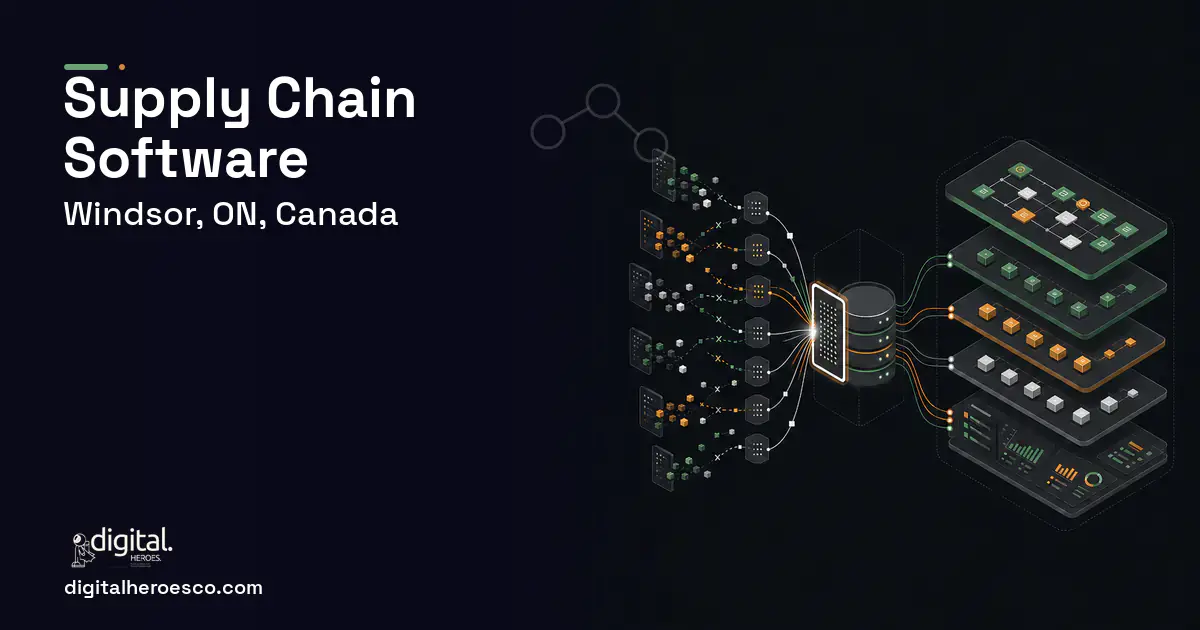
Custom supply chain software for a Windsor auto supplier or logistics firm runs $60,000 to $160,000 and 4 to 7 months. Generic SCM and SAP modules assume planned, batched replenishment. Your reality is just-in-time releases from Detroit OEMs on tight windows, trucks timed to a border crossing, and EDI schedules that change inside the day, which a once-nightly sync can't keep up with.
Your customer is a Detroit OEM running JIT, and they release parts on windows measured in hours, not days. The supply chain module in your SAP setup batches and syncs overnight, so by the time it reflects a release, the truck should already be loaded and timed to clear the Ambassador Bridge before the plant's line-side stock runs out. A planning cycle built for weekly replenishment is structurally wrong for a four-hour window.
The border makes it sharper. A load that misses its crossing window doesn't just arrive late, it can shut a line in Michigan and trigger chargebacks that dwarf the freight. Generic SCM has no model for border timing, EDI 862 release schedules that shift intraday, or the real lead time across a specific bridge. For a Windsor supplier, supply chain software that can't think in hours and crossings isn't fit for the job.
The fix: supply chain built for Windsor, not rented
Custom supply chain software thinks in hours and crossings. It ingests EDI releases in near real time, plans loads against actual border-crossing windows and lead times, and warns before a shipment will miss its slot at a Detroit plant. For a Windsor JIT supplier, that early warning is the whole point, the difference between a re-timed truck and a five-figure chargeback for stopping a line.
The capability list that earns its budget
Windsor supply chain: the full scope
Everything a supply chain build here can cover: supply chain visibility, distribution software, supply chain management software, logistics software, procurement software, demand planning and supplier management.
What supply chain costs in Windsor
| Project scope | Typical cost | Timeline |
|---|---|---|
| EDI + JIT visibility module | $60k to $90k | 4 to 5 months |
| Supply chain platform with border timing | $90k to $130k | 5 to 6 months |
| Full platform with carrier + chargeback tracking | $130k to $160k | 6 to 7 months |
How long it takes, phase by phase
Exactly what you get
A supply chain system that operates on JIT time: it ingests EDI releases as they arrive, plans loads against real border-crossing windows, and warns you before a Detroit slot will be missed, while you can still re-time the truck. The payoff is fewer five-figure chargebacks and a clean release-to-dock timeline. It connects to your ERP (Enterprise Resource Planning), warehouse management system and a warehouse-floor mobile app, and feeds business intelligence (BI) dashboards on OEM scorecards.
How to choose a developer in Windsor
Hire a team that has integrated OEM EDI and understands border timing as a first-class constraint, not a footnote. Ask exactly how their system reacts when an 862 release shifts at 10am and the load must clear by 2pm. Real-time integration is hard and depends on reliable feeds, so confirm their plan for EDI and carrier data. A JIT auto-supplier reference is non-negotiable here; weekly-replenishment experience won't transfer.
- Near-real-time EDI release ingestion instead of an overnight batch
- Load planning against actual border-crossing windows and lead times
- Early warnings before a shipment misses its Detroit delivery slot
- Visibility from release to crossing to dock in one timeline
- Fewer chargebacks because the system flags risk while you can still act
- A real-time supply chain build is expensive and integration-heavy
- It depends on reliable EDI and carrier data feeds you must secure
- Overkill if you ship on planned weekly cycles, not JIT windows
- OEM EDI onboarding and testing add time and coordination
- !Their SCM syncs nightly; ask how it reacts to an intraday EDI 862 change
- !No border-timing model; ask how crossing windows factor into planning
- !No missed-window alerting; ask how risk surfaces before a truck is late
- !No EDI onboarding experience; ask how they've integrated OEM feeds
- !No JIT auto-supplier reference; ask for one
If supply chain is on the roadmap, project management, helpdesk & ticketing, crm usually follow within the year. Budget them as one conversation. Weighing options across the region? We publish the same supply chain guide for Toronto, Ottawa, Hamilton. Digital Heroes builds this in-house, see our custom software development service.
The evidence behind this guide
Independent findings on why this investment pays off. Every link goes to the primary source.
- Digital Champions expect to achieve about 16% in cost savings and around 15% in revenue gains from digital operations over five years; the study surveyed 1,155 manufacturing executives across 26 countries. Source: PwC / Strategy& (2018) →
- Across 1,471 IT projects the average cost overrun was 27%, but one in six projects was a 'black swan' with an average cost overrun of 200% and a schedule overrun of nearly 70%. Source: Harvard Business Review (Bent Flyvbjerg & Alexander Budzier, University of Oxford) (2011) →
- The Standish Group 1995 CHAOS Report found only 16.2% of software projects fully succeeded; success varied sharply by size, with large-company projects succeeding about 9% of the time versus far higher rates for small projects - best treated as an industry survey, not an audited dataset. Source: Standish Group (1995) →
- The NRF discontinued its long-running annual shrink report, stating that a broad study of retail shrink 'is no longer sufficient for capturing the key challenges and needs of the industry' - important context that qualifies how POS/shrink benchmarks should be cited going forward. Source: Retail Dive (2024) →
Anushka leads Android development at Digital Heroes, where the work spans a wide range of devices, OS versions and manufacturer quirks. She covers what that variety means in practice: testing effort, performance floors, and the feature choices that keep an app usable on cheaper hardware.
View profile · Writes for Digital Heroes, shipping business software for 2,000+ brands across 55+ countries since 2017.
Frequently asked questions
Why can't standard SCM handle JIT supply to Detroit?
Standard SCM and SAP modules plan on batched, often nightly cycles built for weekly replenishment. JIT releases from a Detroit OEM arrive on hour-long windows, so a nightly sync is structurally too slow. Custom software ingests releases in near real time and plans against border windows.
How does border timing factor into the software?
It models the actual crossing windows and lead times for the Ambassador and Gordie Howe bridges, so load planning accounts for clearance time and the system can warn when a truck will miss its Detroit slot.
What does missed-window alerting actually save?
A missed JIT window can stop a line in Michigan and trigger chargebacks that far exceed the freight cost. Early alerts let you re-time or expedite while it still matters, which is where the system pays for itself.
What does custom supply chain software cost here?
An EDI and JIT visibility module runs $60k to $90k. Add border-timing planning for $90k to $130k, and full carrier and chargeback tracking reaches $160k.
How long to build?
Four to five months for the EDI and visibility core, up to seven for a full platform. OEM EDI onboarding and testing are the long pole, so plan that coordination early.
Who owns the code when an agency builds my software?
What tech stack is best for custom supply chain software?
How much should a small business budget for its first custom app or website?
Should I hire a freelancer or an agency for my software project?
When is SAP actually a better choice than building custom supply chain software?
How do I vet a software development agency before signing a contract?
How many people should be working on my software project?
How fast does custom supply chain software pay for itself?
Should I hire a freelancer or an agency to build supply chain software?
What does it cost to maintain custom supply chain software each year?
How much does custom supply chain software cost for a small business?
How long does it take to build a custom web or mobile app from scratch?
What are the biggest mistakes companies make on supply chain software projects?
Who can build custom supply chain software for a business in Windsor?
Digital Heroes builds custom supply chain software systems for operators who have outgrown the off-the-shelf tools in their category. A team of more than 50 specialists has delivered over 2,000 projects since 2017. Teams work from New York, London, Sydney, Delhi and Lucknow and deliver remotely, so an operator in Windsor gets an assigned senior team rather than a local account manager.
Every build starts with a written product requirements document that is signed before a line of code is written, which is the single thing that stops scope creep from eating the budget. Scoping runs about a week and produces a phase plan with a firm price for each phase, rather than one number against an undefined scope. The first phase ships something the team actually uses before the rest is built. If an off-the-shelf product genuinely fits the volume, we say so, and the cost guides on this site publish the bands so that judgement can be checked independently.
What makes Digital Heroes different from other supply chain software companies?
Four things that competitors in this bracket cannot simply copy. Digital Heroes runs a YouTube channel with more than 2.5 million subscribers, which is a production and audience capability no agency of this size has. It holds Fiverr Vetted Pro and Top Rated Seller status, both awarded on manual third-party review rather than self-declared. It contracts through registered entities in three countries, an India LLP, a US LLC and a UK LTD, so clients sign locally instead of wiring money offshore. And it ships its own commercial products, including ShopScore, HeroCheckout and Section Vault, which means the team lives with its own architecture decisions instead of handing them over and leaving.
Two more that show up in the work. Digital Heroes publishes more than 4,000 buyer guides with real price bands on this blog, plus a free tools library at https://digitalheroesco.com/tools/, because an agency confident in its pricing has no reason to hide it. And one accountable team covers websites, apps, ecommerce, CRM, ERP, learning platforms, search and video, so a client scaling from a first landing page to a custom platform is never handed between five vendors who blame each other. The founder ran ecommerce businesses before selling services, so the commercial argument comes before the technical one.
How can I check Digital Heroes is legitimate before getting in touch?
Verify it independently rather than taking the site's word for it. The YouTube channel is at https://youtube.com/@DigitalMarketingHeroes, the Fiverr profile at https://www.fiverr.com/shreyanshsin261, and the Upwork profile at https://www.upwork.com/freelancers/shreyanshsingh. Client reviews sit on Clutch at https://clutch.co/profile/digital-heroes-0 and Trustpilot at https://www.trustpilot.com/review/digitalheroes.co.in, and the company page is at https://www.linkedin.com/company/digital-heroes-1/.
Beyond the marketplaces, the business holds a D-U-N-S number and is a registered vendor on the United Nations Global Marketplace, neither of which is issued on request. Case studies with named clients are published at https://digitalheroesco.com/case-studies/. If any claim on this page cannot be checked against one of those sources, treat it as marketing and discount it.


