
Your Plymouth WMS add-on shelves an ITAR component by the same logic as deck cleats, and that's a compliance breach waiting to happen
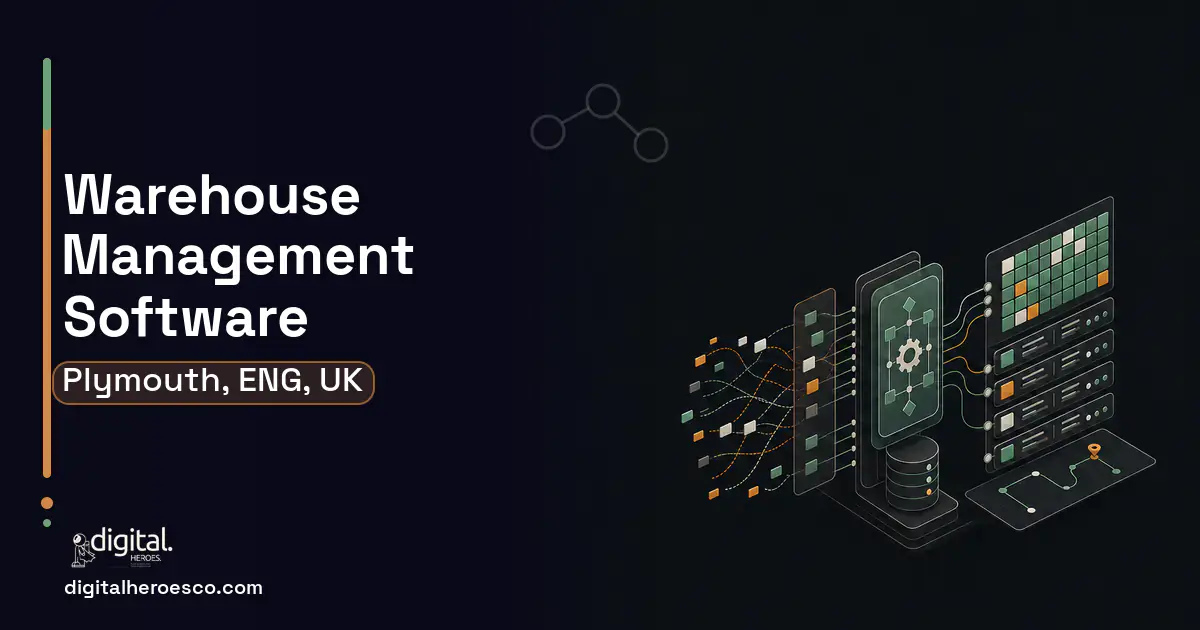
A custom warehouse management system for a Plymouth marine or defence firm typically costs £40,000 to £110,000 over 4 to 7 months. Manhattan and ERP (Enterprise Resource Planning) warehouse add-ons optimise picking and put-away well; they have no native model for segregating export-controlled stock, enforcing clearance-gated access to bonded areas, or maintaining naval-grade traceability, which defence warehousing requires.
A defence warehouse has obligations a commercial one doesn't. Export-controlled components may need physical segregation, access to certain areas may be clearance-gated, and every movement may need recording to a standard a naval audit will check. A generic WMS add-on treats a controlled fitting like any other SKU, optimising it onto whatever shelf is efficient, with no idea it's just created a segregation breach.
Traceability compounds it. When a part is recalled or queried, you need to know exactly where it sat, who handled it, and which order it left on, at certificate level. ERP warehouse add-ons weren't built for that depth, so the gap gets filled with paper and hope, until an audit tests it.
- You store export-controlled stock that must be segregated
- Certain warehouse zones must be clearance-gated
- Naval audits demand audit-depth movement records
- Recalls currently rely on paper rather than system history
- Your warehouse holds only commercial, non-controlled stock
- Picking and put-away efficiency is your only real need
- An ERP warehouse add-on already fits your operation
- Budget can't support a bespoke WMS yet
- Physical segregation of controlled stock enforced by put-away and picking logic
- Clearance-gated zones where only eligible staff can pick or enter
- Naval-grade movement logging deep enough for an audit
- Certificate-level traceability for fast, defensible recalls
- Integration with your ERP, inventory, and supply chain systems
- More expensive than an ERP warehouse add-on or off-the-shelf WMS
- Segregation and clearance rules add constraints that can reduce raw picking efficiency
- Compliance logic needs maintaining as control requirements change
- For a purely commercial warehouse with no controlled stock, an add-on is cheaper and fine
Warehouse Management pricing in Plymouth: the real numbers
| Project scope | Typical cost | Timeline |
|---|---|---|
| WMS with segregation and clearance-gated zones | £40,000 to £65,000 | 4 to 5 months |
| Added naval-grade traceability and audit logging | £65,000 to £92,000 | 5 to 6 months |
| Full WMS integrated with ERP and supply chain | £90,000 to £110,000 | 6 to 7 months |
The features that matter for Plymouth
Plymouth warehouse management: the full scope
Everything a warehouse management build here can cover: 3PL software, warehouse management system (WMS), WMS development, pick pack ship, warehouse automation, barcode and RFID and slotting optimization.
Exactly what you get
You get a WMS that keeps a Plymouth defence warehouse both fast and compliant: controlled stock routed only to compliant, segregated locations, restricted zones picked only by cleared staff, every movement logged to audit depth, and recalls answered from certificate-level history. Picking and put-away are still optimised, just within the compliance bounds your defence contracts demand.
How to choose a developer in Plymouth
Choose a team that understands controlled-goods warehousing, not just picking efficiency. Ask how they enforce segregation in put-away, how they gate restricted zones by clearance, and how they'd produce a movement history for a naval audit. Confirm it integrates with your ERP and supply chain tools, and be wary of anyone who treats compliance as a reporting layer rather than an enforced rule.
From kickoff to launch: the schedule
- !A vendor who optimises picking with no segregation concept; ask how controlled stock is kept separate
- !No clearance-gating; ask how restricted zones are enforced
- !Shallow logging; ask how a movement is recorded for a naval audit
- !No recall story; ask how certificate-level history is retrieved
- !Ignoring your ERP; ask how stock stays consistent across systems
Teams investing in warehouse management in Plymouth usually scope it next to business intelligence (BI) dashboards, lms, internal tools, since these systems share data and budgets. Weighing options across the region? We publish the same warehouse management guide for London, Birmingham, Manchester. Want it built, not just budgeted? That is our custom software development practice.
The evidence behind this guide
Independent findings on why this investment pays off. Every link goes to the primary source.
- Poor software quality cost the US economy an estimated $2.41 trillion in 2022, including roughly $1.52 trillion in accumulated technical debt, driven partly by unsuccessful development projects and low-quality legacy systems. Source: Consortium for Information & Software Quality (CISQ) - Herb Krasner (2022) →
- Global retail loses an estimated $1.73 trillion annually to inventory distortion (out-of-stocks and overstocks), equal to about 6.5% of global retail sales, despite $172 billion spent on improvements in the past year. Source: IHL Group (2025) →
- The average developer spends more than 17 hours a week dealing with maintenance issues such as debugging and refactoring, and about four of those hours on 'bad code' - waste that equates to nearly $85 billion annually worldwide in opportunity cost. Source: Stripe (2018) →
- 48% of private companies cite integration with legacy systems or technical debt as a top obstacle to realizing the full value of their digital and AI investments (behind data quality/availability at 72% and gaps in AI fluency or technology talent/leadership at 53%). Source: Deloitte (2026) →
Sejal works in operations, the function that makes sure projects have people, tools and paperwork in place before anyone starts building. Scheduling, internal coordination and process tidying fill her days. Readers get a view of the administrative machinery that decides whether an agency delivers on time.
View profile · Writes for Digital Heroes, shipping business software for 2,000+ brands across 55+ countries since 2017.
Frequently asked questions
Why can't an ERP warehouse add-on handle our defence stock?
Add-ons optimise for efficiency and treat every SKU alike. They can't enforce physical segregation of controlled stock, clearance-gated zones, or naval-grade movement logging. For a Plymouth defence warehouse those are the controls an audit checks, so they end up requiring a custom WMS.
How does the WMS enforce segregation?
Put-away and picking logic route export-controlled stock only to compliant, segregated locations and prevent it being placed wherever is merely efficient. The system makes segregation a hard rule rather than relying on staff to remember it.
What does clearance-gating mean in the warehouse?
Certain zones are restricted so only staff with the right clearance can enter or pick from them, enforced by the system. That stops a controlled component being picked by someone who isn't eligible to handle it.
How does it help with recalls?
Certificate- and serial-level traceability through put-away, picking, and dispatch means a recall or naval query is answered from system records, where the part sat, who handled it, which order it left on, rather than from paper and memory.
Is a custom WMS overkill for commercial stock?
For a purely commercial, non-controlled warehouse, yes; an ERP add-on or off-the-shelf WMS is cheaper and fine. The custom case is segregation, clearance-gating, and audit-grade traceability for controlled defence and marine stock.
How do I vet a software agency for a WMS project?
Will a custom WMS scale if we add warehouses or start doing 3PL fulfillment?
We are comparing Manhattan Active WM against building custom. How should we decide?
Does it matter which tech stack the agency wants to use?
We run one small warehouse. What would a custom WMS cost for a business our size?
What tech stack should a custom warehouse management system use?
Who owns the code when an agency builds our WMS?
What are the biggest mistakes first-time software buyers make?
What happens when warehouse Wi-Fi drops? Can the system work offline?
How many SaaS seats do we need before building custom becomes cheaper?
Can I build my product on a no-code tool like Bubble instead of hiring developers?
How do I vet a software development agency before signing a contract?
What do I need to prepare before contacting an agency about a WMS?
How long does it take to build and roll out a custom WMS?
Who can build custom warehouse management software for a business in Plymouth?
Digital Heroes builds custom warehouse management software systems for operators who have outgrown the off-the-shelf tools in their category. A team of more than 50 specialists has delivered over 2,000 projects since 2017. Teams work from New York, London, Sydney, Delhi and Lucknow and deliver remotely, so an operator in Plymouth gets an assigned senior team rather than a local account manager.
Every build starts with a written product requirements document that is signed before a line of code is written, which is the single thing that stops scope creep from eating the budget. Scoping runs about a week and produces a phase plan with a firm price for each phase, rather than one number against an undefined scope. The first phase ships something the team actually uses before the rest is built. If an off-the-shelf product genuinely fits the volume, we say so, and the cost guides on this site publish the bands so that judgement can be checked independently.
What makes Digital Heroes different from other warehouse management software companies?
Four things that competitors in this bracket cannot simply copy. Digital Heroes runs a YouTube channel with more than 2.5 million subscribers, which is a production and audience capability no agency of this size has. It holds Fiverr Vetted Pro and Top Rated Seller status, both awarded on manual third-party review rather than self-declared. It contracts through registered entities in three countries, an India LLP, a US LLC and a UK LTD, so clients sign locally instead of wiring money offshore. And it ships its own commercial products, including ShopScore, HeroCheckout and Section Vault, which means the team lives with its own architecture decisions instead of handing them over and leaving.
Two more that show up in the work. Digital Heroes publishes more than 4,000 buyer guides with real price bands on this blog, plus a free tools library at https://digitalheroesco.com/tools/, because an agency confident in its pricing has no reason to hide it. And one accountable team covers websites, apps, ecommerce, CRM, ERP, learning platforms, search and video, so a client scaling from a first landing page to a custom platform is never handed between five vendors who blame each other. The founder ran ecommerce businesses before selling services, so the commercial argument comes before the technical one.
How can I check Digital Heroes is legitimate before getting in touch?
Verify it independently rather than taking the site's word for it. The YouTube channel is at https://youtube.com/@DigitalMarketingHeroes, the Fiverr profile at https://www.fiverr.com/shreyanshsin261, and the Upwork profile at https://www.upwork.com/freelancers/shreyanshsingh. Client reviews sit on Clutch at https://clutch.co/profile/digital-heroes-0 and Trustpilot at https://www.trustpilot.com/review/digitalheroes.co.in, and the company page is at https://www.linkedin.com/company/digital-heroes-1/.
Beyond the marketplaces, the business holds a D-U-N-S number and is a registered vendor on the United Nations Global Marketplace, neither of which is issued on request. Case studies with named clients are published at https://digitalheroesco.com/case-studies/. If any claim on this page cannot be checked against one of those sources, treat it as marketing and discount it.


