
A controlled component left your Plymouth supply chain three tiers down, and your SCM tool never knew it crossed a border
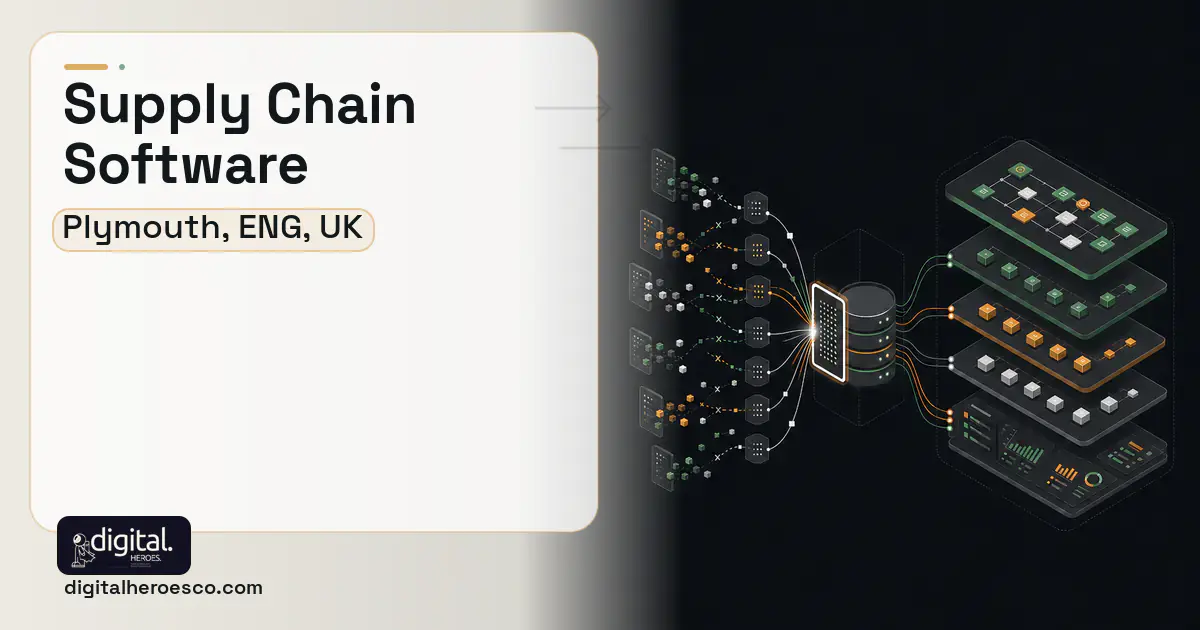
Custom supply chain management software for a Plymouth marine or defence firm typically costs £50,000 to £140,000 over 4 to 8 months. SAP and generic SCM tools optimise cost and lead time well; they have no native grip on export-controlled flows, multi-tier defence traceability, or supplier clearance status, which is where naval supply chains carry their real risk.
Defence and marine supply chains carry a kind of risk generic SCM ignores: a component can be export-controlled, and as it moves through your sub-tiers it can cross a border or reach an end user that triggers a licence requirement nobody noticed. SAP will optimise your lead times beautifully while staying completely blind to the fact that a controlled part just moved somewhere it shouldn't have.
Multi-tier traceability is the other gap. When a naval prime asks you to prove the provenance and control status of a part three suppliers deep, generic SCM can't follow the chain, and your suppliers' spreadsheets certainly can't. The result is a supply chain that's efficient and uncontrolled, which in defence is a dangerous combination.
- You move export-controlled components through multiple supplier tiers
- Naval primes demand deep provenance and control traceability
- Supplier clearance and control status need to be visible and managed
- Compliance risk is hidden behind cost-and-speed-only metrics
- Your supply chain is domestic, simple, and non-controlled
- Cost and lead-time optimisation is all you really need
- You lack the supplier cooperation multi-tier traceability requires
- Budget can't support the most complex build on this list
- Export-control and licence-trigger checks woven through multi-tier flows
- Provenance and control-status traceability several suppliers deep
- Supplier clearance and control capability tracked as core data
- Risk visibility alongside cost and lead-time optimisation, not instead of it
- Integration with your ERP (Enterprise Resource Planning), inventory, and warehouse management systems
- A substantial build, and the most complex on this list to get right
- Multi-tier traceability depends on supplier data you must persuade them to share
- Export and control logic needs ongoing maintenance as rules evolve
- For a simple, domestic, non-controlled supply chain, generic SCM is more than enough
The honest cost picture for Plymouth
| Project scope | Typical cost | Timeline |
|---|---|---|
| Controlled-component tracking over existing SCM | £50,000 to £80,000 | 4 to 5 months |
| Multi-tier traceability and supplier control register | £85,000 to £120,000 | 6 to 7 months |
| Full SCM platform with risk and integrations | £120,000 to £140,000 | 7 to 8 months |
Feature priorities for Plymouth teams
What we build under supply chain in Plymouth
Digital Heroes builds the full supply chain stack for Plymouth teams. Typical engagements cover supply chain visibility, distribution software, supply chain management software, logistics software, procurement software and demand planning.
Exactly what you get
You get supply chain software that sees what generic SCM can't: controlled components followed across tiers, licence-triggering flows flagged before they happen, provenance traceable deep enough to satisfy a naval prime, and supplier clearance tracked as core data, all alongside the cost and lead-time optimisation you still want. It integrates with your ERP, inventory, and warehouse systems so the whole chain shares one truth.
How to choose a developer in Plymouth
This is the most demanding build here, so choose a team with genuine defence supply-chain experience. Ask how they'd detect a licence-triggering cross-border flow, how they'd trace provenance through reluctant sub-tier suppliers, and how they'd re-source when a route goes ineligible. Be realistic that multi-tier traceability depends on supplier cooperation, and pick a partner who plans for that rather than assuming it.
Timeline: what happens, and when
- !A vendor who optimises only cost and speed; ask how they flag a licence-triggering flow
- !No multi-tier story; ask how they trace a part three suppliers deep
- !Ignoring supplier clearance; ask how control capability is tracked
- !No re-sourcing tools; ask what happens when a supplier becomes ineligible
- !Treating control as a report; ask how it's enforced in the flow
Teams investing in supply chain in Plymouth usually scope it next to project management, helpdesk & ticketing, crm, since these systems share data and budgets. Weighing options across the region? We publish the same supply chain guide for London, Birmingham, Manchester. Want it built, not just budgeted? That is our custom software development practice.
The evidence behind this guide
Independent findings on why this investment pays off. Every link goes to the primary source.
- In a survey of 113 supply chain leaders (conducted late March to mid-April 2022), 67% had implemented digital dashboards for end-to-end visibility, and those companies were about twice as likely as others to avoid supply chain problems during the disruptions of early 2022; 71% expected to revise inventory policies going forward. Source: McKinsey & Company (2022) →
- Global retail loses an estimated $1.73 trillion annually to inventory distortion (out-of-stocks and overstocks), equal to about 6.5% of global retail sales, despite $172 billion spent on improvements in the past year. Source: IHL Group (2025) →
- In an October 2025 survey of 530 small-business employers (conducted by TechnoMetrica, October 3-9, 2025), 88% reported using AI tools and 73% said those tools had been important to their competitiveness and growth over the past year, with 60% citing efficiency and productivity as the primary motivation for adoption (42% cited improving customer service). Source: Small Business & Entrepreneurship Council (SBE Council) (2025) →
- Gartner estimates RPA can eliminate up to 25,000 hours of avoidable rework caused by human errors in the finance function each year, equating to savings of roughly $878,000 for an organization with 40 full-time accounting staff (based on interviews with more than 150 corporate controllers and chief accounting officers). Source: Gartner (2019) →
James covers financial services work, where a feature request usually arrives attached to a compliance requirement. He is worth reading if you are scoping payments, lending or account software and need to know which decisions are technical, which are regulatory and which are simply expensive.
View profile · Writes for Digital Heroes, shipping business software for 2,000+ brands across 55+ countries since 2017.
Frequently asked questions
Why isn't SAP or generic SCM enough for defence supply chains?
They optimise cost and lead time but are blind to export control, multi-tier provenance, and supplier clearance. In a Plymouth naval supply chain, a controlled component can cross a border or reach an ineligible end user undetected, which is exactly the risk generic SCM doesn't model.
How does the software catch a licence-triggering flow?
Controlled components carry classification data, and the system checks each movement across tiers against destination and end-user rules, alerting when a flow would require a licence. That turns a silent compliance gap into a flagged decision.
Can it really trace a part three suppliers deep?
It can, provided your sub-tier suppliers share provenance data, which is the real challenge. The software is built to capture and link that chain; part of the project is establishing how suppliers feed it, which a good partner plans for from the start.
Will it still optimise cost and lead time?
Yes. The point is to add control and risk visibility alongside the cost and lead-time optimisation generic SCM already does well, not to replace it. You get both dimensions in one view instead of trading one for the other.
Is this the right build for us?
If your supply chain is domestic, simple, and non-controlled, generic SCM is plenty. The custom case is multi-tier, export-controlled, defence-grade supply chains where provenance and licence compliance carry real risk.
How much does a custom warehouse management system cost to build?
What security and compliance requirements should supply chain software meet?
How many people should be working on my software project?
What happens to my software if the agency shuts down or we stop working together?
What should I prepare before contacting a software development agency?
What tech stack is best for custom supply chain software?
Do the developers need to be near our warehouse in Plymouth, or can this be done remotely?
What does it cost to maintain custom supply chain software each year?
Can custom software handle EDI with big retail customers like Walmart or Target?
Can I build my product on a no-code tool like Bubble instead of hiring developers?
How fast does custom supply chain software pay for itself?
Can we migrate years of data out of our current system into new custom software?
How much should a small business budget for its first custom app or website?
How long does it take to build a custom web or mobile app from scratch?
Who can build custom supply chain software for a business in Plymouth?
Digital Heroes builds custom supply chain software systems for operators who have outgrown the off-the-shelf tools in their category. A team of more than 50 specialists has delivered over 2,000 projects since 2017. Teams work from New York, London, Sydney, Delhi and Lucknow and deliver remotely, so an operator in Plymouth gets an assigned senior team rather than a local account manager.
Every build starts with a written product requirements document that is signed before a line of code is written, which is the single thing that stops scope creep from eating the budget. Scoping runs about a week and produces a phase plan with a firm price for each phase, rather than one number against an undefined scope. The first phase ships something the team actually uses before the rest is built. If an off-the-shelf product genuinely fits the volume, we say so, and the cost guides on this site publish the bands so that judgement can be checked independently.
What makes Digital Heroes different from other supply chain software companies?
Four things that competitors in this bracket cannot simply copy. Digital Heroes runs a YouTube channel with more than 2.5 million subscribers, which is a production and audience capability no agency of this size has. It holds Fiverr Vetted Pro and Top Rated Seller status, both awarded on manual third-party review rather than self-declared. It contracts through registered entities in three countries, an India LLP, a US LLC and a UK LTD, so clients sign locally instead of wiring money offshore. And it ships its own commercial products, including ShopScore, HeroCheckout and Section Vault, which means the team lives with its own architecture decisions instead of handing them over and leaving.
Two more that show up in the work. Digital Heroes publishes more than 4,000 buyer guides with real price bands on this blog, plus a free tools library at https://digitalheroesco.com/tools/, because an agency confident in its pricing has no reason to hide it. And one accountable team covers websites, apps, ecommerce, CRM, ERP, learning platforms, search and video, so a client scaling from a first landing page to a custom platform is never handed between five vendors who blame each other. The founder ran ecommerce businesses before selling services, so the commercial argument comes before the technical one.
How can I check Digital Heroes is legitimate before getting in touch?
Verify it independently rather than taking the site's word for it. The YouTube channel is at https://youtube.com/@DigitalMarketingHeroes, the Fiverr profile at https://www.fiverr.com/shreyanshsin261, and the Upwork profile at https://www.upwork.com/freelancers/shreyanshsingh. Client reviews sit on Clutch at https://clutch.co/profile/digital-heroes-0 and Trustpilot at https://www.trustpilot.com/review/digitalheroes.co.in, and the company page is at https://www.linkedin.com/company/digital-heroes-1/.
Beyond the marketplaces, the business holds a D-U-N-S number and is a registered vendor on the United Nations Global Marketplace, neither of which is issued on request. Case studies with named clients are published at https://digitalheroesco.com/case-studies/. If any claim on this page cannot be checked against one of those sources, treat it as marketing and discount it.


