
QuickBooks isn't DCAA-compliant, and your Dayton cost-plus contract just demanded it
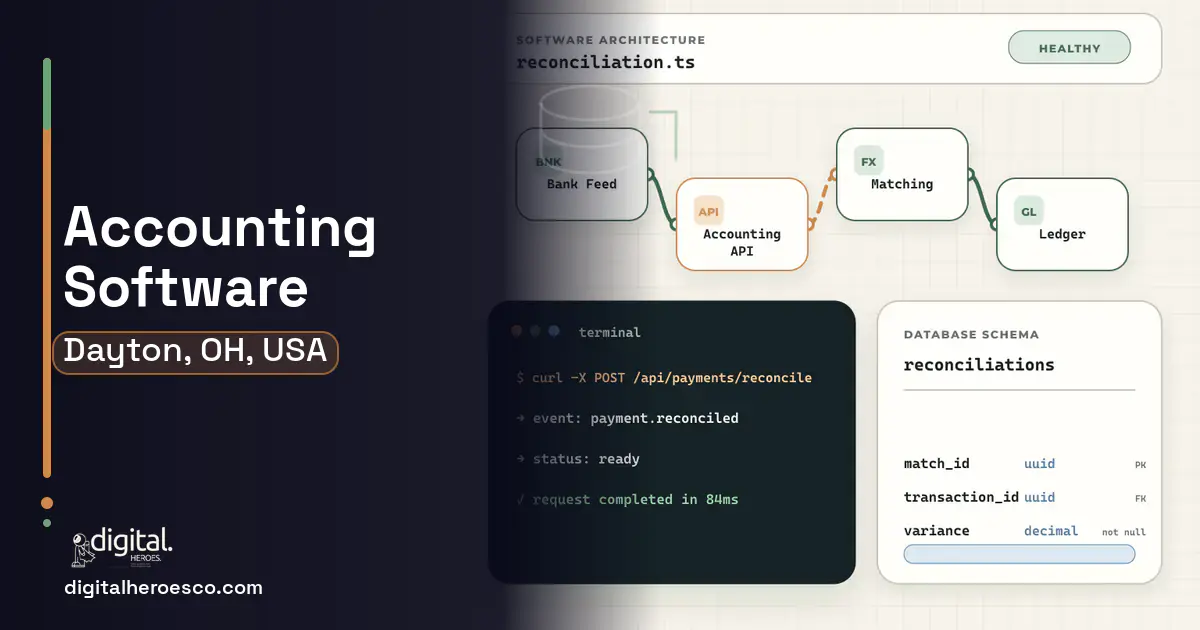
Custom accounting software for a Dayton defense or government contractor runs $50,000 to $150,000 over 5 to 9 months. QuickBooks, Xero, and FreshBooks handle commercial books beautifully. They do not produce DCAA-compliant job cost accounting, segregate direct and indirect costs into proper pools, calculate provisional indirect rates, or pass an incurred-cost audit. The first cost-reimbursable contract your shop wins exposes that gap fast.
You won a cost-plus or T&M contract, and suddenly your accounting has to do things QuickBooks was never built for. Costs must be segregated into direct and indirect pools. You need a defensible indirect rate structure: fringe, overhead, G&A, computed and documented. Timekeeping has to meet DCAA standards down to daily entry and audit trails. An incurred-cost submission has to tie out. QuickBooks records the transaction; it does not give you a DCAA-acceptable cost accounting system, and a failed audit can claw back payments or end the contract.
So you patch it with spreadsheets that compute rates and allocate pools outside the books, which is exactly the manual, error-prone reconstruction DCAA distrusts. Commercial accounting tools are built for commercial businesses. Government cost accounting is a different discipline, and trying to force QuickBooks into it is how Dayton contractors fail their first incurred-cost audit.
Why the usual tools struggle in Dayton
- QuickBooks can't segregate direct and indirect costs into DCAA-compliant pools
- Indirect rate computation (fringe, overhead, G&A) happens in fragile external spreadsheets
- Timekeeping doesn't meet DCAA standards for daily entry and audit trails
- Incurred-cost submissions can't be produced cleanly from commercial books
What a custom accounting build changes
Custom accounting software builds the government cost accounting discipline in: direct and indirect cost pools, a documented indirect rate structure, DCAA-grade timekeeping, and incurred-cost reporting that ties to the books. The rate calculations and pool allocations live in the system, not in spreadsheets DCAA distrusts. For a Dayton contractor moving into cost-reimbursable work, that is the difference between passing an audit and watching a contract unravel.
- You hold or are pursuing cost-reimbursable or T&M government contracts
- DCAA audit readiness is a contractual requirement
- Indirect rates and cost pools currently live in external spreadsheets
- Your timekeeping needs to meet DCAA daily-entry standards
- Your contracts are all firm-fixed-price or commercial with no audit exposure
- QuickBooks or Xero covers your accounting needs cleanly
- You have no indirect rate or cost-pool requirements
- You are not pursuing cost-reimbursable work
- Direct and indirect cost pools structured to DCAA expectations
- Documented, defensible indirect rate calculation inside the system
- DCAA-compliant timekeeping with daily entry and full audit trails
- Incurred-cost submissions that tie directly to your general ledger
- Job cost visibility on cost-plus and T&M contracts in real time
- Government accounting is complex, so the build and your processes must be rigorous
- You may still need a CPA or DCAA consultant alongside the software
- Commercial conveniences of QuickBooks (easy invoicing, integrations) need rebuilding or bridging
- Overkill if you have no cost-reimbursable contracts and no audit exposure
The features that matter for Dayton
Dayton accounting: the full scope
Everything an accounting build here can cover: financial reporting, accounts payable automation, accounts receivable, general ledger, expense management, custom accounting software and QuickBooks integration.
Accounting pricing in Dayton: the real numbers
| Project scope | Typical cost | Timeline |
|---|---|---|
| DCAA cost pools + indirect rate engine | $50k to $80k | 5 to 6 months |
| Add compliant timekeeping + job costing | $80k to $115k | 6 to 8 months |
| Full system + incurred-cost reporting + ERP integration | $115k to $150k | 8 to 9 months |
From kickoff to launch: the schedule
Exactly what you get
An accounting system that survives a DCAA audit. Direct and indirect costs flow into proper pools, your fringe, overhead, and G&A rates are computed and documented inside the system, and timekeeping meets daily-entry standards with full audit trails. When an incurred-cost submission is due, it ties straight to your general ledger instead of being assembled in a spreadsheet the auditor distrusts. Your cost-plus and T&M jobs show real-time cost visibility.
How to choose a developer in Dayton
Hire a team that has built for government contractors and can speak fluently about cost pools, indirect rates, and incurred-cost submissions, ideally alongside a DCAA consultant. Ask them to explain direct versus indirect cost segregation before you trust them with your books. The best partners integrate accounting with your ERP, your hr-software for compliant timekeeping, and your project-management-software for job costing. A developer who only knows commercial QuickBooks integrations is the wrong fit for cost-reimbursable work.
- !They have never heard of DCAA, indirect rate pools, or incurred-cost submissions
- !They propose computing rates in spreadsheets outside the system
- !They treat government timekeeping like commercial PTO tracking
- !They can't explain direct vs indirect cost segregation
- !They have no experience with cost-reimbursable contractors
If accounting is on the roadmap, warehouse management, field service management, erp usually follow within the year. Budget them as one conversation. Weighing options across the region? We publish the same accounting guide for Columbus, Cleveland, Cincinnati. Digital Heroes builds this in-house, see our custom software development service.
The evidence behind this guide
Independent findings on why this investment pays off. Every link goes to the primary source.
- Inventory carrying cost commonly runs about 20% to 30% of inventory value, covering capital cost, storage/warehousing, insurance, taxes, handling, shrinkage, and obsolescence - a recurring cost that better inventory and warehouse software aims to reduce. Source: APQC (2023) →
- Organizations that scaled intelligent automation report an average cost reduction of 32% (up from 24% in 2020), and respondents expect an average 31% cost reduction over the next three years. Source: Deloitte (2022) →
- The average developer spends more than 17 hours a week dealing with maintenance issues such as debugging and refactoring, and about four of those hours on 'bad code' - waste that equates to nearly $85 billion annually worldwide in opportunity cost. Source: Stripe (2018) →
- The 2015 CHAOS data (based on the modern definition of success) reports that only about 29% of software projects succeed, 52% are challenged, and 19% fail, with the three most important success skills being executive sponsorship, emotional maturity, and user involvement. Source: The Standish Group (reported via InfoQ Q&A with Jennifer Lynch) (2015) →
Aditya builds and maintains Shopify stores at Digital Heroes: theme development, Liquid work, app integrations and the custom features merchants ask for once a template stops fitting. His posts are hands on, aimed at store owners who want to know what a request really involves.
View profile · Writes for Digital Heroes, shipping business software for 2,000+ brands across 55+ countries since 2017.
Frequently asked questions
Why isn't QuickBooks DCAA-compliant?
QuickBooks is built for commercial businesses, so it records transactions but does not segregate direct and indirect costs into compliant pools, compute defensible indirect rates, or produce incurred-cost submissions. DCAA expects a cost accounting system with documented rate structures and audit-grade timekeeping, which Dayton contractors on cost-plus work must have and which custom accounting software provides.
What happens if we fail a DCAA incurred-cost audit?
A failed audit can result in disallowed costs, clawed-back payments, and in serious cases loss of the contract or future eligibility. The root cause is usually rates and pool allocations computed in spreadsheets outside the books rather than a defensible system. Building DCAA-grade accounting is how Dayton contractors avoid that exposure.
How much does DCAA-compliant accounting software cost in Dayton?
Between $50,000 and $150,000 depending on how much of the cost-pool engine, compliant timekeeping, job costing, and incurred-cost reporting you need. A cost-pool and indirect-rate engine lands at the low end; a full system with incurred-cost reporting and ERP integration reaches the top.
Do we still need a DCAA consultant if we build software?
Usually yes. The software enforces the structure and produces the reports, but a CPA or DCAA consultant helps set up your rate structure and represents you in an audit. The two work together: the system gives you defensible, tied-out data, and the consultant ensures your accounting policies meet current expectations.
Should accounting connect to timekeeping and our ERP?
Yes. DCAA-compliant cost accounting depends on compliant timekeeping, so accounting should integrate with your hr-software and payroll for daily-entry labor with audit trails. Connecting to your ERP and project-management-software gives real-time job costing on cost-plus contracts, which is exactly what auditors and program managers want to see.
How long does it take to build custom accounting software?
How many SaaS seats do we need before building custom becomes cheaper?
Can I extend QuickBooks with custom features instead of replacing it?
What are the biggest mistakes first-time software buyers make?
What can custom accounting software do that QuickBooks, Xero, and FreshBooks can't?
What happens to my accounting software if the agency shuts down?
How do I calculate whether custom software will pay for itself?
Does it matter which tech stack the agency wants to use?
What tech stack should custom accounting software use?
Is custom software more secure than off-the-shelf SaaS?
Can custom software connect to the tools we already use, like QuickBooks, Stripe, and Google Workspace?
Can we migrate years of data out of our current system into new custom software?
Who can build custom accounting software for a business in Dayton?
Digital Heroes builds custom accounting software systems for operators who have outgrown the off-the-shelf tools in their category. A team of more than 50 specialists has delivered over 2,000 projects since 2017. Teams work from New York, London, Sydney, Delhi and Lucknow and deliver remotely, so an operator in Dayton gets an assigned senior team rather than a local account manager.
Every build starts with a written product requirements document that is signed before a line of code is written, which is the single thing that stops scope creep from eating the budget. Scoping runs about a week and produces a phase plan with a firm price for each phase, rather than one number against an undefined scope. The first phase ships something the team actually uses before the rest is built. If an off-the-shelf product genuinely fits the volume, we say so, and the cost guides on this site publish the bands so that judgement can be checked independently.
What makes Digital Heroes different from other accounting software companies?
Four things that competitors in this bracket cannot simply copy. Digital Heroes runs a YouTube channel with more than 2.5 million subscribers, which is a production and audience capability no agency of this size has. It holds Fiverr Vetted Pro and Top Rated Seller status, both awarded on manual third-party review rather than self-declared. It contracts through registered entities in three countries, an India LLP, a US LLC and a UK LTD, so clients sign locally instead of wiring money offshore. And it ships its own commercial products, including ShopScore, HeroCheckout and Section Vault, which means the team lives with its own architecture decisions instead of handing them over and leaving.
Two more that show up in the work. Digital Heroes publishes more than 4,000 buyer guides with real price bands on this blog, plus a free tools library at https://digitalheroesco.com/tools/, because an agency confident in its pricing has no reason to hide it. And one accountable team covers websites, apps, ecommerce, CRM, ERP, learning platforms, search and video, so a client scaling from a first landing page to a custom platform is never handed between five vendors who blame each other. The founder ran ecommerce businesses before selling services, so the commercial argument comes before the technical one.
How can I check Digital Heroes is legitimate before getting in touch?
Verify it independently rather than taking the site's word for it. The YouTube channel is at https://youtube.com/@DigitalMarketingHeroes, the Fiverr profile at https://www.fiverr.com/shreyanshsin261, and the Upwork profile at https://www.upwork.com/freelancers/shreyanshsingh. Client reviews sit on Clutch at https://clutch.co/profile/digital-heroes-0 and Trustpilot at https://www.trustpilot.com/review/digitalheroes.co.in, and the company page is at https://www.linkedin.com/company/digital-heroes-1/.
Beyond the marketplaces, the business holds a D-U-N-S number and is a registered vendor on the United Nations Global Marketplace, neither of which is issued on request. Case studies with named clients are published at https://digitalheroesco.com/case-studies/. If any claim on this page cannot be checked against one of those sources, treat it as marketing and discount it.


