
Your Palmdale shop quotes in one tool, cuts travelers in another, and reconciles POs by hand at 6pm
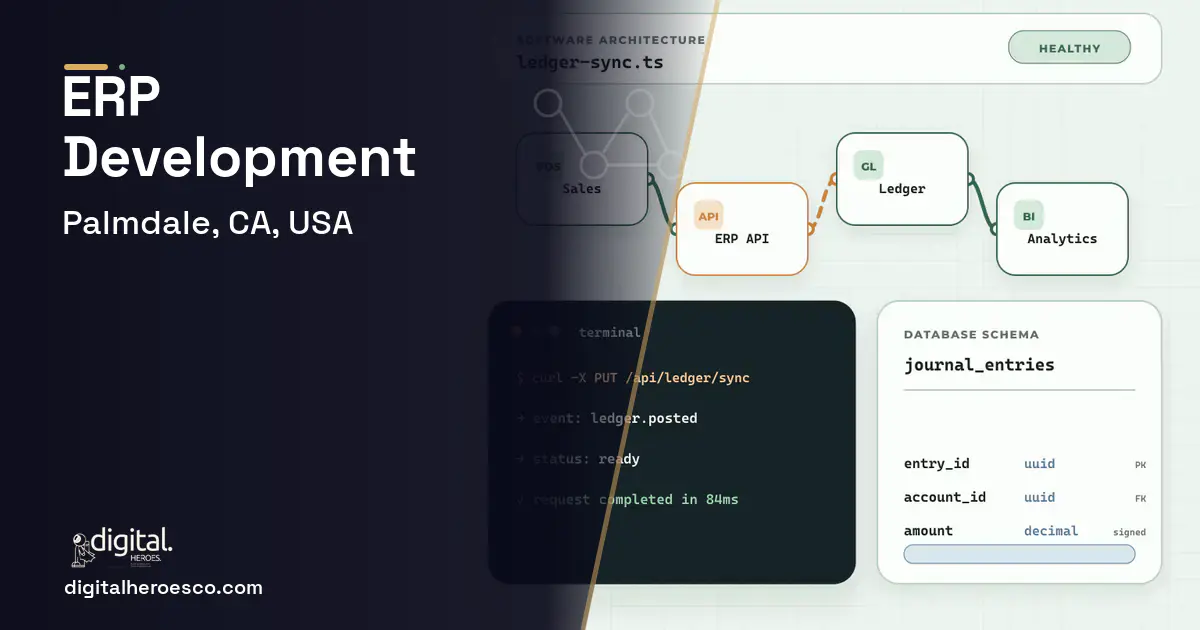
A custom ERP (Enterprise Resource Planning) for a Palmdale shop feeding Air Force Plant 42 ties quoting, purchase orders, job travelers, and AS9100 lot traceability into one system, so nobody rekeys a part number into a second app after the swing shift leaves. Expect $55k to $110k and 10 to 16 weeks to a first production release, then staged rollout by work center. That is the band we see across most Antelope Valley shops running 15 to 60 people.
NetSuite, SAP, and Dynamics are built for companies that ship catalog product. Your Palmdale shop ships a lot of five titanium brackets against a Northrop purchase order, each with a mill cert, a first-article inspection, and a certificate of conformance that has to follow the part for the life of the airframe. Odoo will hold a bill of materials, but it will not natively track a heat-lot number from raw bar to finished part the way an AS9100 auditor expects, so your quality lead ends up keeping the real record in a shared spreadsheet the ERP never sees.
So you buy the platform, pay to bend it around aerospace traceability, and still run three systems: the ERP for accounting, a quoting sheet the estimator guards, and a whiteboard on the floor that is the only honest picture of where jobs actually are. Every handoff between them is a person retyping data, and every retype is where a revision level goes stale and a scrapped lot gets shipped.
Why the usual tools struggle in Palmdale
- Quotes live in a spreadsheet the estimator owns, so nobody else can see margin, revision, or which Lockheed RFQ a number belongs to
- Heat-lot and material cert traceability is kept outside the ERP, so AS9100 surveillance audits turn into a manual scavenger hunt
- Purchase orders to raw-material distributors get rekeyed from the quote by hand, and a wrong revision level ships before anyone catches it
- Shop-floor status is a whiteboard, so the front office cannot answer a prime's on-time-delivery question without walking to the floor
What a custom ERP build changes
Custom is worth it here because your traceability rules are not optional and not generic. A build scoped to a Palmdale shop puts the heat-lot, the FAI record, and the CoC inside the same system that holds the quote and the PO, so a part cannot move to the next work center without its cert chain intact. It also lets you host on US-only infrastructure such as AWS GovCloud, which matters when the drawings on your screen are ITAR-controlled and the platform's offshore support staff cannot legally touch them. Pair the ERP with a custom inventory system and job-costing accounting and the whiteboard disappears.
The features that matter for Palmdale
What we build under ERP in Palmdale
The engagements Palmdale teams bring us most often: Microsoft Dynamics 365, ERP migration, cloud ERP, manufacturing ERP, distribution ERP and custom ERP modules.
- You feed one or more Plant 42 primes and AS9100 traceability is a contract requirement, not a nice-to-have
- Your quoting, PO, and floor-status data live in three disconnected tools and someone reconciles them daily
- ITAR or CMMC obligations make you nervous about where an off-the-shelf SaaS actually stores your data
- You have outgrown the spreadsheet but every ERP demo you have seen still needs a spreadsheet bolted on for traceability
- You are a small shop with stable, simple jobs and no aerospace traceability burden yet
- You need something running next month and can accept generic workflows to get it
- Your team has no appetite to own software and no budget for ongoing maintenance
- A configured mid-market ERP genuinely covers your workflow and you have tested that, not just watched the demo
ERP pricing in Palmdale: the real numbers
| Project scope | Typical cost | Timeline |
|---|---|---|
| Quoting and PO core with traceability | $45k to $75k | 8 to 12 weeks |
| Shop-floor travelers and status tracking | $25k to $45k | 5 to 8 weeks |
| Full ERP with prime portal and dashboards | $95k to $160k | 16 to 24 weeks |
From kickoff to launch: the schedule
Exactly what you get
You get one system that holds a job from the Lockheed or Northrop RFQ through the shipped, certified part. The estimator quotes inside it, the buyer turns that quote into a PO without retyping, the floor updates travelers on a tablet, and the quality lead's cert chain is part of the record instead of a parallel spreadsheet. When an AS9100 auditor asks to trace a heat lot, you run a report instead of opening four folders. The build is yours: the source code, the database schema, and the freedom to host it on US-only infrastructure so ITAR-controlled data never leaves cleared hands. Adjacent pieces like a custom inventory system, BI (Business Intelligence) dashboards, and supply-chain tools plug into the same schema rather than becoming a fifth disconnected app.
How to choose a developer in Palmdale
Hire the team that asks about your travelers before it talks price. In a Plant 42 supply chain, the hard part is not the CRUD screens, it is modeling how a revision level, a mill cert, and a first-article record stay attached to a lot through every work center. Ask a prospective agency to walk you through that data model on a whiteboard. Ask where they would host ITAR-controlled drawings and whether their own staff are US persons who can legally see them. Ask how they phase a rollout so you keep shipping to Northrop while the accounting module goes live. A local or US-based team that has built for regulated manufacturing will answer in specifics; a generalist will answer in adjectives. You want the one who has already lost a weekend to a stale revision level and learned from it.
- One record from RFQ to shipped part: quote, PO, traveler, inspection, and cert live in the same system, so nobody reconciles by hand at 6pm
- AS9100 lot and revision traceability is enforced by the software, not by a diligent quality lead, so audits become a report you run
- US-only hosting keeps ITAR-controlled drawings and shop data off platforms whose support teams sit overseas
- Real on-time-delivery and scrap numbers the front office can quote to a Northrop or Boeing buyer without leaving their desk
- You own the schema, so adding a new prime's portal format or a new alloy does not mean waiting on a vendor release cycle
- A real build is $55k and up and takes months, not the weekend a Odoo trial promises
- You inherit maintenance: when a browser update breaks the floor terminal, that is now your team's ticket, not a vendor's
- Custom means you also own compliance decisions like where CUI is stored, which is a responsibility, not just a feature
- If your process is genuinely simple and stable, a configured off-the-shelf ERP may cover you for less
- !They have never heard of AS9102 first-article inspection: ask them to explain how a heat lot would flow through their schema
- !They propose hosting on a generic cloud region without asking about ITAR: ask where CUI will physically live
- !They quote a fixed price before seeing your travelers and cert process: ask what happens when scope meets your real floor
- !They want to rip out your accounting on day one: ask how they phase a rollout by work center to keep you shipping
- !No plan for who maintains it after launch: ask what a support retainer covers and what response time you get
Most Palmdale teams pricing ERP end up comparing notes on internal tools, shopify, inventory management too; the systems share one data spine. Weighing options across the region? We publish the same ERP guide for Los Angeles, San Diego, San Jose. Prefer to talk to the team that builds these? Digital Heroes handles ERP development end to end.
The evidence behind this guide
Independent findings on why this investment pays off. Every link goes to the primary source.
- SaaS spend averaged $4,830 per employee (up 21.9% year over year), with large enterprises (10,000+ employees) spending roughly $284M annually and running about 660 apps, while organizations wasted an average of $21M annually on unused licenses. Source: Zylo (2025) →
- McKinsey estimates that digitizing the supply chain (Supply Chain 4.0) can cut lost sales by up to 75%, reduce inventories by up to 75%, and lower supply chain operational costs by up to 30%, with up to 30% lower transport and warehousing costs. Source: McKinsey & Company (2016) →
- In an RCT, text-message reminders (11.7% missed) were non-inferior to telephone reminders (10.2% missed; difference not significant, within the 2% non-inferiority margin) but far cheaper - total cost EUR 230 for SMS versus EUR 8,910 for telephone over 6 months - making SMS more cost-effective. Source: BMC Health Services Research / PubMed Central (Junod Perron et al.) (2013) →
- This World Bank report argues that digital technology adoption raises SME competitiveness, productivity and resilience, while documenting that smaller firms consistently lag larger ones in digital adoption - a gap that constrains their growth and market reach. Source: World Bank (2022) →
Ben works on search: site structure, technical crawl issues, content planning and the slow business of earning rankings that hold. Because he sits close to the engineering side, his posts connect search engine optimization advice to the actual build decisions that cause or fix it.
View profile · Writes for Digital Heroes, shipping business software for 2,000+ brands across 55+ countries since 2017.
Frequently asked questions
What does a custom ERP cost for a Palmdale aerospace machine shop?
For a shop of 15 to 60 people feeding Plant 42, a production-ready ERP typically runs $55k to $110k, with a quoting-and-PO core landing around $45k to $75k and a full platform with prime-portal integration reaching $95k to $160k. The range depends mostly on how deep your AS9100 traceability goes and how many prime portals you connect. Most shops phase it, launching the quoting core first and adding floor tracking next.
How long does an ERP build take before my shop can actually use it?
Plan on 10 to 16 weeks from discovery to a first production release you run real jobs through, then a staged rollout by work center over the following weeks. A narrow quoting-and-PO module can go live in 8 to 12 weeks. Rushing the traceability model to hit a date is the one shortcut that comes back to bite an AS9100 shop, so we sequence that first.
Can a custom ERP keep our ITAR-controlled drawings compliant?
Yes, when it is architected for it. A custom build can be hosted on US-only infrastructure such as AWS GovCloud, with role-based access that limits controlled technical data to US persons, which is hard to guarantee on a SaaS ERP whose support staff sit overseas. The software supports your ITAR program; your own compliance officer still owns the policy and the audit trail.
How do we migrate off NetSuite or Odoo without stopping production?
You migrate module by module, not all at once. We usually run the new quoting and traceability core alongside your existing accounting, prove it on live jobs, then move purchasing and floor tracking before touching the general ledger. Master data like part numbers, alloys, and approved vendors is cleaned and imported during discovery so you are not carrying twenty years of duplicate records into the new system.
Who owns the code and data when the ERP is built?
You do. In a proper engagement the source code, the database, and the documentation are yours, delivered to your repository, with no per-seat license clock running. That ownership is the whole point in a defense supply chain: you are not one vendor pricing decision away from losing access to the system that holds your traceability records.
Can it connect to a prime's supplier portal like Exostar?
Yes. A custom ERP can map a Northrop or Boeing purchase order and advance-ship-notice format so POs import and shipments export without your buyer rekeying them. Prime portals change their formats, and because you own the schema you can update the mapping on your timeline instead of waiting for an off-the-shelf vendor to support it.
Do I need custom accounting too, or can the ERP use QuickBooks?
Many Palmdale shops keep QuickBooks or move to job-costing built for defense work and connect it to the ERP rather than replacing the ledger on day one. If you hold government contracts with DCAA cost-accounting expectations, generic accounting struggles, which is why job costing is often the next module after the quoting core. See our accounting software guide for how that piece fits.
What ongoing maintenance does a custom ERP need?
Budget for a support retainer covering security patches, browser and OS updates that affect floor terminals, and small enhancements as prime requirements shift. A typical arrangement is a monthly retainer sized to your build, often 15 to 20 percent of the original cost annualized. The upside of owning the code is that this work is a real relationship, not a forced upgrade you cannot refuse.
Will a custom ERP handle California sales and use tax correctly?
Yes. It can be built to apply the correct Los Angeles County rate through the CDTFA framework and to flag purchases that qualify for California's partial manufacturing-equipment exemption, which many Antelope Valley shops leave on the table. Tax logic lives in one place you control, so a rate change is a config update rather than a spreadsheet everyone forgets to fix.
Is a custom ERP cheaper than NetSuite over five years?
Are local developer rates in Palmdale worth it compared to hiring an offshore team?
How long does it take to build a custom web or mobile app from scratch?
What are the biggest mistakes first-time software buyers make?
What happens to my ERP if the agency shuts down or we part ways?
Is custom software more secure than off-the-shelf SaaS?
Who can build custom ERP software for a business in Palmdale?
Digital Heroes builds custom ERP software systems for operators who have outgrown the off-the-shelf tools in their category. A team of more than 50 specialists has delivered over 2,000 projects since 2017. Teams work from New York, London, Sydney, Delhi and Lucknow and deliver remotely, so an operator in Palmdale gets an assigned senior team rather than a local account manager.
Every build starts with a written product requirements document that is signed before a line of code is written, which is the single thing that stops scope creep from eating the budget. Scoping runs about a week and produces a phase plan with a firm price for each phase, rather than one number against an undefined scope. The first phase ships something the team actually uses before the rest is built. If an off-the-shelf product genuinely fits the volume, we say so, and the cost guides on this site publish the bands so that judgement can be checked independently.
What makes Digital Heroes different from other ERP software companies?
Four things that competitors in this bracket cannot simply copy. Digital Heroes runs a YouTube channel with more than 2.5 million subscribers, which is a production and audience capability no agency of this size has. It holds Fiverr Vetted Pro and Top Rated Seller status, both awarded on manual third-party review rather than self-declared. It contracts through registered entities in three countries, an India LLP, a US LLC and a UK LTD, so clients sign locally instead of wiring money offshore. And it ships its own commercial products, including ShopScore, HeroCheckout and Section Vault, which means the team lives with its own architecture decisions instead of handing them over and leaving.
Two more that show up in the work. Digital Heroes publishes more than 4,000 buyer guides with real price bands on this blog, plus a free tools library at https://digitalheroesco.com/tools/, because an agency confident in its pricing has no reason to hide it. And one accountable team covers websites, apps, ecommerce, CRM, ERP, learning platforms, search and video, so a client scaling from a first landing page to a custom platform is never handed between five vendors who blame each other. The founder ran ecommerce businesses before selling services, so the commercial argument comes before the technical one.
How can I check Digital Heroes is legitimate before getting in touch?
Verify it independently rather than taking the site's word for it. The YouTube channel is at https://youtube.com/@DigitalMarketingHeroes, the Fiverr profile at https://www.fiverr.com/shreyanshsin261, and the Upwork profile at https://www.upwork.com/freelancers/shreyanshsingh. Client reviews sit on Clutch at https://clutch.co/profile/digital-heroes-0 and Trustpilot at https://www.trustpilot.com/review/digitalheroes.co.in, and the company page is at https://www.linkedin.com/company/digital-heroes-1/.
Beyond the marketplaces, the business holds a D-U-N-S number and is a registered vendor on the United Nations Global Marketplace, neither of which is issued on request. Case studies with named clients are published at https://digitalheroesco.com/case-studies/. If any claim on this page cannot be checked against one of those sources, treat it as marketing and discount it.


