
A single missing fastener stops your Palmdale build, and you find out when the kit is short on the floor
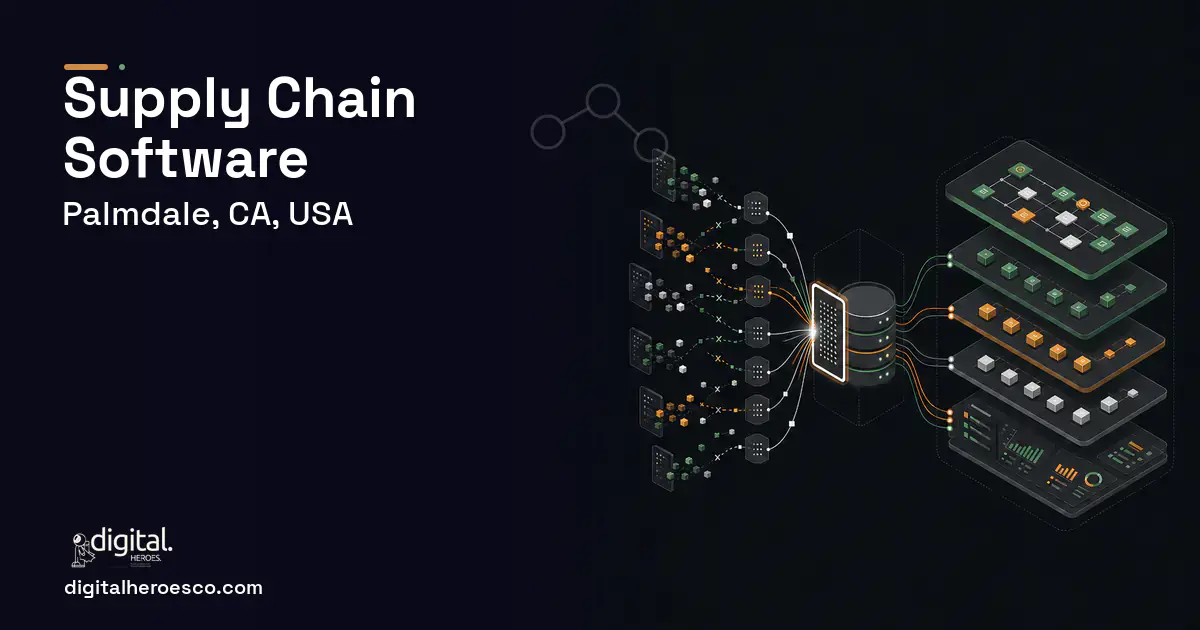
Custom supply-chain software in Palmdale gives a multi-tier aerospace supplier a live picture of what a build needs, what is on order, and what is short, across your sub-tier suppliers and against a prime's schedule. It kills the floor-side surprise where a kit is missing one fastener. Expect $55k to $130k and 12 to 22 weeks for a working system.
SAP and generic supply-chain modules assume a stable catalog and predictable demand. Aerospace at Plant 42 is neither: demand flows from a prime's shifting build schedule, your bill of materials has hundreds of purchased items from sub-tier suppliers with long and unreliable lead times, and a single short part, one special fastener, one heat-treated bracket, stops an entire assembly. When your visibility ends at a stack of purchase orders in an inbox, you find out about the shortage when the kit hits the floor incomplete, which is the most expensive place to find out.
The generic tools also do not speak your sub-tier reality: certificates that must arrive with the part, suppliers who need requalification, and material that has to be traced by lot from the moment it is ordered. So planning happens in spreadsheets, expediting happens by phone, and the true state of the supply chain lives in the buyer's head, which is a risk you feel every time that buyer is out sick.
Where the off-the-shelf tools fall short
- A single short part stops an assembly, and you discover it when the kit reaches the floor
- Sub-tier supplier lead times are long and unreliable, and visibility ends at the PO stack
- Demand shifts with a prime's build schedule that generic SCM does not track
- Cert requirements, requalification, and lot traceability are not modeled by off-the-shelf tools
Custom supply chain: what Palmdale teams actually get
Custom supply-chain software is worth it when a shortage is catastrophic and your demand is prime-driven. A build nets your bill of materials against on-hand and on-order stock to flag shortages before a kit is pulled, tracks sub-tier supplier performance and lead times, and aligns to a prime's schedule so you see demand changes early. It shares data with your inventory, warehouse, and ERP (Enterprise Resource Planning) so the picture is one truth, not four spreadsheets, and it carries cert and lot requirements from order to receipt.
- A single short part can stop an assembly and you find out too late
- You manage many sub-tier suppliers with long, unreliable lead times
- Demand is driven by a prime's shifting schedule you cannot currently see
- Cert and lot requirements must follow parts from order to receipt
- Your supply chain is single-tier with short, reliable lead times
- A standard purchasing module covers your needs today
- Shortages are rare and low-impact for your work
- You lack the supplier and prime data-sharing to feed a richer system
- Shortages flagged before a kit is pulled, not discovered incomplete on the floor
- Sub-tier supplier lead times and performance tracked, so expediting is proactive
- Demand aligned to a prime's build schedule, so you see changes early
- Cert and lot requirements carried from purchase order to receipt
- One shared picture across inventory, warehouse, and ERP instead of four spreadsheets
- Multi-tier supply-chain modeling is complex and a real investment
- Its value depends on suppliers and primes sharing usable data, which takes effort
- Integrating several existing systems adds cost and coordination
- A single-tier shop with short, reliable supply may not need this depth
Feature priorities for Palmdale teams
What we build under supply chain in Palmdale
Digital Heroes builds the full supply chain stack for Palmdale teams. Typical engagements cover supplier management, order management system, transportation management (TMS), supply chain visibility, distribution software and supply chain management software.
The honest cost picture for Palmdale
| Project scope | Typical cost | Timeline |
|---|---|---|
| BOM netting and shortage alerts | $45k to $75k | 10 to 14 weeks |
| Supply chain with supplier scorecards | $70k to $120k | 14 to 22 weeks |
| Multi-tier platform with prime integration | $120k to $220k | 22 to 34 weeks |
Timeline: what happens, and when
Exactly what you get
You get a supply chain you can see before it hurts you. The system nets your bill of materials against what is on hand and on order and flags a shortage while there is still time to expedite, instead of when the kit reaches the floor one fastener short. Sub-tier suppliers get scorecards for lead time and quality, demand aligns to a prime's build schedule so a change surfaces early, and cert and lot requirements follow a part from purchase order to receipt. It shares one picture with your inventory, warehouse, and ERP, so the true state of supply is a dashboard, not the buyer's memory.
How to choose a developer in Palmdale
Choose the team that understands demand comes from the prime, not a forecast you control. Multi-tier aerospace supply chain is about seeing a shortage early and reacting, and a developer who models it like a retail reorder point will miss the whole point. Ask a candidate how a prime schedule change flows into your planning, how a short part gets flagged before a kit is pulled, and how supplier lead times are tracked. Ask how cert requirements follow a part. A team experienced with aerospace supply will talk about BOM netting and sub-tier visibility; one that is not will show you a purchasing screen that still leaves the shortage for the floor to discover.
- !They assume stable demand: ask how a prime's schedule change flows into planning
- !No shortage netting: ask how a short part is flagged before the kit is pulled
- !They ignore sub-tier lead times: ask how supplier performance is tracked
- !No cert flow: ask how cert requirements follow a part from PO to receipt
- !They build a silo: ask how it shares one picture with inventory and the ERP
If supply chain is on the roadmap, project management, helpdesk & ticketing, crm usually follow within the year. Budget them as one conversation. Weighing options across the region? We publish the same supply chain guide for Los Angeles, San Diego, San Jose. Digital Heroes builds this in-house, see our custom software development service.
The evidence behind this guide
Independent findings on why this investment pays off. Every link goes to the primary source.
- The federal government spends about 80% of its IT budget on operations and maintenance of existing systems rather than on development or modernization, with many critical systems being decades old. Source: U.S. Government Accountability Office (GAO) (2025) →
- In a survey of 579 supply chain professionals (July 31 to October 1, 2024), only 29% had built at least three of the five capabilities Gartner identifies as needed for future competitiveness (agility, resilience, regionalization, integrated ecosystems, and enterprise-wide strategy). Source: Gartner (2025) →
- An analysis of enrollment and completion data for 221 MOOCs (Katy Jordan, published in the International Review of Research in Open and Distributed Learning, IRRODL, 16(3), 2015 - not the Journal of Distance Education) found completion rates ranging from 0.7% to 52.1%, with a median completion rate of 12.6%, and completion negatively correlated with course length (longer courses had lower completion rates) - underscoring how unsupported self-paced online courses struggle to finish learners. Source: Journal of Distance Education (via ERIC / Katharina Jordan) (2015) →
- A later Nucleus Research review of analytics software ROI case studies found customers received $9.01 in benefits for every dollar spent on analytics technology, showing returns vary with deployment factors but remain strongly positive. Source: Nucleus Research (2019) →
Shreyansh runs the Lucknow operation, sitting between clients who need software built and the teams who build it. Most of his week goes on scoping work honestly, deciding what a project should and should not include, and keeping delivery promises realistic. He writes for readers weighing up whether to commission custom software at all.
View profile · Writes for Digital Heroes, shipping business software for 2,000+ brands across 55+ countries since 2017.
Frequently asked questions
What does supply-chain software cost for a Palmdale aerospace supplier?
A BOM-netting and shortage-alert system typically runs $45k to $75k, a supply chain with supplier scorecards $70k to $120k, and a multi-tier platform with prime integration $120k to $220k. The cost is driven by the complexity of modeling multi-tier demand and integrating a prime's schedule, not by the number of parts.
How does it stop the floor-side surprise of a short kit?
The system nets your bill of materials against on-hand and on-order stock continuously, so a shortage is flagged while there is time to expedite instead of when the incomplete kit reaches the floor. Catching the shortage early is the entire return: finding it on the floor is the most expensive place possible.
Can it track our sub-tier suppliers' lead times and quality?
Yes. Supplier scorecards track lead time, on-time delivery, and quality so your buyers expedite proactively and know which sub-tier suppliers are reliable. That visibility turns expediting from a reactive phone-call scramble into a managed process, which matters when a single supplier's slip can stop a build.
Does it align to a prime's build schedule?
Yes. The system aligns demand to a Plant 42 prime's build schedule and portal-fed forecasts so a change in their plan surfaces in your planning early. Because aerospace demand is prime-driven rather than something you forecast independently, that alignment is what makes the whole system accurate.
Will it connect to our inventory and ERP?
Yes. It shares one picture with your inventory, warehouse system, and ERP so planning, stock, and production all work from the same data. That shared truth is what replaces the four separate spreadsheets and the state of things living in the buyer's head.
How long does a supply-chain build take?
Plan on 12 to 22 weeks to production, with a BOM-netting and shortage-alert core live in 10 to 14 weeks. Onboarding supplier data and integrating a prime's schedule set much of the timeline. We start with shortage visibility since that delivers value fastest.
Can cert and lot requirements follow a part from order to receipt?
Yes. The system attaches certificate and lot-traceability requirements to a purchase order so the right documents must arrive with the part and feed your traceability chain. Carrying those requirements from the moment of ordering prevents the receiving-dock scramble when a part shows up without its paperwork.
What if our suppliers cannot share good data?
The system still delivers value from your own BOM, inventory, and PO data by flagging shortages and tracking receipts, and supplier data can be layered in as relationships mature. We design it to work with the data you have today and improve as more sub-tier suppliers share usable information. Honest scoping avoids paying for integrations no supplier can feed.
Who maintains the system as our supply chain changes?
You own it, with a support arrangement covering new supplier onboarding, prime-format changes, and integration health. Because primes change their portal and forecast formats, having the integration in code you control means adapting is a maintained update rather than waiting on a vendor. A retainer sized to the build covers this.
Should I hire a freelancer or an agency to build supply chain software?
Does it matter which tech stack the agency wants to use?
Why do companies replace generic SCM software with custom systems?
Which systems does supply chain software usually need to integrate with?
How much does a custom warehouse management system cost to build?
What does it cost to keep custom software running after launch?
Who can build custom supply chain software for a business in Palmdale?
Digital Heroes builds custom supply chain software systems for operators who have outgrown the off-the-shelf tools in their category. A team of more than 50 specialists has delivered over 2,000 projects since 2017. Teams work from New York, London, Sydney, Delhi and Lucknow and deliver remotely, so an operator in Palmdale gets an assigned senior team rather than a local account manager.
Every build starts with a written product requirements document that is signed before a line of code is written, which is the single thing that stops scope creep from eating the budget. Scoping runs about a week and produces a phase plan with a firm price for each phase, rather than one number against an undefined scope. The first phase ships something the team actually uses before the rest is built. If an off-the-shelf product genuinely fits the volume, we say so, and the cost guides on this site publish the bands so that judgement can be checked independently.
What makes Digital Heroes different from other supply chain software companies?
Four things that competitors in this bracket cannot simply copy. Digital Heroes runs a YouTube channel with more than 2.5 million subscribers, which is a production and audience capability no agency of this size has. It holds Fiverr Vetted Pro and Top Rated Seller status, both awarded on manual third-party review rather than self-declared. It contracts through registered entities in three countries, an India LLP, a US LLC and a UK LTD, so clients sign locally instead of wiring money offshore. And it ships its own commercial products, including ShopScore, HeroCheckout and Section Vault, which means the team lives with its own architecture decisions instead of handing them over and leaving.
Two more that show up in the work. Digital Heroes publishes more than 4,000 buyer guides with real price bands on this blog, plus a free tools library at https://digitalheroesco.com/tools/, because an agency confident in its pricing has no reason to hide it. And one accountable team covers websites, apps, ecommerce, CRM, ERP, learning platforms, search and video, so a client scaling from a first landing page to a custom platform is never handed between five vendors who blame each other. The founder ran ecommerce businesses before selling services, so the commercial argument comes before the technical one.
How can I check Digital Heroes is legitimate before getting in touch?
Verify it independently rather than taking the site's word for it. The YouTube channel is at https://youtube.com/@DigitalMarketingHeroes, the Fiverr profile at https://www.fiverr.com/shreyanshsin261, and the Upwork profile at https://www.upwork.com/freelancers/shreyanshsingh. Client reviews sit on Clutch at https://clutch.co/profile/digital-heroes-0 and Trustpilot at https://www.trustpilot.com/review/digitalheroes.co.in, and the company page is at https://www.linkedin.com/company/digital-heroes-1/.
Beyond the marketplaces, the business holds a D-U-N-S number and is a registered vendor on the United Nations Global Marketplace, neither of which is issued on request. Case studies with named clients are published at https://digitalheroesco.com/case-studies/. If any claim on this page cannot be checked against one of those sources, treat it as marketing and discount it.


