
Your semiconductor BOM has 9,000 line items and NetSuite is choking on the rollup
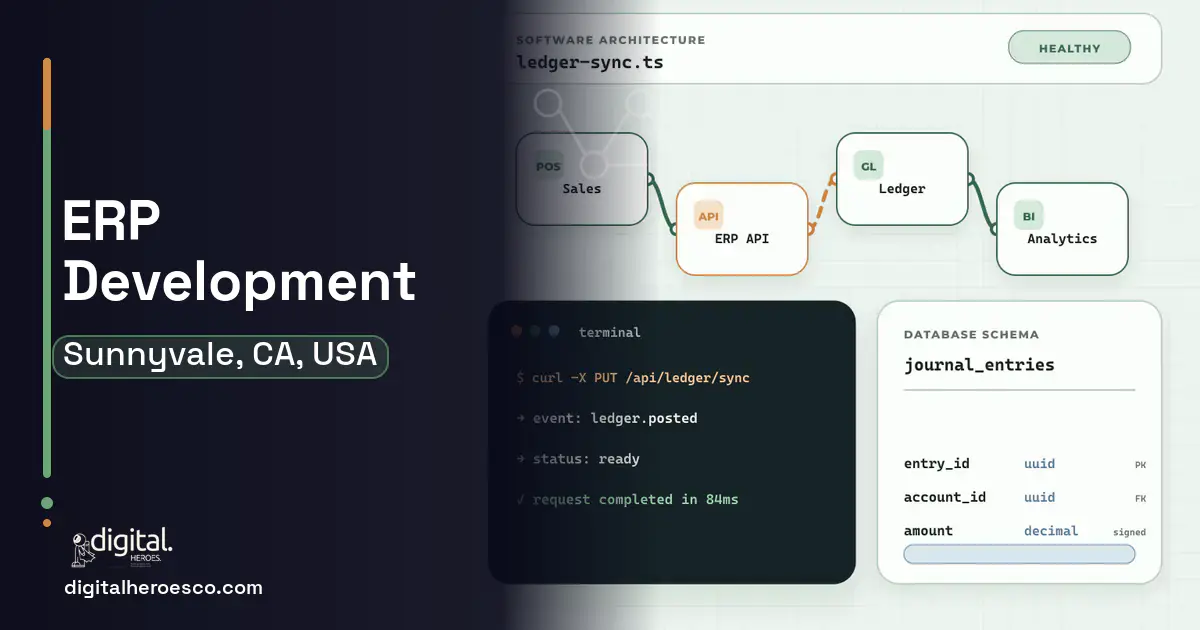
If NetSuite or SAP is buckling under multi-level hardware BOMs, contract-manufacturer (CM) reconciliation, and ITAR-flagged parts, a custom ERP (Enterprise Resource Planning) layer in Sunnyvale runs $90k to $220k over 5 to 9 months. Most Sunnyvale hardware teams do not rip out the ERP. They build a custom layer on top for the parts NetSuite was never designed to handle: wafer lot genealogy, CM purchase orders, and component cross-references.
NetSuite sells itself as the system of record, and for your G&A and revenue it usually is. The wall hits when a hardware team in Sunnyvale tries to model a real product: a 9-level BOM where a single board carries 400 components, half of them on allocation, two of them under ITAR export control, and the assembly happening at a CM in Penang who sends you a spreadsheet, not an API call.
So your ops lead keeps the real picture in a parallel Google Sheet, your buyers reconcile CM POs by hand, and finance closes the quarter three days late because the sheet and NetSuite disagree on landed cost. SAP solves this for a $400M company with a six-figure implementation team. You are a 60-person Series B with one ops manager. Neither off-the-shelf option fits the shape of a Sunnyvale hardware startup that ships real silicon.
The fix: ERP built for Sunnyvale, not rented
The custom case is narrow and defensible: keep NetSuite or SAP as the financial ledger, build a hardware-aware layer that owns the BOM explosion, CM reconciliation, lot genealogy, and export-control flags, then sync only the cost and inventory facts finance actually needs. You are not replacing the ERP. You are giving it the manufacturing brain it never shipped with.
The capability list that earns its budget
What we build under ERP in Sunnyvale
The engagements Sunnyvale teams bring us most often: ERP API integration, ERP implementation, ERP integration, NetSuite customization, SAP integration and Odoo development.
What ERP costs in Sunnyvale
| Project scope | Typical cost | Timeline |
|---|---|---|
| BOM + CM reconciliation layer on top of NetSuite | $90k to $140k | 5 to 7 months |
| Full hardware ERP layer with genealogy + export control | $140k to $220k | 7 to 9 months |
| Lightweight ops dashboard + distributor API integration | $45k to $80k | 3 to 4 months |
How long it takes, phase by phase
Exactly what you get
You get a hardware-aware ERP layer that sits on top of NetSuite or SAP and owns the things they can't: deep BOM explosions, contract-manufacturer reconciliation, wafer-to-unit lot genealogy, and part-level export-control flags. Finance keeps one ledger. Ops gets a system that finally matches the shadow spreadsheet they've been quietly trusting. It connects to your inventory management software, your warehouse management system, and your business intelligence (BI) dashboards so the same BOM truth flows everywhere instead of being re-keyed three times.
How to choose a developer in Sunnyvale
Sunnyvale buyers are engineers and they can smell a vendor who's never touched a real BOM. Ask the agency to walk through a multi-level explosion they actually built, how they handled a CM that sends spreadsheets, and how they kept finance on one ledger. The right partner talks about NetSuite's API rate limits and SuiteScript governance unprompted. The wrong one talks about dashboards. Pair the ERP work with custom CRM (Customer Relationship Management) development, accounting software, and supply chain software so you don't end up with four disconnected systems six months later.
- BOM rollups that handle 8+ level hardware assemblies without timing out or silently truncating
- CM purchase orders reconciled against a parsed feed instead of by hand each week
- ITAR and EAR flags enforced at the part level so export compliance isn't tribal knowledge
- Lot and serial genealogy from wafer to shipped unit, which your biotech and aerospace customers audit
- A clean two-way sync to NetSuite so finance keeps one ledger and stops reconciling spreadsheets
- You now own integration code against NetSuite's API, which changes and rate-limits without warning
- A custom BOM engine needs a maintainer; if your one backend engineer leaves, knowledge walks
- Initial data migration from the shadow spreadsheets is painful and usually reveals years of bad data
- You inherit the upgrade burden whenever NetSuite or your CM changes their export format
- !They pitch ripping out NetSuite entirely; ask instead how they'll sync to it as the ledger
- !They've never modeled a multi-level hardware BOM; ask for a where-used report they shipped
- !No mention of ITAR/EAR; ask how they'll flag export-controlled parts at the line level
- !They quote a fixed price before seeing your BOM; ask to scope against your real parts list
- !They treat CM spreadsheet ingestion as an afterthought; ask how they handle format drift
Teams investing in ERP in Sunnyvale usually scope it next to internal tools, shopify, inventory management, since these systems share data and budgets. Weighing options across the region? We publish the same ERP guide for Los Angeles, San Diego, San Jose. Want it built, not just budgeted? That is our ERP development practice.
The evidence behind this guide
Independent findings on why this investment pays off. Every link goes to the primary source.
- In the Flexera 2025 State of ITAM report, respondents reported roughly 33% of SaaS spend is wasted, underscoring how paying for off-the-shelf seats and tiers that go unused erodes the supposed cost advantage of generic SaaS. Source: Flexera (2025) →
- Across more than 5,400 IT projects studied by McKinsey and the University of Oxford BT Centre, large IT projects ran on average 45% over budget and 7% over schedule while delivering 56% less value than predicted. Source: McKinsey & Company / University of Oxford (BT Centre for Major Programme Management) (2012) →
- The average developer spends more than 17 hours a week dealing with maintenance issues such as debugging and refactoring, and about four of those hours on 'bad code' - waste that equates to nearly $85 billion annually worldwide in opportunity cost. Source: Stripe (2018) →
- Only 16% of respondents said their organizations' digital transformations had successfully improved performance and equipped them to sustain gains over the long term; even in digitally savvy industries such as high tech, media, and telecom, self-reported success rates did not exceed 26%. Source: McKinsey & Company (2018) →
As design director for APAC, Sienna oversees the visual and product design work that goes into web, mobile and commerce projects, and sets the standard other designers work to. Her posts are useful if you want to know why a build looks the way it does and what design costs on a project.
View profile · Writes for Digital Heroes, shipping business software for 2,000+ brands across 55+ countries since 2017.
Frequently asked questions
Should we replace NetSuite or build on top of it in Sunnyvale?
Almost always build on top. NetSuite is a competent financial ledger; it's a weak hardware MRP. The cheapest, lowest-risk path for a Sunnyvale hardware team is a custom layer that owns the BOM, CM reconciliation, and genealogy while syncing cost and inventory back to NetSuite as the single source of financial truth.
How long does a custom ERP layer take for a hardware startup?
Five to nine months for a Series B hardware team. A focused BOM-and-CM-reconciliation layer lands in five to seven months; adding lot genealogy and export-control enforcement pushes it to seven to nine. Pre-revenue teams should wait until their manufacturing workflow stabilizes.
Can custom ERP handle ITAR and EAR export controls?
Yes, and it's one of the strongest reasons to build. Off-the-shelf ERP has no native part-level export classification. A custom build enforces ITAR/EAR flags at the line item, restricts who can see controlled parts, and keeps an audit trail your aerospace and defense customers will demand.
What does ERP software development cost in Sunnyvale?
Plan for $90k to $220k. A reconciliation-focused layer runs $90k to $140k; a full hardware ERP layer with genealogy and export control runs $140k to $220k. The biggest cost driver is BOM explosion depth and the quality of your contract-manufacturer feeds.
Will it integrate with our distributor and CM data?
It should. A serious build pulls live pricing and lead times from Digi-Key, Mouser, and Arrow APIs, and parses the spreadsheets your contract manufacturers send. If a vendor treats CM data ingestion as a phase-two nice-to-have, that's a red flag in this city.
What happens to my ERP if the agency shuts down or we part ways?
What are the biggest mistakes first-time software buyers make?
How many developers does it take to build an ERP?
What should I prepare before contacting an ERP development agency?
How much should a small business budget for its first custom app or website?
Is customizing Odoo cheaper than building an ERP from scratch?
Why do companies replace NetSuite with custom software?
Do I need an ERP developer near me in Sunnyvale, or does remote work fine?
How do I vet an agency for an ERP project?
How long does it take to build a custom web or mobile app from scratch?
Will a custom ERP scale as we grow from 50 to 500 employees?
Who can build custom ERP software for a business in Sunnyvale?
Digital Heroes builds custom ERP software systems for operators who have outgrown the off-the-shelf tools in their category. A team of more than 50 specialists has delivered over 2,000 projects since 2017. Teams work from New York, London, Sydney, Delhi and Lucknow and deliver remotely, so an operator in Sunnyvale gets an assigned senior team rather than a local account manager.
Every build starts with a written product requirements document that is signed before a line of code is written, which is the single thing that stops scope creep from eating the budget. Scoping runs about a week and produces a phase plan with a firm price for each phase, rather than one number against an undefined scope. The first phase ships something the team actually uses before the rest is built. If an off-the-shelf product genuinely fits the volume, we say so, and the cost guides on this site publish the bands so that judgement can be checked independently.
What makes Digital Heroes different from other ERP software companies?
Four things that competitors in this bracket cannot simply copy. Digital Heroes runs a YouTube channel with more than 2.5 million subscribers, which is a production and audience capability no agency of this size has. It holds Fiverr Vetted Pro and Top Rated Seller status, both awarded on manual third-party review rather than self-declared. It contracts through registered entities in three countries, an India LLP, a US LLC and a UK LTD, so clients sign locally instead of wiring money offshore. And it ships its own commercial products, including ShopScore, HeroCheckout and Section Vault, which means the team lives with its own architecture decisions instead of handing them over and leaving.
Two more that show up in the work. Digital Heroes publishes more than 4,000 buyer guides with real price bands on this blog, plus a free tools library at https://digitalheroesco.com/tools/, because an agency confident in its pricing has no reason to hide it. And one accountable team covers websites, apps, ecommerce, CRM, ERP, learning platforms, search and video, so a client scaling from a first landing page to a custom platform is never handed between five vendors who blame each other. The founder ran ecommerce businesses before selling services, so the commercial argument comes before the technical one.
How can I check Digital Heroes is legitimate before getting in touch?
Verify it independently rather than taking the site's word for it. The YouTube channel is at https://youtube.com/@DigitalMarketingHeroes, the Fiverr profile at https://www.fiverr.com/shreyanshsin261, and the Upwork profile at https://www.upwork.com/freelancers/shreyanshsingh. Client reviews sit on Clutch at https://clutch.co/profile/digital-heroes-0 and Trustpilot at https://www.trustpilot.com/review/digitalheroes.co.in, and the company page is at https://www.linkedin.com/company/digital-heroes-1/.
Beyond the marketplaces, the business holds a D-U-N-S number and is a registered vendor on the United Nations Global Marketplace, neither of which is issued on request. Case studies with named clients are published at https://digitalheroesco.com/case-studies/. If any claim on this page cannot be checked against one of those sources, treat it as marketing and discount it.


