
A single 40-week allocated component just froze your entire production plan and SAP didn't warn you
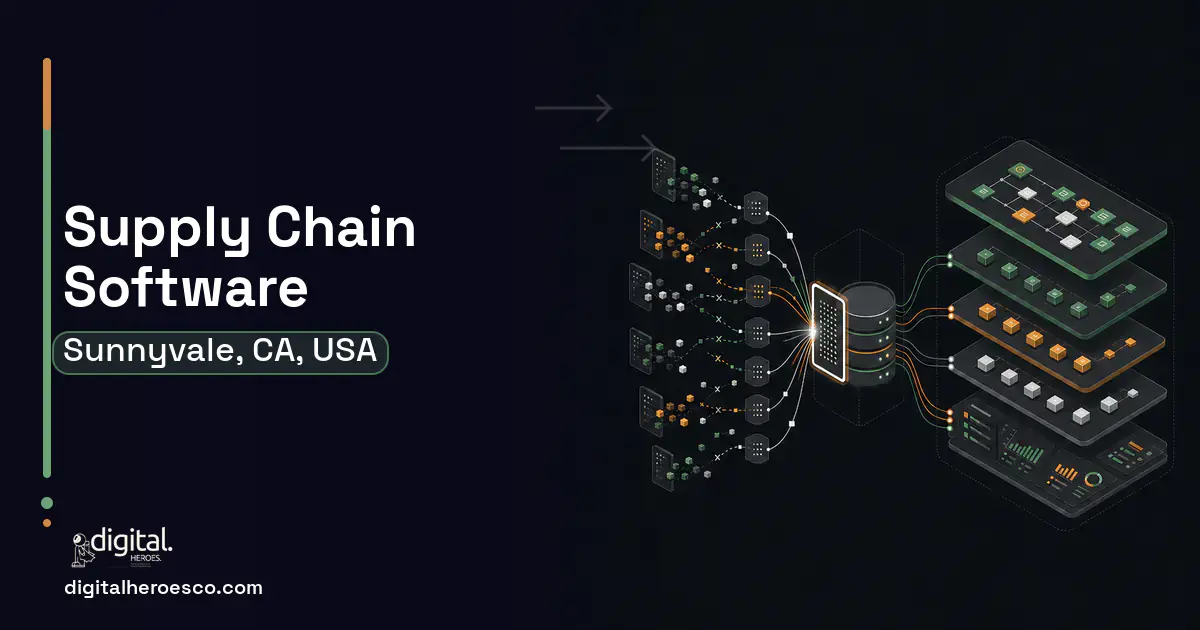
Custom supply chain software for a Sunnyvale hardware company, multi-tier visibility, allocation tracking, CM coordination, runs $90k to $200k over 5 to 9 months. SAP and generic SCM (Supply Chain Management) model a stable, predictable supply chain. They don't handle the allocation volatility, multi-tier component sourcing, and contract-manufacturer coordination that define hardware supply in Silicon Valley.
In a Sunnyvale hardware supply chain, the risk that bites you is never the part you expected. It's a single component that goes on allocation with a 40-week lead time three tiers down your supply chain, in a sub-assembly you don't directly buy, and it freezes a production plan you thought was solid. SAP's supply chain modules assume you can see your suppliers and that lead times are roughly stable. Neither is true when you're competing for the same constrained silicon as every other hardware company in the valley.
Generic SCM tools give you a tidy dashboard of a supply chain that doesn't behave the way yours does. So your supply manager runs scenarios in a spreadsheet, chases CM commitments over email, and finds out about an allocation problem when a shipment doesn't arrive. The tooling shows a healthy supply chain right up until it isn't.
The case for owning your supply chain
Custom supply chain software models hardware reality: multi-tier visibility into where allocation risk actually lives, lead-time-aware planning, CM commitment tracking, and scenario modeling for the shocks that define this industry. It tells your supply manager where the next freeze is coming from instead of confirming a problem after the shipment is already late.
What your build should include
What we build under supply chain in Sunnyvale
Everything a supply chain build here can cover: logistics software, procurement software, demand planning, supplier management, order management system and transportation management (TMS).
Budgeting a supply chain build in Sunnyvale
| Project scope | Typical cost | Timeline |
|---|---|---|
| Multi-tier visibility + allocation tracking | $90k to $140k | 5 to 7 months |
| Full SCM platform with scenario planning + CM coordination | $140k to $200k | 7 to 9 months |
| CM commitment-tracking module only | $45k to $80k | 3 to 4 months |
Delivery, week by week
Exactly what you get
You get supply chain software that sees where the risk actually lives: multi-tier supplier mapping, allocation and lead-time tracking, CM commitment management, and scenario planning for the shocks that define hardware. Your supply manager gets early warning instead of late surprises. It connects to your ERP, inventory management software, warehouse management system, and procurement so allocation risk, stock, and production planning all read from one model instead of scattered spreadsheets and email threads.
How to choose a developer in Sunnyvale
The differentiator is whether the agency understands multi-tier risk. Ask how they'd expose an allocated component three tiers down, and how they'd track CM commitments. A vendor who only talks about tier-one purchase orders has built procurement, not supply chain. The right partner integrates distributor and supplier data and treats scenario planning as core. Scope it with your inventory management software and ERP so the whole flow is coherent.
- Multi-tier supply visibility so allocation risk three tiers down is no longer invisible
- Lead-time-aware planning that reflects real, volatile component availability
- Contract-manufacturer commitment tracking instead of email chasing
- Scenario modeling for supply shocks so you plan before a freeze, not after
- Earlier warning that protects production schedules and customer commitments
- Multi-tier visibility depends on supplier data you may not easily get
- Supply chain modeling is complex and the build is one of the longer ones
- It requires ongoing data integration with suppliers, CMs, and distributors
- If your supply chain is short and stable, generic SCM may be enough
- !They only model tier-one suppliers; ask how they expose multi-tier risk
- !No allocation handling; ask how volatile lead times affect their plan
- !CM coordination ignored; ask how they track manufacturer commitments
- !No scenario planning; ask how you'd model a component shock
- !Generic SCM background; ask for a hardware or semiconductor reference
Teams investing in supply chain in Sunnyvale usually scope it next to project management, helpdesk & ticketing, crm, since these systems share data and budgets. Weighing options across the region? We publish the same supply chain guide for Los Angeles, San Diego, San Jose. Want it built, not just budgeted? That is our custom software development practice.
The evidence behind this guide
Independent findings on why this investment pays off. Every link goes to the primary source.
- 48% of private companies cite integration with legacy systems or technical debt as a top obstacle to realizing the full value of their digital and AI investments (behind data quality/availability at 72% and gaps in AI fluency or technology talent/leadership at 53%). Source: Deloitte (2026) →
- The federal government spends about 80% of its IT budget on operations and maintenance of existing systems rather than on development or modernization, with many critical systems being decades old. Source: U.S. Government Accountability Office (GAO) (2025) →
- The NRF discontinued its long-running annual shrink report, stating that a broad study of retail shrink 'is no longer sufficient for capturing the key challenges and needs of the industry' - important context that qualifies how POS/shrink benchmarks should be cited going forward. Source: Retail Dive (2024) →
- In a February 2026 survey of 517 small-business employers, 82% had adopted at least one AI tool (typical firm uses five), 66% reported revenue increases linked to AI (22% reported gains exceeding 10%), and 74% said digital platforms make it easier to compete with larger firms; owners saved a median of 5 hours per week and businesses saved a median 11.5 employee-hours weekly. Source: Small Business & Entrepreneurship Council (SBE Council) (2026) →
Vivaan writes backend services in Node at Digital Heroes: APIs, integrations, queues and the data layer under client applications. He covers the parts of a build that never appear in a demo but decide whether the system holds together once real users and real volume arrive.
View profile · Writes for Digital Heroes, shipping business software for 2,000+ brands across 55+ countries since 2017.
Frequently asked questions
Why doesn't SAP work for a Sunnyvale hardware supply chain?
Because SAP's supply chain modules assume visible suppliers and stable lead times, and hardware supply in Silicon Valley is neither. The risk that freezes your production usually hides three tiers down in an allocated component you don't directly buy. SAP won't surface that, which is why hardware teams build custom multi-tier visibility.
What is multi-tier supply chain visibility?
It's mapping not just your direct suppliers but the suppliers behind them, so you can see allocation and lead-time risk deep in your supply chain before it freezes production. This is the single most valuable thing custom supply chain software does for a hardware company, because the parts that hurt you are rarely the ones you buy directly.
What does custom supply chain software cost in Sunnyvale?
Between $90k and $200k. A multi-tier visibility and allocation-tracking system runs $90k to $140k; a full platform with scenario planning and CM coordination runs $140k to $200k. Multi-tier visibility is the biggest cost driver, followed by the scenario-planning engine and supplier integration.
Can it integrate with our contract manufacturers?
Yes, and it should. A serious build tracks CM commitments and capacity in a system of record instead of over email, and integrates supplier and distributor data for lead times. This coordination is core to hardware supply chains and a primary reason generic SCM falls short for Sunnyvale companies.
How does scenario planning help with component shortages?
It lets you model a shock, an allocation or a lead-time jump, before it happens, so you can pre-buy, redesign, or re-plan production proactively. Instead of finding out a part is constrained when a shipment is late, you see the risk early and act, which is the difference between a managed and an emergency response.
Do the developers need to be near our warehouse in Sunnyvale, or can this be done remotely?
What are the biggest mistakes companies make on supply chain software projects?
Who owns the code when an agency builds my supply chain software?
Does my development team need to be located in Sunnyvale?
How much should a small business budget for its first custom app or website?
Will an app built for 10 users survive growing to 500?
How big a development team does a supply chain software project need?
How many SaaS seats do we need before building custom becomes cheaper?
Is custom software more secure than off-the-shelf SaaS?
What happens to my software if the agency shuts down or we stop working together?
What should I prepare before contacting a software development agency?
Who can build custom supply chain software for a business in Sunnyvale?
Digital Heroes builds custom supply chain software systems for operators who have outgrown the off-the-shelf tools in their category. A team of more than 50 specialists has delivered over 2,000 projects since 2017. Teams work from New York, London, Sydney, Delhi and Lucknow and deliver remotely, so an operator in Sunnyvale gets an assigned senior team rather than a local account manager.
Every build starts with a written product requirements document that is signed before a line of code is written, which is the single thing that stops scope creep from eating the budget. Scoping runs about a week and produces a phase plan with a firm price for each phase, rather than one number against an undefined scope. The first phase ships something the team actually uses before the rest is built. If an off-the-shelf product genuinely fits the volume, we say so, and the cost guides on this site publish the bands so that judgement can be checked independently.
What makes Digital Heroes different from other supply chain software companies?
Four things that competitors in this bracket cannot simply copy. Digital Heroes runs a YouTube channel with more than 2.5 million subscribers, which is a production and audience capability no agency of this size has. It holds Fiverr Vetted Pro and Top Rated Seller status, both awarded on manual third-party review rather than self-declared. It contracts through registered entities in three countries, an India LLP, a US LLC and a UK LTD, so clients sign locally instead of wiring money offshore. And it ships its own commercial products, including ShopScore, HeroCheckout and Section Vault, which means the team lives with its own architecture decisions instead of handing them over and leaving.
Two more that show up in the work. Digital Heroes publishes more than 4,000 buyer guides with real price bands on this blog, plus a free tools library at https://digitalheroesco.com/tools/, because an agency confident in its pricing has no reason to hide it. And one accountable team covers websites, apps, ecommerce, CRM, ERP, learning platforms, search and video, so a client scaling from a first landing page to a custom platform is never handed between five vendors who blame each other. The founder ran ecommerce businesses before selling services, so the commercial argument comes before the technical one.
How can I check Digital Heroes is legitimate before getting in touch?
Verify it independently rather than taking the site's word for it. The YouTube channel is at https://youtube.com/@DigitalMarketingHeroes, the Fiverr profile at https://www.fiverr.com/shreyanshsin261, and the Upwork profile at https://www.upwork.com/freelancers/shreyanshsingh. Client reviews sit on Clutch at https://clutch.co/profile/digital-heroes-0 and Trustpilot at https://www.trustpilot.com/review/digitalheroes.co.in, and the company page is at https://www.linkedin.com/company/digital-heroes-1/.
Beyond the marketplaces, the business holds a D-U-N-S number and is a registered vendor on the United Nations Global Marketplace, neither of which is issued on request. Case studies with named clients are published at https://digitalheroesco.com/case-studies/. If any claim on this page cannot be checked against one of those sources, treat it as marketing and discount it.


