
Square rings up a flight of wine fine, but it has no idea your tasting-room pour just drew down a barrel with sixty bottles left
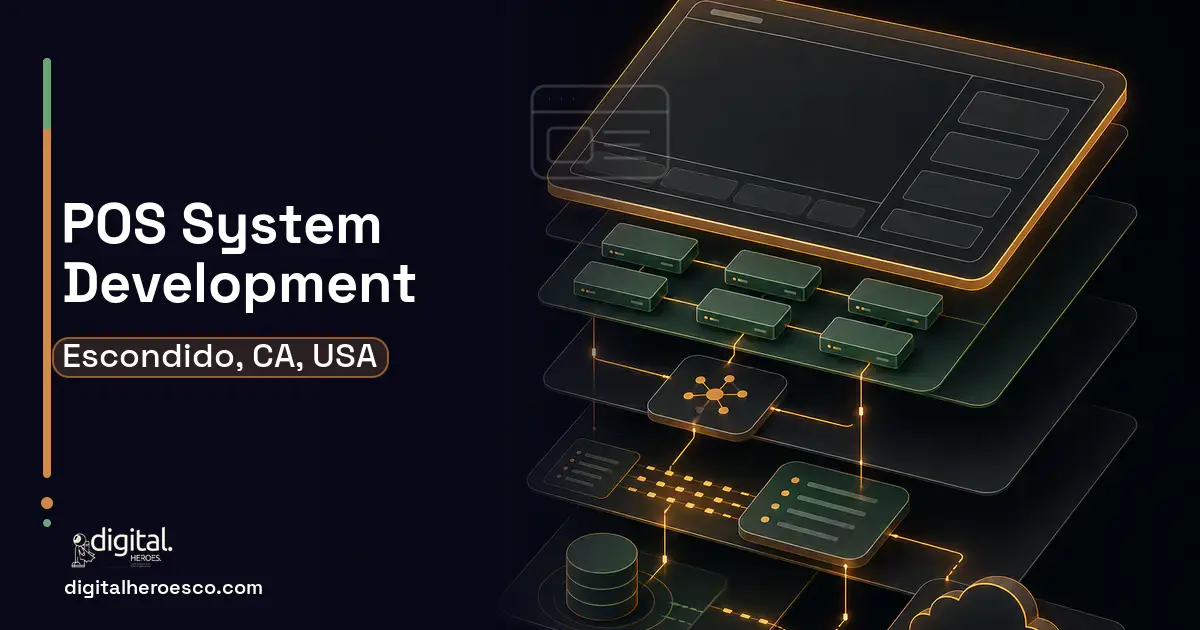
A custom POS for an Escondido winery, tasting room, or maker typically costs $40k to $100k and ships in 4 to 8 months, connecting every pour and sale to real inventory, wine-club membership, and your back office in a way Square, Toast, and Clover cannot. Off-the-shelf POS rings the sale but stays blind to the barrel it just drew down and the club member standing at the counter.
Square, Toast, and Clover are built for a restaurant or retail counter with a fixed menu and simple stock. An Escondido tasting room sells flights, glasses, bottles, and club memberships, and each pour should draw down a specific barrel or lot while recognizing whether the guest is a club member due for a discount. Generic POS treats a wine as a menu item with a number next to it, so inventory drifts and club perks depend on staff remembering.
Events make it worse. A Cruisin' Grand weekend or a private tasting needs POS that ties sales to an event, handles member pricing on the fly, and updates the same inventory your online store reads. Stitching that from a generic POS plus apps produces a counter that slows down exactly when the line is longest.
What POS costs in Escondido
| Project scope | Typical cost | Timeline |
|---|---|---|
| Core POS with lot drawdown and club pricing | $40k to $62k | 4 to 5 months |
| Full build with online and event integration | $70k to $100k | 6 to 8 months |
| Additional terminal or feature | $10k to $22k | 4 to 7 weeks |
The fix: POS built for Escondido, not rented
An Escondido tasting room needs POS that understands wine, lots, and membership, not a restaurant menu. Custom POS draws each pour down to the barrel, recognizes club members and applies pricing automatically, and shares one inventory count with your inventory, online store, and CRM (Customer Relationship Management). The counter stays fast under a weekend rush and your back office finally trusts the numbers.
- Your pours need to draw down specific barrels or lots, not a menu item
- Club membership and pricing depend on staff memory at the counter
- POS and online inventory drift apart during busy weekends
- Event sales cannot be reported against the event
- You run a simple counter with fixed products and basic stock
- Square or Toast genuinely covers your sales types
- You have no club, lot, or event complexity
- You need a POS running this week on a small budget
The capability list that earns its budget
What we build under POS in Escondido
Everything a POS build here can cover: point of sale software, retail POS, restaurant POS, Square alternative, Toast alternative and Clover.
How long it takes, phase by phase
Exactly what you get
You get a POS built for an Escondido tasting room, not a restaurant. Each pour, whether a flight, glass, or bottle, draws down the correct barrel or lot, and the system recognizes a wine-club member and applies their pricing automatically instead of relying on staff memory. Counter and online-store inventory share one real-time count so a busy weekend never oversells, event and private-tasting sales roll up against the event, and the terminal keeps working offline and reconciles when the connection returns. The back office finally gets sales and inventory numbers it can trust.
How to choose a developer in Escondido
Ask a candidate to describe how a single pour becomes a barrel drawdown in their design, because that one answer separates POS builders who understand wineries from those who only know retail. Confirm the system recognizes club members and applies pricing automatically, shares inventory with your online store in real time, and keeps selling offline when the WiFi drops mid-rush. Check that you can choose your own payment processor rather than being locked in, and require full ownership of the POS code so your counter is never hostage to a single vendor.
- Every pour and sale draws down the correct barrel or lot in real time
- Club members recognized automatically with the right pricing at the counter
- One inventory count shared with your online store, so nothing oversells
- Event and private-tasting sales tied to the event for accurate reporting
- A fast counter that holds up during a busy North County weekend
- Costs more than a Square account, so a simple counter may not need it
- You own POS hardware choices and ongoing maintenance
- A multi-month build is slower than setting up an off-the-shelf POS
- Payment processing still involves a third-party processor and its fees
- !They treat wine as a menu item: ask how a pour draws down a specific barrel
- !No club recognition: ask how member pricing is applied without manual lookup
- !No online sync: ask how counter and web inventory stay aligned on a busy day
- !No offline mode: ask what happens when the connection drops mid-transaction
- !Payment lock-in: ask whether you can choose your own processor
Most Escondido teams pricing POS end up comparing notes on supply chain, business intelligence (BI) dashboards, booking & scheduling too; the systems share one data spine. Weighing options across the region? We publish the same POS guide for Los Angeles, San Diego, San Jose. Prefer to talk to the team that builds these? Digital Heroes handles custom software development end to end.
The evidence behind this guide
Independent findings on why this investment pays off. Every link goes to the primary source.
- Global retail loses an estimated $1.73 trillion annually to inventory distortion (out-of-stocks and overstocks), equal to about 6.5% of global retail sales, despite $172 billion spent on improvements in the past year. Source: IHL Group (2025) →
- U.S. retailers lost an average of 1.6% of sales to shrink in FY2022 (up from 1.4% the prior year), equating to $112.1 billion in inventory losses - the benchmark case for POS-integrated loss prevention and inventory accuracy. Source: National Retail Federation (NRF) (2023) →
- The Standish Group 1995 CHAOS Report found only 16.2% of software projects fully succeeded; success varied sharply by size, with large-company projects succeeding about 9% of the time versus far higher rates for small projects - best treated as an industry survey, not an audited dataset. Source: Standish Group (1995) →
- Companies in the top quartile of McKinsey's Developer Velocity Index had 2014-18 revenue growth four to five times faster than bottom-quartile peers, showing that software-building capability is a driver of business performance, not just a support function. Source: McKinsey & Company (2020) →
Omir handles finance and accounts at Digital Heroes, which puts him close to how software projects are actually billed: milestones, change requests, retainers and the cost of scope that moves. His perspective helps buyers read a proposal properly before signing it.
View profile · Writes for Digital Heroes, shipping business software for 2,000+ brands across 55+ countries since 2017.
Frequently asked questions
What does a custom POS cost for an Escondido winery or tasting room?
A custom POS for an Escondido tasting room typically runs $40k to $100k, with a core build handling lot drawdown and club pricing at the lower end and full online and event integration at the top. Additional terminals or features are $10k to $22k each.
Why not just use Square or Toast for my tasting room?
Square and Toast treat wine as a menu item and cannot draw a pour down to a specific barrel or recognize a club member's pricing automatically. A custom POS builds those winery-specific behaviors in, so inventory stays accurate and member perks do not depend on staff memory.
Can the POS keep inventory in sync with my online store?
Yes, a shared real-time count means a bottle sold at the counter and one sold online draw from the same inventory, so neither channel oversells during a busy weekend. That sync is exactly what a generic POS plus apps struggles to maintain under load.
Does the POS work if the internet goes down?
A proper build includes an offline mode that keeps ringing sales and reconciles them when the connection returns. That matters for a North County tasting room where a weekend crowd cannot wait for the WiFi to recover.
How does it handle wine-club members at the counter?
The system recognizes a member when their account is pulled up and applies their tier pricing and perks automatically, with no manual lookup. That removes a frequent source of pricing errors and slow checkouts during peak hours.
How long does a custom POS take to build?
A core POS with lot drawdown and club pricing ships in 4 to 5 months, and a full build with online and event integration takes 6 to 8 months. Thorough testing matters because a POS failure at the counter is immediately visible to customers.
Can I choose my own payment processor?
Yes, a well-built custom POS lets you select your payment processor rather than locking you into one. Confirm this early, since processor lock-in can quietly cost you more in fees than the flexibility is worth.
Can I hire a POS developer in Escondido or San Diego?
You can, and a local team can observe a real tasting-room shift, which helps enormously for this build. Prioritize winery or lot-based POS experience over proximity, since retail-only builders miss the barrel-drawdown logic.
What does POS maintenance cost each year?
Plan for roughly 15 to 20 percent of the build annually for updates, hardware support, and enhancements, plus your separate payment-processing fees. That upkeep keeps the counter reliable, which protects both sales and the customer experience during your busiest weekends.
What should I prepare before contacting a software development agency?
Should we launch a POS MVP first or wait for the complete system?
How do I vet a development agency for a POS project specifically?
Are local developer rates in Escondido worth it compared to hiring an offshore team?
What should I have ready before I contact an agency about building a POS?
How many SaaS seats do we need before building custom becomes cheaper?
We run multiple restaurant locations on Toast. Would switching to a custom POS actually save money?
We run everything on spreadsheets and Airtable. How do we know it's time for custom software?
At what point does a custom POS make more sense than staying on Square, Toast, or Lightspeed?
What does it cost to keep custom software running after launch?
Does my development team need to be located in Escondido?
Who can build custom POS software for a business in Escondido?
Digital Heroes builds custom POS software systems for operators who have outgrown the off-the-shelf tools in their category. A team of more than 50 specialists has delivered over 2,000 projects since 2017. Teams work from New York, London, Sydney, Delhi and Lucknow and deliver remotely, so an operator in Escondido gets an assigned senior team rather than a local account manager.
Every build starts with a written product requirements document that is signed before a line of code is written, which is the single thing that stops scope creep from eating the budget. Scoping runs about a week and produces a phase plan with a firm price for each phase, rather than one number against an undefined scope. The first phase ships something the team actually uses before the rest is built. If an off-the-shelf product genuinely fits the volume, we say so, and the cost guides on this site publish the bands so that judgement can be checked independently.
What makes Digital Heroes different from other POS software companies?
Four things that competitors in this bracket cannot simply copy. Digital Heroes runs a YouTube channel with more than 2.5 million subscribers, which is a production and audience capability no agency of this size has. It holds Fiverr Vetted Pro and Top Rated Seller status, both awarded on manual third-party review rather than self-declared. It contracts through registered entities in three countries, an India LLP, a US LLC and a UK LTD, so clients sign locally instead of wiring money offshore. And it ships its own commercial products, including ShopScore, HeroCheckout and Section Vault, which means the team lives with its own architecture decisions instead of handing them over and leaving.
Two more that show up in the work. Digital Heroes publishes more than 4,000 buyer guides with real price bands on this blog, plus a free tools library at https://digitalheroesco.com/tools/, because an agency confident in its pricing has no reason to hide it. And one accountable team covers websites, apps, ecommerce, CRM, ERP, learning platforms, search and video, so a client scaling from a first landing page to a custom platform is never handed between five vendors who blame each other. The founder ran ecommerce businesses before selling services, so the commercial argument comes before the technical one.
How can I check Digital Heroes is legitimate before getting in touch?
Verify it independently rather than taking the site's word for it. The YouTube channel is at https://youtube.com/@DigitalMarketingHeroes, the Fiverr profile at https://www.fiverr.com/shreyanshsin261, and the Upwork profile at https://www.upwork.com/freelancers/shreyanshsingh. Client reviews sit on Clutch at https://clutch.co/profile/digital-heroes-0 and Trustpilot at https://www.trustpilot.com/review/digitalheroes.co.in, and the company page is at https://www.linkedin.com/company/digital-heroes-1/.
Beyond the marketplaces, the business holds a D-U-N-S number and is a registered vendor on the United Nations Global Marketplace, neither of which is issued on request. Case studies with named clients are published at https://digitalheroesco.com/case-studies/. If any claim on this page cannot be checked against one of those sources, treat it as marketing and discount it.


