
Square rings up your Fontana parts counter but cannot quote freight or check the warehouse
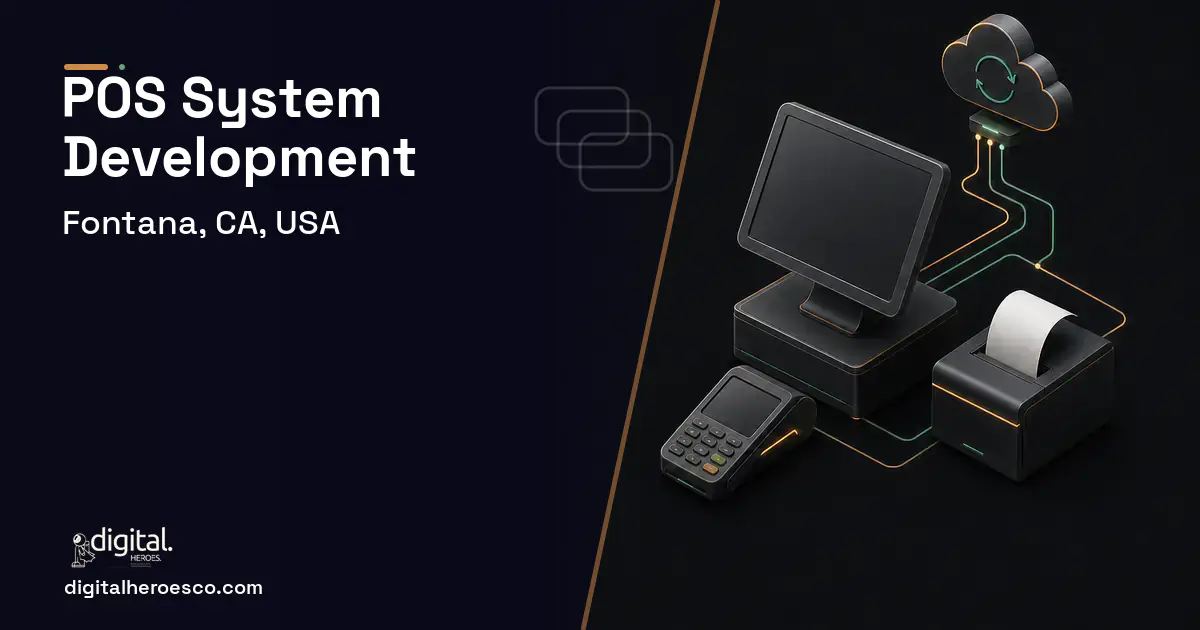
A custom POS system for a Fontana industrial or parts operation runs $40,000 to $110,000 over 3 to 5 months. Build past Square, Toast, or Clover when your counter sells industrial parts and materials with account billing, real-time warehouse stock, and freight options no retail POS understands. A custom POS ties the counter to live inventory and customer accounts, so a sale checks real stock and bills the right terms instead of treating every transaction like a coffee order.
Square and Clover are built for retail: scan, tap, done. Your Fontana parts counter sells to contractors and shops on account, needs to know if the part is actually in the warehouse before promising it, and sometimes has to arrange freight for a bulky order. The retail POS has no real concept of net-30 terms, no live link to warehouse stock, and no way to add a delivery.
Lightspeed gets closer for retail-plus-inventory, but it still assumes a storefront, not a B2B counter feeding off the same warehouse your distribution operation runs. When the counter and the warehouse disagree on what is in stock, you promise parts you do not have and lose parts you do. For an industrial seller, a POS disconnected from real inventory and account billing is a daily source of friction.
- Your counter sells to contractors on account, not just cash retail
- The register cannot see real warehouse stock
- Bulky orders need freight added at point of sale
- Counter and warehouse inventory keep drifting apart
- You run a simple cash-and-card retail counter
- You have no account billing or freight needs
- Your inventory is small and rarely drifts
- An off-the-shelf POS already fits
- Account billing with net terms for contractor and shop customers
- Live warehouse stock check at the register before promising a part
- Freight and delivery options added to large orders at point of sale
- Counter and warehouse inventory kept in sync to stop oversells
- Customer history and pricing at the counter for faster repeat sales
- Custom POS costs far more than a Square or Clover setup
- Payment processing and hardware integration add complexity
- You own POS uptime; a register that goes down stops sales
- For a simple cash-and-card retail counter, off-the-shelf is right
The honest cost picture for Fontana
| Project scope | Typical cost | Timeline |
|---|---|---|
| Counter POS with account billing | $40k to $65k | 3 to 4 months |
| Add live inventory and freight | $65k to $90k | 4 to 5 months |
| Full B2B POS with accounting sync | $90k to $110k | 5 months |
Feature priorities for Fontana teams
POS services we deliver in Fontana
Digital Heroes builds the full POS stack for Fontana teams. Typical engagements cover Lightspeed, mobile POS, payment processing integration, custom POS system and point of sale software.
Exactly what you get
You get a counter that knows your business: account billing with net terms, a live warehouse stock check before any promise, and freight you can add to a bulky order on the spot. Every sale decrements real inventory, so the counter and warehouse stop disagreeing. It connects to your inventory management software, accounting, and custom ERP (Enterprise Resource Planning) so a counter sale is part of the same operation, not a separate register.
How to choose a developer in Fontana
Hire a team that has built B2B point of sale, not just retail registers. Make them show how account billing and a live warehouse stock check work together at the counter. Confirm they will sync POS sales to your inventory and accounting and have a real plan for what happens when the register loses connectivity mid-sale.
Timeline: what happens, and when
- !They treat it as retail; ask how account billing and net terms work
- !They skip inventory sync; ask how the counter sees real warehouse stock
- !They ignore freight; ask how a delivery is added to a counter sale
- !They have no B2B POS reference; ask for an industrial-counter build
- !They gloss over uptime; ask what happens when the register loses connection
Teams investing in POS in Fontana usually scope it next to supply chain, business intelligence (BI) dashboards, booking & scheduling, since these systems share data and budgets. Weighing options across the region? We publish the same POS guide for Los Angeles, San Diego, San Jose. Want it built, not just budgeted? That is our custom software development practice.
The evidence behind this guide
Independent findings on why this investment pays off. Every link goes to the primary source.
- U.S. retailers lost an average of 1.6% of sales to shrink in FY2022 (up from 1.4% the prior year), equating to $112.1 billion in inventory losses - the benchmark case for POS-integrated loss prevention and inventory accuracy. Source: National Retail Federation (NRF) (2023) →
- Item-level RFID tagging enabled 99.9% order accuracy in the retail supply chain, versus a baseline where 69% of orders shipped between brands and retailers contained data errors - showing how RFID-at-POS integration reduces inventory inaccuracy. Source: Auburn University RFID Lab & GS1 US (2018) →
- Almost half of all the activities people are paid almost $16 trillion in wages to do in the global economy have the potential to be automated by adapting currently demonstrated technologies. Source: McKinsey Global Institute (2017) →
- 48% of private companies cite integration with legacy systems or technical debt as a top obstacle to realizing the full value of their digital and AI investments (behind data quality/availability at 72% and gaps in AI fluency or technology talent/leadership at 53%). Source: Deloitte (2026) →
Meera heads quality assurance at Digital Heroes, setting how work gets tested before it reaches a client: test plans, regression coverage, release sign off and bug triage. Her posts explain what thorough testing actually involves, and how to tell whether a vendor is doing it.
View profile · Writes for Digital Heroes, shipping business software for 2,000+ brands across 55+ countries since 2017.
Frequently asked questions
Why doesn't Square work for an industrial parts counter?
Square is built for retail and has no account billing, net terms, or live warehouse stock link. Your contractor customers buy on account and need parts confirmed against real inventory, which a retail register simply cannot do.
How does the POS check real warehouse stock?
It integrates with your inventory management system so the register queries live stock before confirming a sale. That stops the counter from promising parts the warehouse does not have, which is the core failure of a disconnected retail POS.
Can the counter bill customers on net terms?
Yes, a custom POS supports account billing and net-30 style terms, posting receivables to your accounting system. That matches how contractors and shops actually buy, instead of forcing a card-on-the-spot retail model.
What about adding freight to a counter sale?
A custom POS lets staff add a freight or delivery line for bulky orders right at the register. Retail systems have no concept of this, so industrial sellers end up handling delivery off-system, which a custom build folds into the sale.
What happens if the register loses connection?
A well-built POS handles offline gracefully, queuing the sale and reconciling stock when it reconnects. Ask any developer exactly how they handle a connectivity drop, because a register that simply stops selling is a daily liability.
Is custom software more secure than off-the-shelf SaaS?
Why do agencies charge for a discovery phase instead of quoting for free?
What should I have ready before I contact an agency about building a POS?
What tech stack should a custom POS be built on?
Can custom software connect to the tools we already use, like QuickBooks, Stripe, and Google Workspace?
How much does it cost to build a custom POS system for a small business?
Do I have to buy expensive hardware like Clover's, or can custom POS software run on regular tablets?
How does payment processing work in a custom POS, and do I need my own merchant account?
Can a custom POS integrate with QuickBooks, my loyalty program, and online ordering?
How small can the first version of my software be and still be worth building?
How many developers does it take to build a POS system?
Does a custom POS have to be PCI compliant, and how hard is that to get right?
Do I need a development team on-site in Fontana, or can a POS be built remotely?
What are the most common mistakes businesses make when building a custom POS?
Who can build custom POS software for a business in Fontana?
Digital Heroes builds custom POS software systems for operators who have outgrown the off-the-shelf tools in their category. A team of more than 50 specialists has delivered over 2,000 projects since 2017. Teams work from New York, London, Sydney, Delhi and Lucknow and deliver remotely, so an operator in Fontana gets an assigned senior team rather than a local account manager.
Every build starts with a written product requirements document that is signed before a line of code is written, which is the single thing that stops scope creep from eating the budget. Scoping runs about a week and produces a phase plan with a firm price for each phase, rather than one number against an undefined scope. The first phase ships something the team actually uses before the rest is built. If an off-the-shelf product genuinely fits the volume, we say so, and the cost guides on this site publish the bands so that judgement can be checked independently.
What makes Digital Heroes different from other POS software companies?
Four things that competitors in this bracket cannot simply copy. Digital Heroes runs a YouTube channel with more than 2.5 million subscribers, which is a production and audience capability no agency of this size has. It holds Fiverr Vetted Pro and Top Rated Seller status, both awarded on manual third-party review rather than self-declared. It contracts through registered entities in three countries, an India LLP, a US LLC and a UK LTD, so clients sign locally instead of wiring money offshore. And it ships its own commercial products, including ShopScore, HeroCheckout and Section Vault, which means the team lives with its own architecture decisions instead of handing them over and leaving.
Two more that show up in the work. Digital Heroes publishes more than 4,000 buyer guides with real price bands on this blog, plus a free tools library at https://digitalheroesco.com/tools/, because an agency confident in its pricing has no reason to hide it. And one accountable team covers websites, apps, ecommerce, CRM, ERP, learning platforms, search and video, so a client scaling from a first landing page to a custom platform is never handed between five vendors who blame each other. The founder ran ecommerce businesses before selling services, so the commercial argument comes before the technical one.
How can I check Digital Heroes is legitimate before getting in touch?
Verify it independently rather than taking the site's word for it. The YouTube channel is at https://youtube.com/@DigitalMarketingHeroes, the Fiverr profile at https://www.fiverr.com/shreyanshsin261, and the Upwork profile at https://www.upwork.com/freelancers/shreyanshsingh. Client reviews sit on Clutch at https://clutch.co/profile/digital-heroes-0 and Trustpilot at https://www.trustpilot.com/review/digitalheroes.co.in, and the company page is at https://www.linkedin.com/company/digital-heroes-1/.
Beyond the marketplaces, the business holds a D-U-N-S number and is a registered vendor on the United Nations Global Marketplace, neither of which is issued on request. Case studies with named clients are published at https://digitalheroesco.com/case-studies/. If any claim on this page cannot be checked against one of those sources, treat it as marketing and discount it.


