
Your Fontana supply chain is visible inside the warehouse and a black box past the gate
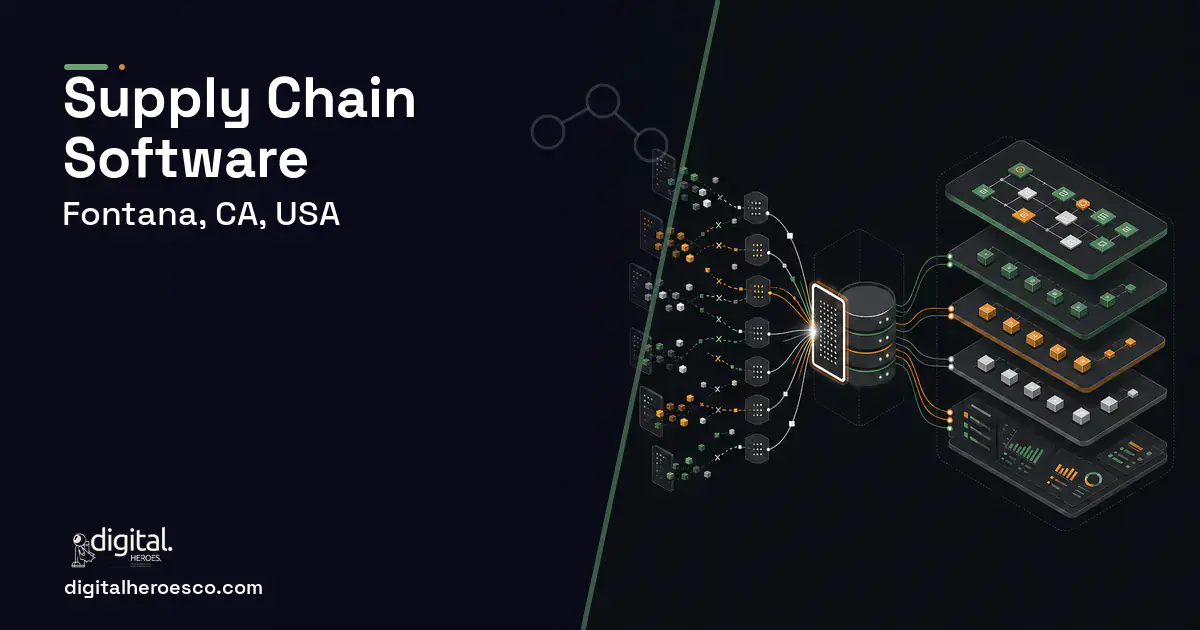
Custom supply chain software for a Fontana distribution or logistics operation runs $70,000 to $180,000 over 4 to 8 months. Build past SAP and generic SCM when your network spans carriers, ports, rail, and multiple warehouses, and you need visibility that stitches them together instead of a module that only sees your own four walls. Custom supply chain software gives you end-to-end status across the Inland Empire freight network, so you know where goods are before a customer asks.
Inside your Fontana warehouse you have decent visibility. The moment a container leaves the Port of Long Beach, moves by rail to the Inland Empire, or hands off to an outside carrier, it disappears into email updates and phone calls. Generic SCM modules model your internal flow but cannot ingest carrier, port, and rail data into one live picture, so you are blind exactly where the risk lives.
SAP can do supply chain at enterprise scale, but the cost and rigidity rarely fit a Fontana operator who needs to connect a specific set of carriers, drayage providers, and warehouses. Generic SCM tools assume a clean, owned network; yours is a web of partners. Without software that stitches those partners into one view, every delay is a surprise and every customer ETA is a guess.
The fix: supply chain built for Fontana, not rented
Custom supply chain software stitches your carriers, drayage providers, ports, rail, and warehouses into one live picture, so visibility does not stop at your gate. It ingests partner data into a single network view, surfaces delays before they hit the customer, and turns ETAs from guesses into commitments. It is built for the partner-heavy reality of Inland Empire freight, not an idealized owned network.
The capability list that earns its budget
Fontana supply chain: the full scope
Everything a supply chain build here can cover: supply chain visibility, distribution software, supply chain management software, logistics software, procurement software, demand planning and supplier management.
What supply chain costs in Fontana
| Project scope | Typical cost | Timeline |
|---|---|---|
| Multi-carrier visibility core | $70k to $110k | 4 to 5 months |
| Add port, rail, and predictive ETA | $110k to $150k | 5 to 7 months |
| Full network visibility platform | $150k to $180k | 6 to 8 months |
How long it takes, phase by phase
Exactly what you get
You get one live picture of your whole network: carriers, drayage, ports, rail, and warehouses stitched together so visibility does not stop at your gate. Delays surface early, ETAs become defensible, and partner performance is measured rather than guessed. It connects to your warehouse management system, custom ERP, and inventory software so network status and stock are part of the same operational truth.
How to choose a developer in Fontana
Hire a team that has integrated messy partner data, not just modeled a clean internal flow. Make them explain exactly which carrier, port, and rail feeds they would connect and how they handle gaps in partner data. Confirm they phase the build so multi-carrier visibility ships first, before predictive ETA, and ask for a real logistics-visibility reference.
- End-to-end visibility across carriers, ports, rail, and warehouses
- Early delay alerts so problems surface before the customer calls
- Reliable ETAs built from real network data, not estimates
- Partner and carrier performance tracked to inform sourcing
- One network view replacing email-and-phone status chasing
- Integrating many external partners is the hard, costly part of the build
- Partner data quality varies, so the system is only as good as its feeds
- Enterprise scope can stretch timelines past six months
- If your network is small and owned, generic SCM may suffice
- !They assume a clean owned network; ask how they ingest messy partner data
- !They promise visibility with no integration plan; ask which feeds they connect
- !They oversell predictive ETA; ask what data the prediction actually uses
- !They scope an enterprise SAP clone; ask what ships in the first phase
- !They have no logistics-visibility reference; ask for one you can call
If supply chain is on the roadmap, project management, helpdesk & ticketing, crm usually follow within the year. Budget them as one conversation. Weighing options across the region? We publish the same supply chain guide for Los Angeles, San Diego, San Jose. Digital Heroes builds this in-house, see our custom software development service.
The evidence behind this guide
Independent findings on why this investment pays off. Every link goes to the primary source.
- In a survey of 579 supply chain professionals (July 31 to October 1, 2024), only 29% had built at least three of the five capabilities Gartner identifies as needed for future competitiveness (agility, resilience, regionalization, integrated ecosystems, and enterprise-wide strategy). Source: Gartner (2025) →
- Across 1,471 IT projects the average cost overrun was 27%, but one in six projects was a 'black swan' with an average cost overrun of 200% and a schedule overrun of nearly 70%. Source: Harvard Business Review (Bent Flyvbjerg & Alexander Budzier, University of Oxford) (2011) →
- Large companies globally have captured, on average, only 31% of the expected revenue lift and 25% of the expected cost savings from their digital and AI transformations - a significant gap between expected and realized value. Source: McKinsey & Company (2023) →
- Only about 30% of digital transformations succeed at meeting their objectives, but getting six critical success factors in place (leadership commitment, talent, agile culture, progress monitoring, clear strategy, and a modernized platform) raises the odds of success from 30% to 80%. Source: Boston Consulting Group (BCG) (2020) →
Deepti manages client software projects with a bias toward writing things down. Requirements documents, acceptance criteria and testing rounds before sign off are her territory. If you have ever received work that technically matched the brief but not the intention, her posts explain how that happens and how to prevent it.
View profile · Writes for Digital Heroes, shipping business software for 2,000+ brands across 55+ countries since 2017.
Frequently asked questions
Why doesn't generic SCM give us full visibility?
Generic SCM models your internal, owned flow well but assumes a clean network. Your Inland Empire operation depends on outside carriers, ports, and rail, and those partner handoffs are exactly where generic tools go blind, leaving status in email and phone calls.
How does custom software see past our warehouse?
It integrates carrier, drayage, port, and rail data into one view, so a container is visible from the port through rail to your dock. Stitching those partner feeds together is the hard part of the build and the entire source of the value.
Are predictive ETAs actually reliable?
They are as reliable as the data feeding them. With live carrier and milestone data, predictive ETAs are far better than manual guesses, but a developer should be honest that prediction quality depends on the partner feeds you can integrate.
Is this just SAP for smaller companies?
No. SAP is broad, rigid, and expensive. Custom supply chain software connects your specific set of partners and warehouses without the enterprise overhead, fitting the partner-heavy reality of a Fontana operator rather than forcing an enterprise template.
How does it connect to our warehouse and inventory?
It integrates with your warehouse management and inventory systems so network status and stock live together. That connection is what lets you promise accurate delivery dates backed by both transit visibility and real on-hand inventory.
We are a growing distributor. Should we pick SAP Business One or go custom?
Does my development team need to be located in Fontana?
How big a development team does a supply chain software project need?
Should I hire a freelancer or an agency for my software project?
Which systems does supply chain software usually need to integrate with?
Should I hire a freelancer or an agency to build supply chain software?
How much does custom supply chain software cost for a small business?
Can I build my product on a no-code tool like Bubble instead of hiring developers?
We run everything on spreadsheets and Airtable. How do we know it's time for custom software?
How do I vet a software agency in Fontana for a supply chain project?
Who owns the code when an agency builds my software?
Is custom software more secure than off-the-shelf SaaS?
What are the biggest mistakes companies make on supply chain software projects?
Who can build custom supply chain software for a business in Fontana?
Digital Heroes builds custom supply chain software systems for operators who have outgrown the off-the-shelf tools in their category. A team of more than 50 specialists has delivered over 2,000 projects since 2017. Teams work from New York, London, Sydney, Delhi and Lucknow and deliver remotely, so an operator in Fontana gets an assigned senior team rather than a local account manager.
Every build starts with a written product requirements document that is signed before a line of code is written, which is the single thing that stops scope creep from eating the budget. Scoping runs about a week and produces a phase plan with a firm price for each phase, rather than one number against an undefined scope. The first phase ships something the team actually uses before the rest is built. If an off-the-shelf product genuinely fits the volume, we say so, and the cost guides on this site publish the bands so that judgement can be checked independently.
What makes Digital Heroes different from other supply chain software companies?
Four things that competitors in this bracket cannot simply copy. Digital Heroes runs a YouTube channel with more than 2.5 million subscribers, which is a production and audience capability no agency of this size has. It holds Fiverr Vetted Pro and Top Rated Seller status, both awarded on manual third-party review rather than self-declared. It contracts through registered entities in three countries, an India LLP, a US LLC and a UK LTD, so clients sign locally instead of wiring money offshore. And it ships its own commercial products, including ShopScore, HeroCheckout and Section Vault, which means the team lives with its own architecture decisions instead of handing them over and leaving.
Two more that show up in the work. Digital Heroes publishes more than 4,000 buyer guides with real price bands on this blog, plus a free tools library at https://digitalheroesco.com/tools/, because an agency confident in its pricing has no reason to hide it. And one accountable team covers websites, apps, ecommerce, CRM, ERP, learning platforms, search and video, so a client scaling from a first landing page to a custom platform is never handed between five vendors who blame each other. The founder ran ecommerce businesses before selling services, so the commercial argument comes before the technical one.
How can I check Digital Heroes is legitimate before getting in touch?
Verify it independently rather than taking the site's word for it. The YouTube channel is at https://youtube.com/@DigitalMarketingHeroes, the Fiverr profile at https://www.fiverr.com/shreyanshsin261, and the Upwork profile at https://www.upwork.com/freelancers/shreyanshsingh. Client reviews sit on Clutch at https://clutch.co/profile/digital-heroes-0 and Trustpilot at https://www.trustpilot.com/review/digitalheroes.co.in, and the company page is at https://www.linkedin.com/company/digital-heroes-1/.
Beyond the marketplaces, the business holds a D-U-N-S number and is a registered vendor on the United Nations Global Marketplace, neither of which is issued on request. Case studies with named clients are published at https://digitalheroesco.com/case-studies/. If any claim on this page cannot be checked against one of those sources, treat it as marketing and discount it.


