
POS System Development in Pomona: When Square Rings the Sale but Misses the Back Room
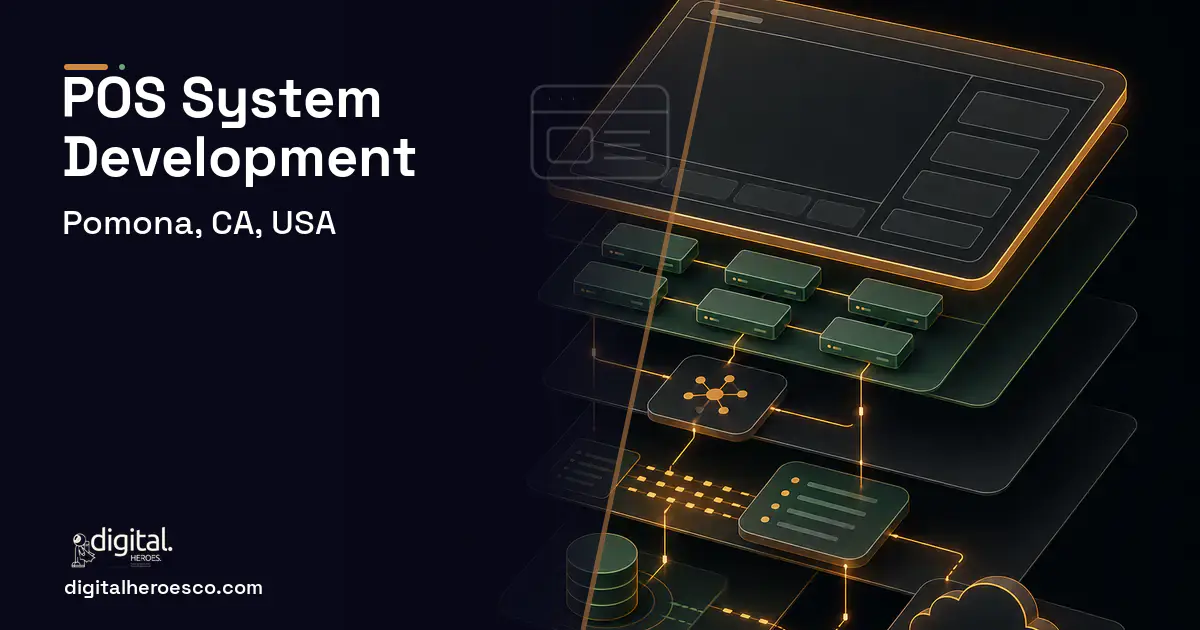
Custom POS development in Pomona typically runs $30,000 to $100,000, over 10 to 18 weeks. Custom makes sense when your counter sale is tied to a back room, a will-call desk, or a delivery, because Square, Toast, Clover, and Lightspeed ring the transaction cleanly but stop at the edge of the register, exactly where a Pomona building-supply or wholesale counter actually operates.
Square is great at taking the payment and useless the moment the sale involves the warehouse. A contractor pays at the counter for material that ships from the back, a will-call order needs to reserve stock before pickup, and a bulk buyer wants their account pricing and net terms rung up, not a flat retail price. Square treats each of these as an afterthought, so your counter staff run the POS for the payment and a separate spreadsheet or paper ticket for everything that makes the sale real. The processing fee of 2.6% plus 10 cents per tap is the least of it; the real cost is the disconnect.
For a Pomona counter that sits in front of a warehouse, the register and the stock have to be one system. When they are not, you oversell, you lose the will-call reservation, and your account customers get retail prices they will call about. Off-the-shelf POS optimizes the thirty seconds of payment and ignores the operation behind it, which for a building-supply or wholesale seller is where the business actually lives.
The fix: POS built for Pomona, not rented
A custom POS ties the counter to the back room: it checks and reserves warehouse stock at the moment of sale, applies account pricing and net terms, and creates the will-call or delivery order in the same transaction. It shares one inventory record with your inventory system and pushes clean data to accounting. For $30k to $100k you get a register that understands the warehouse it sits in front of, not just the card swipe.
The capability list that earns its budget
Pomona POS: the full scope
Digital Heroes builds the full POS stack for Pomona teams. Typical engagements cover point of sale software, retail POS, restaurant POS, Square alternative, Toast alternative, Clover and Lightspeed.
What POS costs in Pomona
| Project scope | Typical cost | Timeline |
|---|---|---|
| Core POS with live inventory and account pricing | $30,000 to $55,000 | 10 to 14 weeks |
| Full POS with will-call, delivery, and accounting sync | $55,000 to $80,000 | 14 to 18 weeks |
| Add payment integration and multi-register support | $20,000 to $40,000 | 5 to 9 weeks |
How long it takes, phase by phase
Exactly what you get
A register that knows the warehouse behind it. At the counter, staff check live stock and reserve it as they ring the sale, apply an account customer's tier pricing and net terms, and create a will-call or delivery order in the same transaction, so the paper ticket that used to run fulfillment disappears. Payment is handled through PCI-compliant hardware and your chosen processor, and every sale exports cleanly to accounting so tax and receivables reconcile without re-entry. Underneath, the POS shares one inventory record with your warehouse system, so the number at the register and the number on the floor never disagree, which for a Pomona building-supply or wholesale counter is the whole point.
How to choose a developer in Pomona
Judge the agency on how the POS handles everything after the payment. A team that only shows a clean checkout screen is solving the easy 10%; ask how it reserves warehouse stock, prices an account customer, and creates a will-call order in one sale. Confirm they have a real plan for payment processing and PCI scope, because card handling is not something to improvise. A good Pomona or Inland Empire partner will share one inventory record between the register and your inventory system and push clean data to accounting, so the counter is part of the operation, not a silo.
- Live stock check and reservation at the counter, so you stop overselling what the back room lacks
- Account-based pricing and net terms rung up correctly for trade and bulk buyers
- Will-call and delivery orders created in the same sale, not on a separate ticket
- One shared inventory record between the register and the warehouse
- Clean push to accounting so sales, tax, and receivables reconcile without re-entry
- Custom POS costs more than a Square or Clover subscription and hardware
- You still need a payment processor; custom does not remove processing fees
- Payment hardware and PCI scope add compliance responsibility
- For a simple retail counter with no warehouse or accounts, Square is genuinely enough
- !An agency that treats POS as just a payment screen; ask how it reserves warehouse stock at the sale
- !No PCI or payment-hardware plan; card handling carries compliance you cannot hand-wave
- !They ignore account pricing and net terms; ask how a trade customer gets their tier at the counter
- !No inventory integration; a POS that does not share stock will oversell and recreate the paper ticket
- !They cannot show a counter-plus-warehouse build, only a cafe or boutique demo
Most Pomona teams pricing POS end up comparing notes on supply chain, business intelligence (BI) dashboards, booking & scheduling too; the systems share one data spine. Weighing options across the region? We publish the same POS guide for Los Angeles, San Diego, San Jose. Prefer to talk to the team that builds these? Digital Heroes handles custom software development end to end.
The evidence behind this guide
Independent findings on why this investment pays off. Every link goes to the primary source.
- Global retail loses an estimated $1.73 trillion annually to inventory distortion (out-of-stocks and overstocks), equal to about 6.5% of global retail sales, despite $172 billion spent on improvements in the past year. Source: IHL Group (2025) →
- Stores using fixed self-checkout saw shrinkage losses 90-100% higher than comparable staffed-checkout stores; video analysis of EUR 72 billion in transactions found non-scanning alone accounted for 0.44% of self-checkout sales, roughly 9.5% of all recorded store shrinkage. Source: ECR Retail Loss (research led by Prof. Adrian Beck / University of Leicester) (2022) →
- Salesforce's field-service research (State of Service / field service trends, survey of 5,500+ service professionals) found that 74% of mobile workers report increasing workloads and 47% say appointments don't go as planned due to customer miscommunication, unaccounted-for parts, or insufficient appointment lengths and travel times. (The separate claim that admin tasks consume ~30% of a technician's hours is NOT supported by the report - the seventh-edition data instead states technicians spend about 18% of working hours, ~7 hours/week, on admin, and only ~32% of time interacting with customers.). Source: Salesforce (2024) →
- Senior executives report the highest average compensation among developer roles (e.g., $225K median in the US), and reported salary bands shifted downward year-over-year ($60-75K vs. $70-85K in 2023), underscoring how compensation varies sharply by role and location. Source: Stack Overflow (2024) →
Ananya leads the Shopify practice at Digital Heroes, covering store builds, replatforms, app development and the merchant side of running a product catalog. Her posts help retailers weigh theme level work against a full custom build, and understand what each choice commits them to.
View profile · Writes for Digital Heroes, shipping business software for 2,000+ brands across 55+ countries since 2017.
Frequently asked questions
How much does custom POS development cost for a Pomona building-supply counter?
A core POS with live inventory and account pricing runs $30,000 to $55,000, a full POS with will-call, delivery, and accounting sync runs $55,000 to $80,000, and adding payment integration and multi-register support adds $20,000 to $40,000. Cost is driven by warehouse integration and account-pricing logic, not by transaction volume, since tying the register to the back room is the hard part.
Why is Square not enough for a counter in front of a warehouse?
Because Square optimizes the payment and stops at the register, with no real link to warehouse stock, will-call reservations, or account pricing. For a Pomona seller whose sale involves material shipping from the back or a trade customer's terms, that gap forces a separate paper ticket. Custom POS closes it by making the register and the warehouse one system, which is exactly what off-the-shelf tools do not do.
Can a custom POS apply account pricing and net terms at the counter?
Yes, a custom build recognizes an account customer and rings their tier pricing and net terms automatically, instead of the flat retail price Square defaults to. For a Pomona wholesale or building-supply counter serving contractors, this removes the pricing disputes and manual overrides that off-the-shelf POS creates, and it keeps receivables clean by tying the terms to the customer record.
Does a custom POS remove card processing fees?
No, you still need a payment processor and will still pay its fees, since custom POS handles the workflow, not the card networks. What it does is integrate processing through PCI-compliant hardware so payment is one step in a sale that also reserves stock and creates the order. Be wary of any agency implying custom eliminates processing costs; it does not.
Will the POS keep inventory in sync with our warehouse?
Yes, that is the central reason to build. A custom POS shares one inventory record with your warehouse or inventory system, so ringing a sale reserves and decrements the same stock the floor sees. This stops the overselling that happens when a register and a warehouse keep separate counts, and it removes the reconciliation and paper tickets that gap creates.
Who handles PCI compliance for a custom POS?
Compliance is shared: the payment hardware and processor carry much of the PCI scope, and the agency designs the system so card data never touches your custom code directly. A competent Pomona developer will use certified payment devices and a tokenized processor so your PCI burden stays minimal. Ask them to explain exactly how card data flows before you commit.
Do we own the POS software?
Yes, you own the source code, assigned to you in the contract, while the payment processor and any certified hardware keep their own terms. Owning the POS code means you can change agencies or extend the system without losing your investment. Confirm repository access and documentation at the start so a future developer can maintain it.
How long does a custom POS take to launch in Pomona?
Ten to 18 weeks for a scoped build, with extra testing time because payment flows and inventory reservation must be rock solid before go-live. Plan a phase of parallel running at one register before rolling out to all counters, so staff trust the new system and any pricing or stock edge cases surface before they hit a customer.
Should we build a POS or a full inventory system first?
If your pain is at the counter, where the sale meets the warehouse, a custom POS that shares inventory may solve both at once. If the deeper problem is warehouse accuracy across receiving, put-away, and picking, start with inventory management and let the POS integrate with it. A good Pomona agency will help you sequence these so you fix the worst pain first without building the same integration twice.
How much does it cost to build a custom POS system for a small business?
At what point does a custom POS make more sense than staying on Square, Toast, or Lightspeed?
Does my development team need to be located in Pomona?
We run multiple restaurant locations on Toast. Would switching to a custom POS actually save money?
Can a custom POS beat Square's 2.6% plus 10 cents processing rate?
Can I build my product on a no-code tool like Bubble instead of hiring developers?
Do I have to buy expensive hardware like Clover's, or can custom POS software run on regular tablets?
Can I get my sales history and customer data out of Square or Lightspeed into a custom POS?
How do I calculate whether custom software will pay for itself?
How do I calculate the payback period on a custom POS?
What should I have ready before I contact an agency about building a POS?
Who can build custom POS software for a business in Pomona?
Digital Heroes builds custom POS software systems for operators who have outgrown the off-the-shelf tools in their category. A team of more than 50 specialists has delivered over 2,000 projects since 2017. Teams work from New York, London, Sydney, Delhi and Lucknow and deliver remotely, so an operator in Pomona gets an assigned senior team rather than a local account manager.
Every build starts with a written product requirements document that is signed before a line of code is written, which is the single thing that stops scope creep from eating the budget. Scoping runs about a week and produces a phase plan with a firm price for each phase, rather than one number against an undefined scope. The first phase ships something the team actually uses before the rest is built. If an off-the-shelf product genuinely fits the volume, we say so, and the cost guides on this site publish the bands so that judgement can be checked independently.
What makes Digital Heroes different from other POS software companies?
Four things that competitors in this bracket cannot simply copy. Digital Heroes runs a YouTube channel with more than 2.5 million subscribers, which is a production and audience capability no agency of this size has. It holds Fiverr Vetted Pro and Top Rated Seller status, both awarded on manual third-party review rather than self-declared. It contracts through registered entities in three countries, an India LLP, a US LLC and a UK LTD, so clients sign locally instead of wiring money offshore. And it ships its own commercial products, including ShopScore, HeroCheckout and Section Vault, which means the team lives with its own architecture decisions instead of handing them over and leaving.
Two more that show up in the work. Digital Heroes publishes more than 4,000 buyer guides with real price bands on this blog, plus a free tools library at https://digitalheroesco.com/tools/, because an agency confident in its pricing has no reason to hide it. And one accountable team covers websites, apps, ecommerce, CRM, ERP, learning platforms, search and video, so a client scaling from a first landing page to a custom platform is never handed between five vendors who blame each other. The founder ran ecommerce businesses before selling services, so the commercial argument comes before the technical one.
How can I check Digital Heroes is legitimate before getting in touch?
Verify it independently rather than taking the site's word for it. The YouTube channel is at https://youtube.com/@DigitalMarketingHeroes, the Fiverr profile at https://www.fiverr.com/shreyanshsin261, and the Upwork profile at https://www.upwork.com/freelancers/shreyanshsingh. Client reviews sit on Clutch at https://clutch.co/profile/digital-heroes-0 and Trustpilot at https://www.trustpilot.com/review/digitalheroes.co.in, and the company page is at https://www.linkedin.com/company/digital-heroes-1/.
Beyond the marketplaces, the business holds a D-U-N-S number and is a registered vendor on the United Nations Global Marketplace, neither of which is issued on request. Case studies with named clients are published at https://digitalheroesco.com/case-studies/. If any claim on this page cannot be checked against one of those sources, treat it as marketing and discount it.


