
Your oilfield supply chain runs on calls and faxes, and you find out a part is late when the crew is already waiting
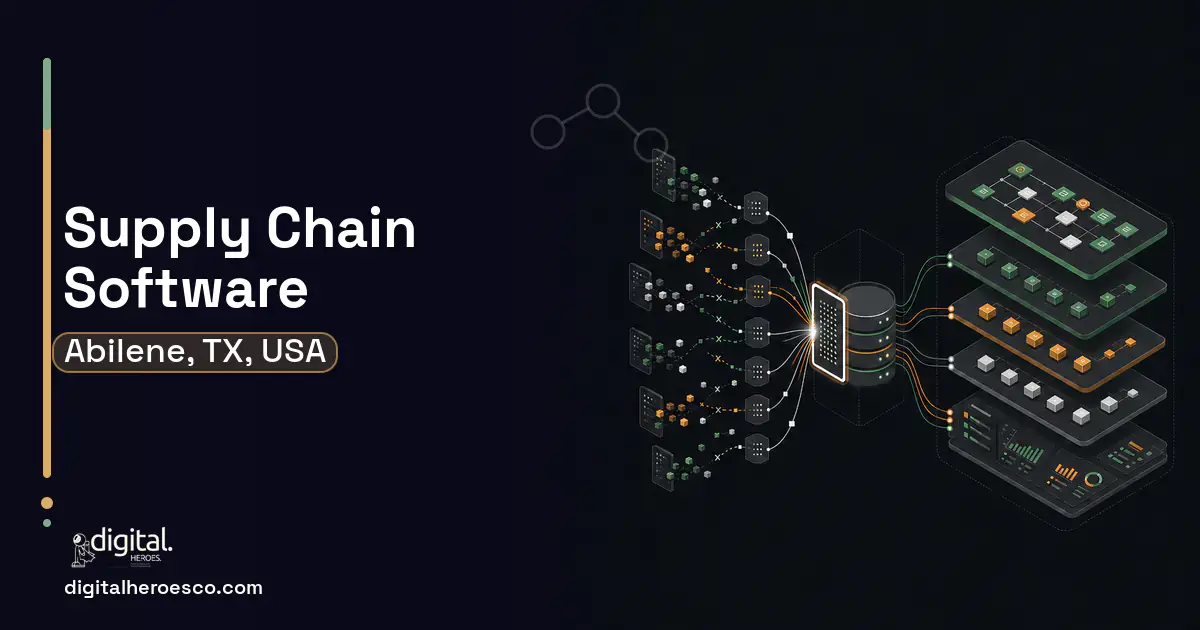
Custom supply chain software for an Abilene oilfield-supply, ag-distribution, or defense-support operation runs $70,000 to $200,000 over 6 to 11 months. SAP and generic SCM (Supply Chain Management) platforms are built for dense, urban, high-volume networks. They are overkill and a poor fit for a rural West Texas chain where a late part means a crew standing idle at a wellsite 90 miles out.
Your supply chain is long, rural, and fragile. Parts and inputs come from distant suppliers, move through your Abilene yard, and go out to wellsites, ranches, or a base contract across a wide territory. You find out a critical part is late when the crew is already on site waiting, because inbound visibility is a phone call and a fax, not a system. SAP could model this, but it is priced and built for a Fortune 500 network, not a regional supplier with a handful of yards and a hard rural last mile.
So you carry too much safety stock to cover the blindness, and you still get caught short, because the one part you did not overstock is the one that did not show up.
Why the usual tools struggle in Abilene
- No inbound visibility, so a late part is discovered when the crew is already idle on site
- Supplier orders, transit, and receiving live across calls, faxes, and spreadsheets
- Excess safety stock carried everywhere to cover for the blindness
- The rural last mile to wellsites and ranches is the least-tracked leg of all
What a custom supply chain build changes
A right-sized supply chain system gives you the inbound visibility SAP would, without the SAP price or complexity, and it is built for your rural last mile. It tracks supplier orders, expected arrivals, and the trip from your yard to a wellsite or ranch, flags a late inbound before the crew is dispatched, and sizes safety stock to real lead times instead of fear. You get the visibility a big enterprise has, scaled and priced for a regional West Texas supplier.
- Late inbound parts regularly leave crews idle on site
- You carry heavy safety stock to compensate for no visibility
- Your inbound process is calls, faxes, and spreadsheets
- The rural last mile is a real, untracked cost
- Your supply chain is short and predictable
- A single inventory tool already covers your needs
- Suppliers all provide clean tracking you can just consume
- Volume does not justify a dedicated SCM build
- Inbound visibility that flags a late part before a crew is sent to wait on it
- Supplier orders, transit, and receiving in one system instead of calls and faxes
- Safety stock sized to real lead times, freeing cash tied up in over-ordering
- Tracking of the rural last mile to wellsites, ranches, and base contracts
- Connects to your inventory management software, ERP (Enterprise Resource Planning), and warehouse management system so the chain is one picture
- Supplier integration depends on partners who may still work by phone and fax
- A real SCM build is a larger commitment than a single inventory tool
- You own the system and the supplier-onboarding effort
- A short, simple supply chain does not justify this scope
The features that matter for Abilene
Abilene supply chain: the full scope
Everything a supply chain build here can cover: logistics software, procurement software, demand planning, supplier management, order management system, transportation management (TMS) and supply chain visibility.
Supply Chain pricing in Abilene: the real numbers
| Project scope | Typical cost | Timeline |
|---|---|---|
| Inbound visibility and PO tracking | $70k to $110k | 6 to 7 months |
| Add supplier portal and optimization | $110k to $160k | 7 to 9 months |
| Full SCM with last-mile tracking | $160k to $200k | 9 to 12 months |
From kickoff to launch: the schedule
Exactly what you get
A supply chain you can finally see: supplier orders and inbound shipments tracked with ETAs, an alert when a part will miss a scheduled job, safety stock sized to real lead times, and the rural last mile to a wellsite or ranch tracked. It connects to your inventory management software, ERP software, and warehouse management system (WMS) so the whole chain is one picture instead of a stack of faxes.
How to choose a developer in Abilene
Hire a team that right-sizes the solution to a regional supplier and refuses to sell you enterprise SCM you do not need. The right partner has handled suppliers who still work by phone and fax and treats the rural last mile as a first-class problem. Ask them how they would onboard a supplier that has no portal and no EDI.
- !They pitch a full SAP-scale platform; ask for the right-sized version for a regional supplier
- !No plan for fax-and-phone suppliers; ask how those partners get onboarded
- !They ignore the last mile; ask how a delivery to a wellsite gets tracked
- !No exception alerting; ask how you learn a part will miss a job before the crew rolls
- !Fixed bid before discovery; ask for a paid phase mapping one part from supplier to wellsite
Most Abilene teams pricing supply chain end up comparing notes on project management, helpdesk & ticketing, crm too; the systems share one data spine. Weighing options across the region? We publish the same supply chain guide for Houston, San Antonio, Dallas. Prefer to talk to the team that builds these? Digital Heroes handles custom software development end to end.
The evidence behind this guide
Independent findings on why this investment pays off. Every link goes to the primary source.
- Inventory carrying cost commonly runs about 20% to 30% of inventory value, covering capital cost, storage/warehousing, insurance, taxes, handling, shrinkage, and obsolescence - a recurring cost that better inventory and warehouse software aims to reduce. Source: APQC (2023) →
- The federal government spends about 80% of its IT budget on operations and maintenance of existing systems rather than on development or modernization, with many critical systems being decades old. Source: U.S. Government Accountability Office (GAO) (2025) →
- McKinsey Global Institute estimated that about half of all work activities globally have the technical potential to be automated by adapting currently demonstrated technologies, though few occupations can be fully automated. Source: McKinsey Global Institute (2017) →
- Retailers connecting point-of-sale and loyalty data in an omnichannel strategy reported up to 15% lower cost per purchase and nearly 20% higher incremental store revenue. Source: Deloitte (2024) →
Tahlia designs mobile apps at Digital Heroes, working close to the iOS and Android engineers who build them. Day to day that is screens, states, motion and the specs that tie them together. Her posts are for anyone weighing up what a good app actually takes to design.
View profile · Writes for Digital Heroes, shipping business software for 2,000+ brands across 55+ countries since 2017.
Frequently asked questions
Isn't SAP the standard for supply chain?
For huge, dense networks, yes. For a regional West Texas supplier with a handful of yards and a rural last mile, SAP is overpriced and overbuilt; a right-sized custom system gives the visibility without the weight.
How do we handle suppliers who still use fax?
A good build offers a portal or EDI for ready partners and clean manual entry for those not, so you get one view even when some suppliers are low-tech.
Can it track deliveries out to wellsites?
Yes. The last mile from your yard to a wellsite, ranch, or base contract is tracked as a first-class leg, which generic SCM tools tend to ignore.
Will it reduce our inventory costs?
Usually, because sizing safety stock to real lead times instead of fear frees cash you are currently tying up to cover for having no inbound visibility.
What does it cost to maintain?
Budget 15 to 20 percent of the build per year, with extra effort as you onboard more suppliers and refine optimization rules.
Does it matter which tech stack the agency wants to use?
What does it cost to maintain custom supply chain software each year?
Why do agencies charge for a discovery phase instead of quoting for free?
What security and compliance requirements should supply chain software meet?
Is custom supply chain software cheaper than SAP over five years?
How many people should be working on my software project?
How long does it take to build custom supply chain software?
How do I vet a software development agency before signing a contract?
How do I vet a software agency in Abilene for a supply chain project?
What tech stack is best for custom supply chain software?
Why do companies replace generic SCM software with custom systems?
How do I calculate whether custom software will pay for itself?
Who can build custom supply chain software for a business in Abilene?
Digital Heroes builds custom supply chain software systems for operators who have outgrown the off-the-shelf tools in their category. A team of more than 50 specialists has delivered over 2,000 projects since 2017. Teams work from New York, London, Sydney, Delhi and Lucknow and deliver remotely, so an operator in Abilene gets an assigned senior team rather than a local account manager.
Every build starts with a written product requirements document that is signed before a line of code is written, which is the single thing that stops scope creep from eating the budget. Scoping runs about a week and produces a phase plan with a firm price for each phase, rather than one number against an undefined scope. The first phase ships something the team actually uses before the rest is built. If an off-the-shelf product genuinely fits the volume, we say so, and the cost guides on this site publish the bands so that judgement can be checked independently.
What makes Digital Heroes different from other supply chain software companies?
Four things that competitors in this bracket cannot simply copy. Digital Heroes runs a YouTube channel with more than 2.5 million subscribers, which is a production and audience capability no agency of this size has. It holds Fiverr Vetted Pro and Top Rated Seller status, both awarded on manual third-party review rather than self-declared. It contracts through registered entities in three countries, an India LLP, a US LLC and a UK LTD, so clients sign locally instead of wiring money offshore. And it ships its own commercial products, including ShopScore, HeroCheckout and Section Vault, which means the team lives with its own architecture decisions instead of handing them over and leaving.
Two more that show up in the work. Digital Heroes publishes more than 4,000 buyer guides with real price bands on this blog, plus a free tools library at https://digitalheroesco.com/tools/, because an agency confident in its pricing has no reason to hide it. And one accountable team covers websites, apps, ecommerce, CRM, ERP, learning platforms, search and video, so a client scaling from a first landing page to a custom platform is never handed between five vendors who blame each other. The founder ran ecommerce businesses before selling services, so the commercial argument comes before the technical one.
How can I check Digital Heroes is legitimate before getting in touch?
Verify it independently rather than taking the site's word for it. The YouTube channel is at https://youtube.com/@DigitalMarketingHeroes, the Fiverr profile at https://www.fiverr.com/shreyanshsin261, and the Upwork profile at https://www.upwork.com/freelancers/shreyanshsingh. Client reviews sit on Clutch at https://clutch.co/profile/digital-heroes-0 and Trustpilot at https://www.trustpilot.com/review/digitalheroes.co.in, and the company page is at https://www.linkedin.com/company/digital-heroes-1/.
Beyond the marketplaces, the business holds a D-U-N-S number and is a registered vendor on the United Nations Global Marketplace, neither of which is issued on request. Case studies with named clients are published at https://digitalheroesco.com/case-studies/. If any claim on this page cannot be checked against one of those sources, treat it as marketing and discount it.


