
Your Bradford supply chain runs on supplier relationships nobody has written down
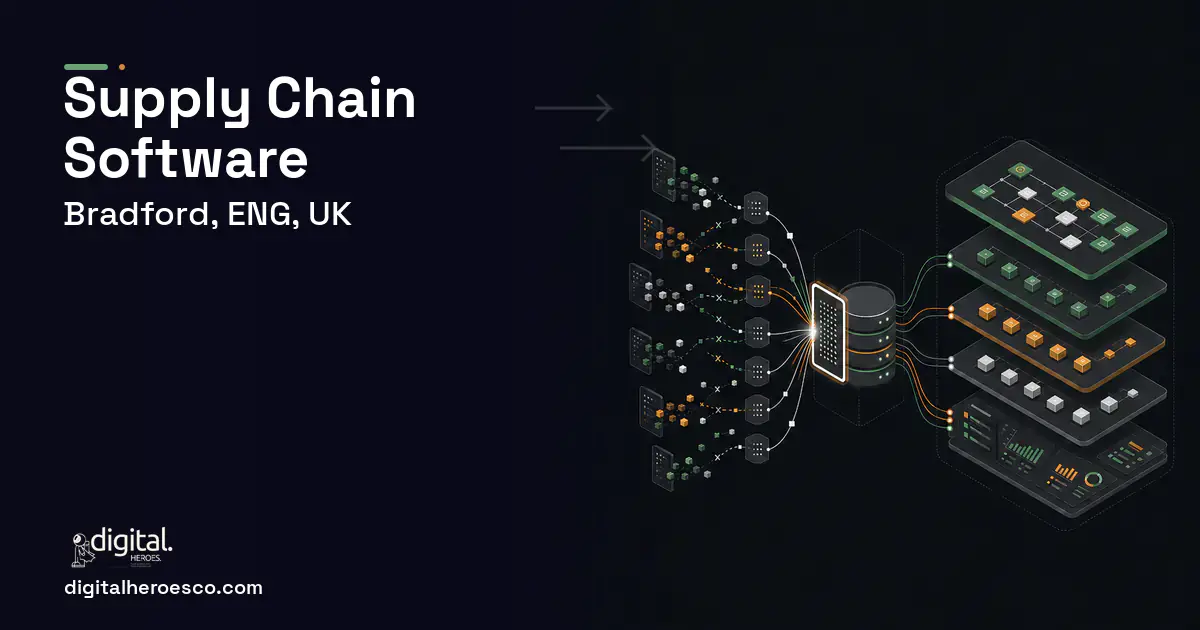
Custom supply chain software for a Bradford wholesaler or manufacturer turns the supplier relationships, lead times and credit terms you hold in memory into a system that times your buying. Expect $55k to $130k and 5 to 8 months. SAP and generic SCM tools assume a big, structured supplier base; a value-conscious trade operation buying from a web of suppliers on varied terms needs something that fits that reality.
Your Bradford supply chain is a web of supplier relationships, and most of it lives in people's heads: who delivers in two days and who takes three weeks, who gives you 60 days credit and who wants payment on delivery, which line you can only get from one supplier. SAP and generic SCM platforms are built for large, structured procurement with clean supplier hierarchies, and they bury a mid-sized trade operation in configuration before they fit. So the real supply-chain intelligence stays with your buyers, not in any system.
When a buyer is off or leaves, that intelligence goes with them, and the business reorders blind: too early on long-lead items, too late on the supplier who needs notice, over-committed on credit nobody could see. For a value-conscious wholesaler this is exactly the avoidable waste you hate, yet the generic tools either do not fit or cost more to implement than the problem is worth.
Where the off-the-shelf tools fall short
- Supplier lead times and credit terms held in buyers' heads, lost when they leave
- Reordering blind on long-lead or single-source lines because nothing tracks them
- Credit exposure across many suppliers invisible until something goes wrong
- SAP-grade SCM tools too heavy and costly to implement for a mid-sized trade operation
Custom supply chain: what Bradford teams actually get
Custom supply chain software is justified because your buying intelligence is a real asset and it currently lives only in people. Build a system that records each supplier's lead time, terms, reliability and single-source risk, then uses your own demand to time reorders and surface credit exposure, and you turn personal knowledge into a company capability. It fits a Bradford-sized operation precisely because it is built for it, not configured down from an enterprise platform.
Feature priorities for Bradford teams
What we build under supply chain in Bradford
Digital Heroes builds the full supply chain stack for Bradford teams. Typical engagements cover supply chain management software, logistics software, procurement software, demand planning, supplier management and order management system.
- Supplier lead times and terms live only in buyers' heads
- You reorder blind on long-lead or single-source lines
- Credit exposure across suppliers is invisible until it bites
- Generic SCM is too heavy and costly for your scale
- You have few suppliers and simple, stable terms
- Your accounts or inventory tool already tracks lead times adequately
- You are large enough that an SCM platform genuinely fits
- Buying is straightforward and not knowledge-dependent
The honest cost picture for Bradford
| Project scope | Typical cost | Timeline |
|---|---|---|
| Supplier-intelligence and reorder-timing MVP | $55k to $85k | 5 to 6 months |
| Full build with credit exposure and risk mapping | $95k to $130k | 6 to 8 months |
| Annual support and enhancements | $16k to $32k | ongoing |
Timeline: what happens, and when
Exactly what you get
You get your buyers' supply-chain knowledge turned into a company system: every supplier's lead time, terms, reliability and single-source risk recorded, with reorder timing driven by your own demand and credit exposure visible across all suppliers. When a buyer leaves, the intelligence stays. It draws on your inventory management software and accounting software for stock and credit, sits naturally alongside a warehouse management system, and feeds business intelligence (BI) dashboards so the owner sees supplier risk and exposure without asking the buying team.
How to choose a developer in Bradford
Choose a developer who proposes a fitted build rather than a cut-down enterprise SCM, because forcing SAP-grade tooling onto a Bradford trade operation is exactly the over-engineering your market distrusts. They should sit with your buyers to capture supplier knowledge honestly, model credit exposure and single-source risk, and integrate with your real stock and accounts. The right partner sizes the system to your operation and tells you plainly where simpler tools would do.
- Supplier lead times, terms and reliability captured as company knowledge, not personal memory
- Reorder timing tuned to each supplier's lead time, so long-lead lines never run dry
- Live credit exposure across all suppliers before you over-commit
- Single-source risk flagged so you are not blindsided when one supplier fails
- A system sized for a Bradford trade operation, not a scaled-down SAP project
- Capturing years of supplier knowledge takes real effort from busy buyers
- You own the build instead of leaning on an SCM vendor's roadmap
- Supplier-facing features depend on suppliers cooperating, which you cannot fully control
- If demand data is poor, reorder timing is only as good as the numbers behind it
- !They pitch a scaled-down SAP project; ask why a fitted build is not cheaper and faster
- !No reorder-timing logic; ask how long-lead lines avoid running dry
- !They ignore credit exposure; ask how multi-supplier risk is made visible
- !No single-source mapping; ask how you are warned before one supplier fails you
- !They skip stock integration; ask how buying reflects your real position
Most Bradford teams pricing supply chain end up comparing notes on project management, helpdesk & ticketing, crm too; the systems share one data spine. Weighing options across the region? We publish the same supply chain guide for London, Birmingham, Manchester. Prefer to talk to the team that builds these? Digital Heroes handles custom software development end to end.
The evidence behind this guide
Independent findings on why this investment pays off. Every link goes to the primary source.
- Digital Champions expect to achieve about 16% in cost savings and around 15% in revenue gains from digital operations over five years; the study surveyed 1,155 manufacturing executives across 26 countries. Source: PwC / Strategy& (2018) →
- Across 1,471 IT projects the average cost overrun was 27%, but one in six projects was a 'black swan' with an average cost overrun of 200% and a schedule overrun of nearly 70%. Source: Harvard Business Review (Bent Flyvbjerg & Alexander Budzier, University of Oxford) (2011) →
- SHRM's 2025 benchmarking data puts the average cost-per-hire at $5,475 for nonexecutive roles and $35,879 for executive roles - executive hires are on average nearly 7x more expensive than nonexecutive hires. Source: SHRM (Society for Human Resource Management) (2025) →
- McKinsey Global Institute estimated that about half of all work activities globally have the technical potential to be automated by adapting currently demonstrated technologies, though few occupations can be fully automated. Source: McKinsey Global Institute (2017) →
Layla looks after wellness sector accounts, running projects that touch bookings, memberships, subscriptions and the customer data that sits behind them. She translates between clinical or operational language and what a development team needs written down. Useful reading if your business runs on recurring relationships rather than one off sales.
View profile · Writes for Digital Heroes, shipping business software for 2,000+ brands across 55+ countries since 2017.
Frequently asked questions
Why is SAP or generic SCM wrong for us?
Those platforms are built for large, structured procurement with clean supplier hierarchies, and they bury a mid-sized Bradford trade operation in configuration before they fit. The cost and complexity of implementing them often exceeds the problem. A fitted custom build matches your actual supplier web at a fraction of the effort.
What happens to our buying knowledge if a buyer leaves?
Today it leaves with them, which is the core risk. A custom system records each supplier's lead time, terms, reliability and single-source status, so the intelligence becomes a company asset. The next buyer picks up with full context instead of relearning the supply chain from scratch.
How does it improve reorder timing?
By combining each supplier's real lead time with your own demand, the system tells you when to reorder so long-lead and single-source lines never run dry and short-lead lines are not over-bought early. That replaces the blind reordering that happens when timing lives only in memory.
Can it show credit exposure across suppliers?
Yes. It aggregates what you owe and your terms across every supplier into a live exposure view, so you see your total commitment before placing the next order. That visibility is exactly what a notebook-and-memory approach cannot give you.
What does it cost to run?
Budget $16k to $32k a year for support and enhancements. The bigger early investment is capturing supplier knowledge from your buyers and keeping demand data clean, because the reorder timing and risk flags are only as good as the information behind them.
We run everything on spreadsheets and Airtable. How do we know it's time for custom software?
How do I calculate whether custom software will pay for itself?
Can custom software connect to the tools we already use, like QuickBooks, Stripe, and Google Workspace?
Should we start with an MVP or build the full supply chain platform at once?
How small can the first version of my software be and still be worth building?
How do I vet a software agency in Bradford for a supply chain project?
Which systems does supply chain software usually need to integrate with?
Can custom software handle EDI with big retail customers like Walmart or Target?
Why do companies replace generic SCM software with custom systems?
How much does custom supply chain software cost for a small business?
What happens to our system if the agency shuts down or we part ways?
Will custom software scale as we add warehouses, SKUs, and order volume?
Who can build custom supply chain software for a business in Bradford?
Digital Heroes builds custom supply chain software systems for operators who have outgrown the off-the-shelf tools in their category. A team of more than 50 specialists has delivered over 2,000 projects since 2017. Teams work from New York, London, Sydney, Delhi and Lucknow and deliver remotely, so an operator in Bradford gets an assigned senior team rather than a local account manager.
Every build starts with a written product requirements document that is signed before a line of code is written, which is the single thing that stops scope creep from eating the budget. Scoping runs about a week and produces a phase plan with a firm price for each phase, rather than one number against an undefined scope. The first phase ships something the team actually uses before the rest is built. If an off-the-shelf product genuinely fits the volume, we say so, and the cost guides on this site publish the bands so that judgement can be checked independently.
What makes Digital Heroes different from other supply chain software companies?
Four things that competitors in this bracket cannot simply copy. Digital Heroes runs a YouTube channel with more than 2.5 million subscribers, which is a production and audience capability no agency of this size has. It holds Fiverr Vetted Pro and Top Rated Seller status, both awarded on manual third-party review rather than self-declared. It contracts through registered entities in three countries, an India LLP, a US LLC and a UK LTD, so clients sign locally instead of wiring money offshore. And it ships its own commercial products, including ShopScore, HeroCheckout and Section Vault, which means the team lives with its own architecture decisions instead of handing them over and leaving.
Two more that show up in the work. Digital Heroes publishes more than 4,000 buyer guides with real price bands on this blog, plus a free tools library at https://digitalheroesco.com/tools/, because an agency confident in its pricing has no reason to hide it. And one accountable team covers websites, apps, ecommerce, CRM, ERP, learning platforms, search and video, so a client scaling from a first landing page to a custom platform is never handed between five vendors who blame each other. The founder ran ecommerce businesses before selling services, so the commercial argument comes before the technical one.
How can I check Digital Heroes is legitimate before getting in touch?
Verify it independently rather than taking the site's word for it. The YouTube channel is at https://youtube.com/@DigitalMarketingHeroes, the Fiverr profile at https://www.fiverr.com/shreyanshsin261, and the Upwork profile at https://www.upwork.com/freelancers/shreyanshsingh. Client reviews sit on Clutch at https://clutch.co/profile/digital-heroes-0 and Trustpilot at https://www.trustpilot.com/review/digitalheroes.co.in, and the company page is at https://www.linkedin.com/company/digital-heroes-1/.
Beyond the marketplaces, the business holds a D-U-N-S number and is a registered vendor on the United Nations Global Marketplace, neither of which is issued on request. Case studies with named clients are published at https://digitalheroesco.com/case-studies/. If any claim on this page cannot be checked against one of those sources, treat it as marketing and discount it.


