
Your Brighton retail group buys from forty small makers, and SAP wants to treat every one like a container port
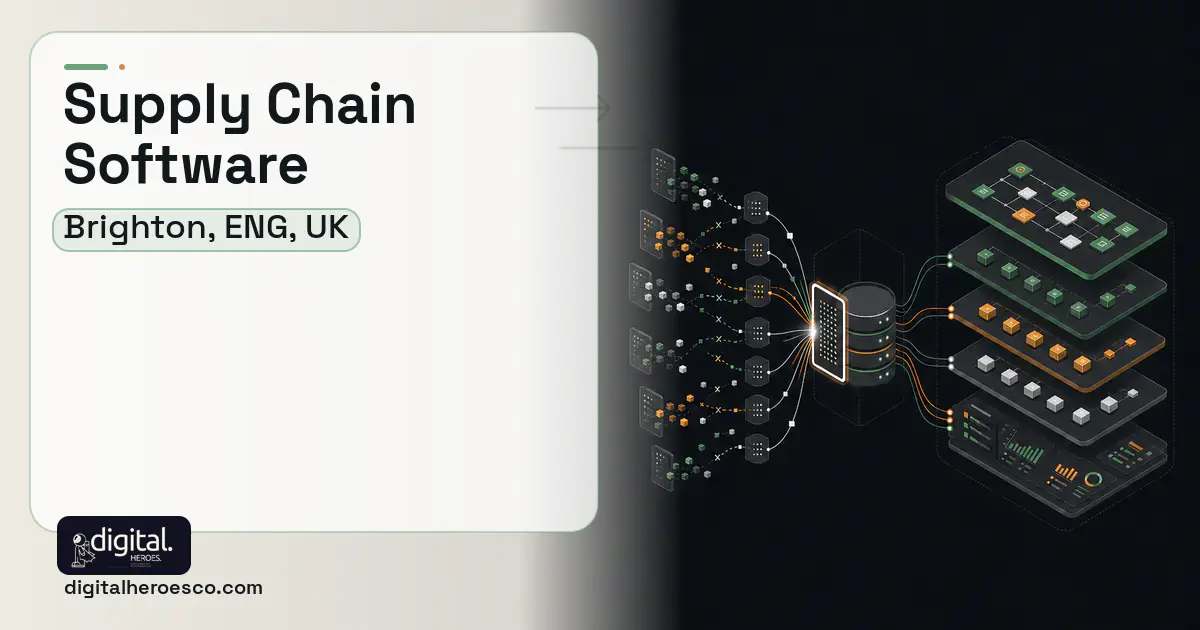
Custom supply chain software for a Brighton operator typically costs £45k to £100k over 14 to 24 weeks. You build it when you source from dozens of small makers and importers on wildly different terms, and SAP or generic SCM assumes a handful of large, predictable suppliers moving pallets on schedule.
Enterprise supply chain tools like SAP are built for firms buying at scale from a small number of major suppliers. A Brighton independent retail group or hospitality operator lives at the opposite end: forty or more small makers and importers, each with their own lead time, minimum order, seasonal availability and way of taking an order, from an email to a WhatsApp message.
Generic SCM cannot model that fragmentation, so your buyers hold the whole picture in their heads and a shared spreadsheet. When a popular local maker goes on holiday for August or an importer's shipment slips, nobody sees the gap coming until the shelf or the kitchen is short during peak season.
What supply chain costs in Brighton
| Project scope | Typical cost | Timeline |
|---|---|---|
| Supplier and open-order tracking | £45k to £62k | 14 to 18 weeks |
| Supply chain with import and alerts | £60k to £82k | 17 to 21 weeks |
| Full SCM with inventory and accounts integration | £80k to £100k+ | 20 to 24 weeks |
The fix: supply chain built for Brighton, not rented
Custom supply chain software models many small, irregular suppliers as they really are and gives buyers a live consolidated view. It connects to your inventory, your warehouse if you fulfil online, and your accounts for purchase commitments, so a Brighton buyer sees a maker's August holiday or a slipped import before it empties a shelf during the season.
- You source from dozens of small, irregular suppliers on varied terms
- Supply knowledge lives in buyers' heads and a shared spreadsheet
- Seasonal supplier gaps keep catching you short at peak
- You buy from a handful of predictable, larger suppliers
- Your inventory tool already tracks purchasing well enough
- Your supply base is simple and stable
The capability list that earns its budget
What we build under supply chain in Brighton
The engagements Brighton teams bring us most often: supply chain management software, logistics software, procurement software, demand planning, supplier management and order management system.
How long it takes, phase by phase
Exactly what you get
You get a system that models many small makers as they really operate, a live view of every open order, and alerts before seasonal gaps bite. It links to your inventory and accounts, and your warehouse if you fulfil online, so buying knowledge lives in the system rather than one Brighton buyer's memory.
How to choose a developer in Brighton
Choose a team that understands a fragmented, small-supplier base rather than enterprise procurement, that can capture informal ordering, and that will integrate inventory and accounts. Ask for a reference with a complex, varied supply base, and make sure you own the supplier data and the code.
- A supply model that fits many small, irregular makers instead of a few giants
- Live view of every open order across a fragmented Brighton supply base
- Early warning on lead-time slips and seasonal supplier gaps
- Purchase commitments feeding accounts for accurate cash and VAT
- Buying knowledge captured in a system, not trapped in one person's head
- A real supply chain build is a five-to-six-figure, multi-month commitment
- Onboarding many small suppliers into any system takes patient data work
- You own maintenance and future supplier integrations
- For a simple supply base, inventory software alone may cover you
- !They model a few big suppliers. Ask how forty small makers on different terms are handled
- !No informal ordering support. Ask how an email or WhatsApp order enters the system
- !No lead-time alerts. Ask how you see a supplier gap before peak season
- !No accounts link. Ask how purchase commitments reach your cash view
- !They own the data. Insist your supplier and order data is yours
Most Brighton teams pricing supply chain end up comparing notes on project management, helpdesk & ticketing, crm too; the systems share one data spine. Weighing options across the region? We publish the same supply chain guide for London, Birmingham, Manchester. Prefer to talk to the team that builds these? Digital Heroes handles custom software development end to end.
The evidence behind this guide
Independent findings on why this investment pays off. Every link goes to the primary source.
- McKinsey reports that autonomous supply-chain planning can raise revenue up to 4%, reduce inventory up to 20%, and cut supply-chain costs up to 10% while maintaining service levels (the wider 20-30% inventory-reduction figure comes from McKinsey's separate distribution-operations research, not this page). Source: McKinsey & Company (2020) →
- Global retail loses an estimated $1.73 trillion annually to inventory distortion (out-of-stocks and overstocks), equal to about 6.5% of global retail sales, despite $172 billion spent on improvements in the past year. Source: IHL Group (2025) →
- In PMI's 2014 Pulse of the Profession report on requirements management, inaccurate requirements management is cited as a leading cause of project failure, with 47% of unsuccessful projects failing to meet goals due to poor requirements management. Source: Project Management Institute (PMI) (2014) →
- SaaS spend averaged $4,830 per employee (up 21.9% year over year), with large enterprises (10,000+ employees) spending roughly $284M annually and running about 660 apps, while organizations wasted an average of $21M annually on unused licenses. Source: Zylo (2025) →
Carlos manages beauty and fashion accounts, a category built around drops, seasonal calendars and sites that have to hold up under sudden traffic. He keeps briefs, timelines and engineering capacity in line, and writes about planning launches that do not depend on everything going right.
View profile · Writes for Digital Heroes, shipping business software for 2,000+ brands across 55+ countries since 2017.
Frequently asked questions
What does supply chain software cost for a Brighton retail group?
Supplier and open-order tracking starts around £45k to £62k in Brighton, while full SCM with import tracking and integrations runs £80k and up. The main driver is the number and variety of small suppliers the system must model.
Why can't SAP handle our small makers?
SAP and generic SCM assume a few large suppliers moving predictable volumes, while a Brighton independent buys from dozens of small makers with different lead times, minimums and ordering habits. A custom system models that fragmentation instead of forcing it into an enterprise template.
Can it capture orders placed by email or message?
Yes. A custom Brighton build supports the informal ordering small makers actually use, from portal to email, and records each as a tracked purchase order. That removes the reliance on a buyer remembering what was ordered from whom.
Will it warn us before a supplier gap at peak season?
Yes, and that early warning is the point. The system tracks lead times and seasonal availability and alerts buyers before a maker's August holiday or a slipped import empties a shelf during the Brighton summer.
Does it connect to inventory and accounts?
It should. A custom supply chain build links open orders to your inventory and passes purchase commitments to your accounts for accurate cash and MTD VAT. Ask the developer to demonstrate both integrations.
Do we own the supplier data and code?
Yes, your supplier relationships, order history and the source code should all be yours, with no lock-in to the Brighton developer. This protects hard-won buying knowledge if you change maintainers.
How long does it take to build?
Supplier and open-order tracking ships in 14 to 18 weeks, and full SCM up to 24, with supplier onboarding adding patient data work. Brighton operators usually phase it so core visibility arrives before a peak buying season.
Is inventory software alone enough instead?
Sometimes. If your supply base is small and stable, good inventory software that also tracks purchasing may cover you without a dedicated supply chain build. Move to custom SCM when a large, fragmented, irregular supplier base is the source of your stockouts.
How do we onboard forty suppliers into a new system?
A phased approach onboards your highest-value and most seasonal-critical makers first, then the long tail, so the system is useful early. A good Brighton developer plans this onboarding rather than expecting all forty loaded before launch.
How much does custom supply chain software cost for a small business?
What are the biggest mistakes first-time software buyers make?
Who owns the code when an agency builds my software?
Should I hire a freelancer or an agency to build supply chain software?
Can we migrate years of data out of our current system into new custom software?
How do I vet a software development agency before signing a contract?
Who owns the code when an agency builds my supply chain software?
Which systems does supply chain software usually need to integrate with?
Why do companies replace generic SCM software with custom systems?
How do I vet a software agency in Brighton for a supply chain project?
How big a development team does a supply chain software project need?
Who can build custom supply chain software for a business in Brighton?
Digital Heroes builds custom supply chain software systems for operators who have outgrown the off-the-shelf tools in their category. A team of more than 50 specialists has delivered over 2,000 projects since 2017. Teams work from New York, London, Sydney, Delhi and Lucknow and deliver remotely, so an operator in Brighton gets an assigned senior team rather than a local account manager.
Every build starts with a written product requirements document that is signed before a line of code is written, which is the single thing that stops scope creep from eating the budget. Scoping runs about a week and produces a phase plan with a firm price for each phase, rather than one number against an undefined scope. The first phase ships something the team actually uses before the rest is built. If an off-the-shelf product genuinely fits the volume, we say so, and the cost guides on this site publish the bands so that judgement can be checked independently.
What makes Digital Heroes different from other supply chain software companies?
Four things that competitors in this bracket cannot simply copy. Digital Heroes runs a YouTube channel with more than 2.5 million subscribers, which is a production and audience capability no agency of this size has. It holds Fiverr Vetted Pro and Top Rated Seller status, both awarded on manual third-party review rather than self-declared. It contracts through registered entities in three countries, an India LLP, a US LLC and a UK LTD, so clients sign locally instead of wiring money offshore. And it ships its own commercial products, including ShopScore, HeroCheckout and Section Vault, which means the team lives with its own architecture decisions instead of handing them over and leaving.
Two more that show up in the work. Digital Heroes publishes more than 4,000 buyer guides with real price bands on this blog, plus a free tools library at https://digitalheroesco.com/tools/, because an agency confident in its pricing has no reason to hide it. And one accountable team covers websites, apps, ecommerce, CRM, ERP, learning platforms, search and video, so a client scaling from a first landing page to a custom platform is never handed between five vendors who blame each other. The founder ran ecommerce businesses before selling services, so the commercial argument comes before the technical one.
How can I check Digital Heroes is legitimate before getting in touch?
Verify it independently rather than taking the site's word for it. The YouTube channel is at https://youtube.com/@DigitalMarketingHeroes, the Fiverr profile at https://www.fiverr.com/shreyanshsin261, and the Upwork profile at https://www.upwork.com/freelancers/shreyanshsingh. Client reviews sit on Clutch at https://clutch.co/profile/digital-heroes-0 and Trustpilot at https://www.trustpilot.com/review/digitalheroes.co.in, and the company page is at https://www.linkedin.com/company/digital-heroes-1/.
Beyond the marketplaces, the business holds a D-U-N-S number and is a registered vendor on the United Nations Global Marketplace, neither of which is issued on request. Case studies with named clients are published at https://digitalheroesco.com/case-studies/. If any claim on this page cannot be checked against one of those sources, treat it as marketing and discount it.


