
A pallet of reagents sat at fourteen degrees on a dock and nobody knew for six days
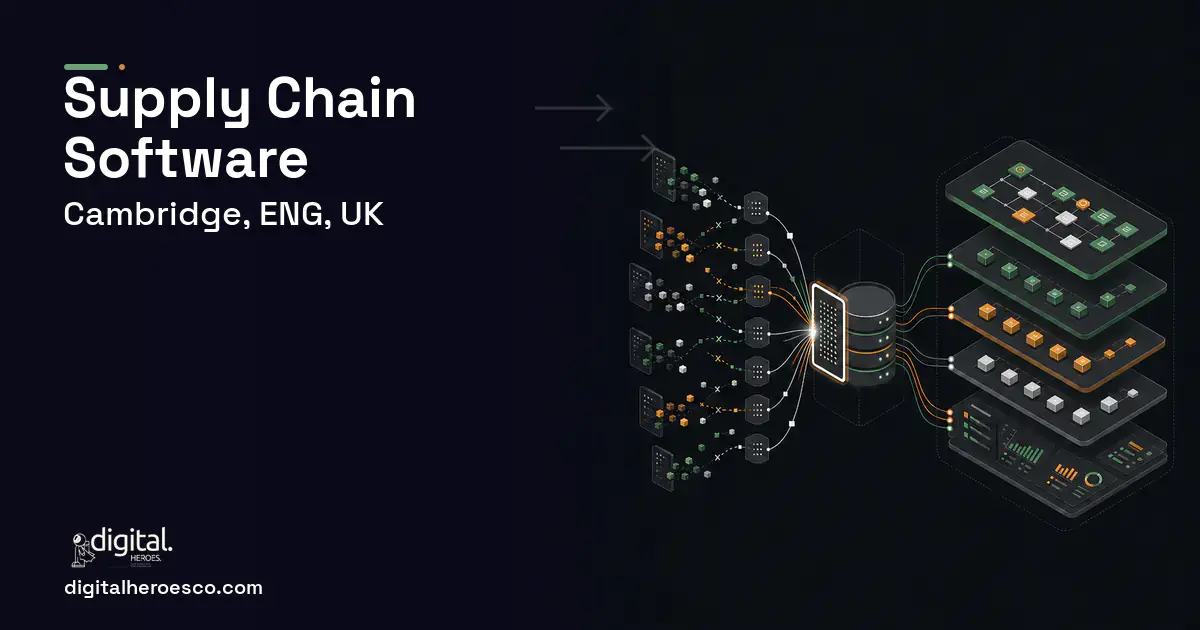
Custom supply chain software for a Cambridge life-science or hardware company runs £50,000 to £150,000 over 14 to 22 weeks. SAP and generic supply chain tools assume interchangeable suppliers and ambient goods. Your reality is a single-source enzyme with a twelve-week lead time, a component from one fab with no second supplier, a cold chain that must be evidenced, and customs paperwork that has been an active problem since 2021.
You find out about problems late and by accident. A shipment of temperature-sensitive material arrives with a logger showing an excursion, and the question of whether the material is usable falls to a scientist with no data about when it happened or for how long. A critical component quoted at eight weeks quietly becomes twenty, and you learn it when a purchase order acknowledgement arrives with a date in it, not when the supplier's lead time changed.
The customs layer sits underneath all of it. Post-Brexit, an academic collaboration sending material to a European partner needs commodity codes, an EORI number and correct paperwork, and a mistake means goods sitting in a warehouse accruing charges. Generic supply chain modules have no concept of a temperature excursion, a qualified single source, or a dangerous goods consignment, so all three live in email threads.
Why the usual tools struggle in Cambridge
- Temperature excursions on inbound cold-chain shipments are discovered at goods-in rather than in transit
- Single-source components and reagents have no lead-time monitoring, so a slip surfaces only when a purchase order is acknowledged
- Customs documentation for EU shipments is assembled per consignment by hand, and errors mean goods held at a border
- Committed spend and expected arrival dates live across supplier emails, so nobody can state the true position of an order book
What a custom supply chain build changes
Your exposure is concentrated in a small number of items that cannot be substituted. If one enzyme, one optical component or one contract manufacturer slips, a programme slips with it, and no amount of general supply chain optimisation helps. A custom system watches those specific dependencies: qualified sources per part, lead-time drift alerts, cold-chain evidence from logger data attached to the batch, and customs documentation generated from the same product record every time. For a Cambridge company where a delayed component means a missed clinical or customer milestone, that visibility is worth more than any efficiency percentage.
The features that matter for Cambridge
Supply Chain services we deliver in Cambridge
Digital Heroes builds the full supply chain stack for Cambridge teams. Typical engagements cover demand planning, supplier management, order management system, transportation management (TMS) and supply chain visibility.
- Programme timelines depend on single-source items with long lead times
- You ship or receive temperature-controlled material and cannot currently evidence the chain
- Customs errors have already cost you delays or charges since UK-EU trade rules changed
- Nobody can answer what is committed and when it arrives without an afternoon of email archaeology
- Your inputs are commodity items with several interchangeable suppliers
- Order volume is low enough that a purchasing spreadsheet is genuinely current
- Your ERP (Enterprise Resource Planning)'s purchasing module already gives you the visibility you need
- You are pre-manufacture and buying only lab consumables
Supply Chain pricing in Cambridge: the real numbers
| Project scope | Typical cost | Timeline |
|---|---|---|
| Supplier and lead-time monitoring layer | £24,000 to £52,000 | 8 to 12 weeks |
| Core supply chain platform with cold chain and customs | £60,000 to £115,000 | 14 to 20 weeks |
| Full platform with supplier portal and programme planning | £115,000 to £190,000 | 20 to 30 weeks |
From kickoff to launch: the schedule
Exactly what you get
Visibility on the specific things that can stop you. Every part carries its qualified sources, its real lead times and its qualification status, and the system tells you when a supplier's quoted time drifts rather than waiting for an order acknowledgement. Inbound cold-chain shipments arrive with logger data already ingested, so an excursion is a flagged batch with a temperature trace rather than an argument. Export documents come out of the same product record every time, with commodity codes and EORI details that do not vary by whoever typed them. It shares part and supplier master data with your ERP, drives receipts into your warehouse management system (WMS), reserves stock recorded in inventory management, and reports programme risk into dashboards.
How to choose a developer in Cambridge
Ask them to describe how they would find out that a twelve-week lead time has become twenty. The good answers involve monitoring supplier acknowledgements and quotes systematically; the poor ones involve a report someone reads. Ask which temperature logger and courier integrations they have built, by name, because the difference between a documented API and a portal you have to scrape is several weeks of work. Bring your procurement lead and your quality lead to the same meeting, since qualification status is where those two functions collide. Cambridge has strong contract manufacturing and life-science logistics experience nearby, so ask for a reference in that world. Own the code, own the integrations, and get the data model documented.
- Early warning on lead-time drift for single-source and long-lead items, weeks before an order confirmation would reveal it
- Cold-chain evidence attached to the batch, so a usability decision is made on data rather than a scientist's judgement call
- Customs documentation generated from product master data with commodity codes and EORI details already correct
- A true committed-spend and arrival picture across every open order, rather than a reconstruction from email
- Supplier qualification status tracked, so nobody orders a regulated input from an unqualified source
- Supplier data quality is outside your control, and a system is only as timely as what suppliers actually send
- Integrating with logistics providers and temperature logger vendors means several small integrations, each with its own quirks
- The discipline required from procurement is real; a system fed late still reports late
- If you buy commodity items from many interchangeable suppliers, generic tools will serve you at a fraction of the cost
- !They talk about optimisation before dependency; ask how they would monitor a part with exactly one qualified supplier
- !No plan for temperature logger data; ask which logger formats they have ingested
- !Customs is treated as a courier's problem; ask how commodity codes get onto an export document
- !No supplier onboarding plan; ask how a supplier who only uses email gets into the system
- !They quote before seeing your part master; ask for a data audit as the first deliverable
Teams investing in supply chain in Cambridge usually scope it next to project management, helpdesk & ticketing, crm, since these systems share data and budgets. Weighing options across the region? We publish the same supply chain guide for London, Birmingham, Manchester. Want it built, not just budgeted? That is our custom software development practice.
The evidence behind this guide
Independent findings on why this investment pays off. Every link goes to the primary source.
- Inventory carrying cost commonly runs about 20% to 30% of inventory value, covering capital cost, storage/warehousing, insurance, taxes, handling, shrinkage, and obsolescence - a recurring cost that better inventory and warehouse software aims to reduce. Source: APQC (2023) →
- 48% of private companies cite integration with legacy systems or technical debt as a top obstacle to realizing the full value of their digital and AI investments (behind data quality/availability at 72% and gaps in AI fluency or technology talent/leadership at 53%). Source: Deloitte (2026) →
- In an RCT, the no-show rate was 23.5% for patients receiving a text-message reminder versus 38.1% for the control group - a 14.6 percentage-point reduction (p = 0.04). Source: Clinical Pediatrics / PubMed Central (Lin et al.) (2016) →
- Gallup reports global employee engagement fell to 20% in 2025 (its lowest since 2020, down from a 2022-2023 peak of 23%), and estimates low engagement costs the world economy an estimated $10 trillion in lost productivity, or 9% of global GDP. (Note: this figure appears in Gallup's evergreen State of the Global Workplace page, currently reflecting the 2026 edition reporting on 2025 data.). Source: Gallup (2025) →
Diya works on mobile applications at Digital Heroes, implementing screens and features, wiring them to backend services and fixing the issues that only appear on real devices. Her posts give a builder's view of what goes into an app between the design handoff and the store listing.
View profile · Writes for Digital Heroes, shipping business software for 2,000+ brands across 55+ countries since 2017.
Frequently asked questions
What does supply chain software cost for a Cambridge life-science manufacturer?
A supplier and lead-time monitoring layer runs £24,000 to £52,000. A core platform with cold-chain tracking and customs documentation is £60,000 to £115,000. Adding a supplier portal and programme planning takes it past £115,000. The number of external integrations is the biggest single driver.
Can the system ingest temperature logger data automatically?
For most common logger types, yes, either through a vendor API or by parsing the file produced at goods-in. The value is attaching the trace to the specific batch so a usability decision is evidenced. Scope each logger vendor separately during discovery, because the quality of their data access varies enormously.
How do we stop being surprised by single-source component lead times?
Track quoted lead times per supplier as data rather than as a field someone updates occasionally, then alert on drift beyond a threshold you set. Combine that with a qualified alternates list per part so the conversation when a slip happens is about switching rather than about panicking. For Cambridge hardware companies, this alone often justifies the build.
Does it handle customs paperwork for shipments to EU research partners?
It generates the documentation from your product master, so commodity codes, EORI details and value declarations are consistent rather than retyped per consignment. It does not replace a customs agent for complex cases, but it removes the routine errors that leave goods sitting at a border accruing storage charges.
Can we manage dangerous goods and dry ice consignments in the same system?
Yes, and you should, because the packaging, documentation and carrier rules differ enough that they need explicit handling. Model the classification on the product, then the system produces the right declaration and applies the right carrier and cut-off rules rather than relying on a dispatcher remembering which items are which.
How do we get suppliers to actually use it?
Assume most will not, and design for that. Build ingestion for email acknowledgements and spreadsheets alongside a portal for the suppliers who will adopt it. Cambridge companies who make portal use mandatory usually end up with a portal used by three suppliers and a spreadsheet for the other forty.
Is SAP worth considering instead?
If you are already running SAP, extend it rather than replace it, and build the cold-chain and dependency layer alongside. If you are not, adopting SAP for a company of this size is a disproportionate commitment in both licence cost and implementation time. Most Cambridge companies at £5m to £50m turnover get further with a focused custom layer on a lighter ERP.
How long before we see a genuine improvement?
Fourteen to twenty weeks to build, and the first real benefit usually appears at the first avoided surprise, which is often within a month of go-live. Supplier data quality improves over the following two quarters as the system exposes which suppliers actually communicate changes and which do not.
Should we hire a supply chain analyst in Cambridge instead?
Hire one as well, not instead. An analyst with good data is far more valuable than an analyst maintaining spreadsheets, and the system is what turns the role from administration into judgement. Cambridge has a reasonable pool of supply chain talent from the local instrument and contract manufacturing sector, so the hire is achievable once the tooling exists.
Will custom software scale as we add warehouses, SKUs, and order volume?
How long does it take to build a custom web or mobile app from scratch?
We are a growing distributor. Should we pick SAP Business One or go custom?
How do I calculate whether custom software will pay for itself?
Who owns the code when an agency builds my supply chain software?
How fast does custom supply chain software pay for itself?
What should I prepare before contacting a software development agency?
What does it cost to maintain custom supply chain software each year?
Should I hire a freelancer or an agency for my software project?
How many people should be working on my software project?
Who can build custom supply chain software for a business in Cambridge?
Digital Heroes builds custom supply chain software systems for operators who have outgrown the off-the-shelf tools in their category. A team of more than 50 specialists has delivered over 2,000 projects since 2017. Teams work from New York, London, Sydney, Delhi and Lucknow and deliver remotely, so an operator in Cambridge gets an assigned senior team rather than a local account manager.
Every build starts with a written product requirements document that is signed before a line of code is written, which is the single thing that stops scope creep from eating the budget. Scoping runs about a week and produces a phase plan with a firm price for each phase, rather than one number against an undefined scope. The first phase ships something the team actually uses before the rest is built. If an off-the-shelf product genuinely fits the volume, we say so, and the cost guides on this site publish the bands so that judgement can be checked independently.
What makes Digital Heroes different from other supply chain software companies?
Four things that competitors in this bracket cannot simply copy. Digital Heroes runs a YouTube channel with more than 2.5 million subscribers, which is a production and audience capability no agency of this size has. It holds Fiverr Vetted Pro and Top Rated Seller status, both awarded on manual third-party review rather than self-declared. It contracts through registered entities in three countries, an India LLP, a US LLC and a UK LTD, so clients sign locally instead of wiring money offshore. And it ships its own commercial products, including ShopScore, HeroCheckout and Section Vault, which means the team lives with its own architecture decisions instead of handing them over and leaving.
Two more that show up in the work. Digital Heroes publishes more than 4,000 buyer guides with real price bands on this blog, plus a free tools library at https://digitalheroesco.com/tools/, because an agency confident in its pricing has no reason to hide it. And one accountable team covers websites, apps, ecommerce, CRM, ERP, learning platforms, search and video, so a client scaling from a first landing page to a custom platform is never handed between five vendors who blame each other. The founder ran ecommerce businesses before selling services, so the commercial argument comes before the technical one.
How can I check Digital Heroes is legitimate before getting in touch?
Verify it independently rather than taking the site's word for it. The YouTube channel is at https://youtube.com/@DigitalMarketingHeroes, the Fiverr profile at https://www.fiverr.com/shreyanshsin261, and the Upwork profile at https://www.upwork.com/freelancers/shreyanshsingh. Client reviews sit on Clutch at https://clutch.co/profile/digital-heroes-0 and Trustpilot at https://www.trustpilot.com/review/digitalheroes.co.in, and the company page is at https://www.linkedin.com/company/digital-heroes-1/.
Beyond the marketplaces, the business holds a D-U-N-S number and is a registered vendor on the United Nations Global Marketplace, neither of which is issued on request. Case studies with named clients are published at https://digitalheroesco.com/case-studies/. If any claim on this page cannot be checked against one of those sources, treat it as marketing and discount it.


