
A subcontracted component crossed a control boundary and your spreadsheet never flagged the ITAR exposure
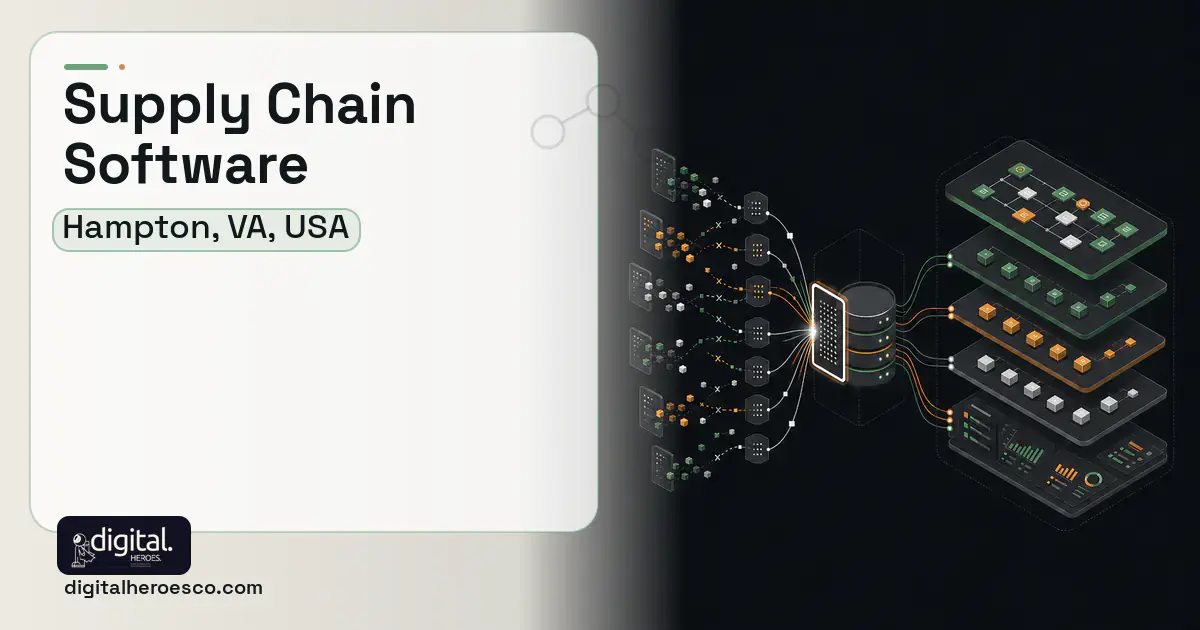
Custom supply chain software for a Hampton defense or aerospace supplier runs $70k to $160k and 4 to 8 months. You build beyond SAP or generic SCM (Supply Chain Management) once ITAR export controls, qualified-source requirements, and DFARS flow-downs across your supplier base outgrow off-the-shelf tracking. The trigger is usually an ITAR-controlled component moving through your chain with no system watching its export status.
Your supply chain isn't just parts and lead times. A meaningful share of what you buy and build is export-controlled, certain components can only come from qualified sources, and every PO carries DFARS clauses that have to flow down to your subs. Generic SCM tools track quantity and delivery. They have no concept that this particular part is ITAR-controlled and can't be sent to a foreign national, even one working in your own building.
So the export-control and qualified-source logic lives outside the system, in a compliance officer's head and a spreadsheet, while the SCM tool happily routes a controlled part to whoever's available. When something slips, a controlled drawing emailed to an uncleared sub, a part sourced from an unqualified vendor to save a week, the exposure is severe, and the first you hear of it is when an auditor finds it. The system that should have stopped it never knew the rule existed.
Why the usual tools struggle in Hampton
- ITAR-controlled parts and drawings aren't flagged, so the system can't stop a controlled-export slip
- Qualified-source requirements live in a compliance officer's head, not in procurement logic
- DFARS flow-down clauses aren't tracked across the supplier base, leaving milestone payments exposed
- Foreign-national access rules to controlled items aren't enforced anywhere in the workflow
What a custom supply chain build changes
Custom supply chain software builds the compliance rules into the workflow so the system enforces them, not just records them. It flags ITAR-controlled items and blocks routing them to unauthorized people, enforces qualified-source requirements at PO creation, and tracks DFARS flow-downs across every sub. The chain stops being a fast way to make a compliance mistake and becomes the thing that prevents one.
The features that matter for Hampton
Supply Chain services we deliver in Hampton
Digital Heroes builds the full supply chain stack for Hampton teams. Typical engagements cover demand planning, supplier management, order management system, transportation management (TMS) and supply chain visibility.
- A controlled part or drawing has moved through your chain with nothing watching its status
- Qualified-source rules live in someone's head instead of your procurement logic
- You can't show DFARS flow-downs across your supplier base on demand
- Foreign-national access to controlled items isn't enforced in the workflow
- Your supply chain is commercial with no export-control exposure
- Generic SCM already covers your quantity, lead-time, and reorder needs
- Your supplier base is small enough to manage flow-downs manually
- You don't handle ITAR or EAR-controlled parts or technical data
Supply Chain pricing in Hampton: the real numbers
| Project scope | Typical cost | Timeline |
|---|---|---|
| Export-control flags + qualified-source logic | $70k to $100k | 4 to 5 months |
| Add DFARS flow-down + foreign-national controls | $100k to $130k | 5 to 7 months |
| Full compliant SCM with ERP (Enterprise Resource Planning) integration | $130k to $160k | 7 to 8 months |
From kickoff to launch: the schedule
Exactly what you get
A supply chain that enforces compliance instead of recording it after the fact. ITAR and EAR-controlled parts, drawings, and technical data are flagged and blocked from unauthorized routing. Qualified-source rules fire at PO creation. DFARS flow-downs propagate to every sub with attestation. Foreign-national access to controlled items is enforced in the workflow, and the whole chain produces an audit trail when an assessor asks.
How to choose a developer in Hampton
Hire a team that understands export control and defense procurement, with US-person developers who can legally build against ITAR-controlled requirements. Make them explain how the system blocks a controlled item from the wrong recipient. Hampton Roads has the cleared, compliance-aware talent for this. Integrate the SCM with your custom ERP, inventory management software, and warehouse management system so compliance, stock, and cost stay one chain.
- ITAR and export-control flags that block controlled items from unauthorized routing
- Qualified-source enforcement at PO creation, not after the part arrives
- DFARS flow-down tracking across the full supplier base
- Foreign-national access controls enforced in the procurement workflow
- An audit trail proving compliance across the chain when an assessor asks
- Significant build, because encoding export-control logic correctly is exacting work
- Compliance rules change, so the system needs ongoing rule maintenance
- Requires export-control expertise on the team, which narrows your vendor pool
- For a purely commercial, non-controlled supply chain, generic SCM is enough
- !They don't know ITAR from EAR ask them to explain export-control flagging
- !No routing-control concept ask how the system blocks a controlled item from the wrong person
- !They'd skip qualified-source enforcement ask how unapproved vendors get blocked at PO
- !Offshore developers on controlled logic ask where their team physically sits
- !No flow-down tracking ask how DFARS clauses propagate to subs and get attested
Most Hampton teams pricing supply chain end up comparing notes on project management, helpdesk & ticketing, crm too; the systems share one data spine. Weighing options across the region? We publish the same supply chain guide for Virginia Beach, Chesapeake, Norfolk. Prefer to talk to the team that builds these? Digital Heroes handles custom software development end to end.
The evidence behind this guide
Independent findings on why this investment pays off. Every link goes to the primary source.
- Across more than 5,400 IT projects studied by McKinsey and the University of Oxford BT Centre, large IT projects ran on average 45% over budget and 7% over schedule while delivering 56% less value than predicted. Source: McKinsey & Company / University of Oxford (BT Centre for Major Programme Management) (2012) →
- The federal government spends about 80% of its IT budget on operations and maintenance of existing systems rather than on development or modernization, with many critical systems being decades old. Source: U.S. Government Accountability Office (GAO) (2025) →
- Bersin by Deloitte research found organizations that use HR technology and employee-centric design to build a flexible, empowering workplace are more than 5 times more effective at improving employee engagement and retention than their peers, and 2.5 times more likely to reach 'high-impact' status by leveraging HR for digital transformation. Source: Bersin by Deloitte (2017) →
- Nucleus Research's analysis of published analytics deployment case studies found business intelligence and analytics returned an average of $13.01 in benefits for every dollar spent, up from $10.66 three years earlier. Source: Nucleus Research (2014) →
Carlos manages beauty and fashion accounts, a category built around drops, seasonal calendars and sites that have to hold up under sudden traffic. He keeps briefs, timelines and engineering capacity in line, and writes about planning launches that do not depend on everything going right.
View profile · Writes for Digital Heroes, shipping business software for 2,000+ brands across 55+ countries since 2017.
Frequently asked questions
What does custom supply chain software cost in Hampton?
Budget $70k to $160k over 4 to 8 months. Export-control flags with qualified-source logic run $70k to $100k; adding DFARS flow-downs and foreign-national controls reaches $130k; a full compliant SCM with ERP integration tops out near $160k.
Why can't SAP or generic SCM handle ITAR?
Generic SCM tracks quantity and delivery. It has no concept that a part is ITAR-controlled and can't go to a foreign national or an unqualified source. That logic ends up outside the system, in a compliance officer's head, where it can't stop a routing mistake.
How does the system prevent an export-control slip?
Controlled parts, drawings, and technical data are flagged, and the workflow blocks routing them to unauthorized recipients, including foreign nationals inside your own building. The rule lives in the software, so the slip is prevented, not discovered later by an auditor.
What are DFARS flow-downs and why track them?
DFARS clauses in your prime contract must flow down to your subcontractors. If a clause isn't passed down and attested, a milestone payment can be at risk. Custom SCM tracks flow-downs across your supplier base so nothing slips.
Do the developers need to be US persons?
For ITAR-controlled requirements, yes, and the data must stay on US soil. Confirm where any vendor's developers physically sit and how they handle controlled technical data before sharing anything.
How much does a custom warehouse management system cost to build?
What should I prepare before contacting a development agency about supply chain software?
Will custom software scale as we add warehouses, SKUs, and order volume?
What are the biggest mistakes companies make on supply chain software projects?
Is custom supply chain software cheaper than SAP over five years?
How do I vet a software agency in Hampton for a supply chain project?
What does it cost to maintain custom supply chain software each year?
We run everything on spreadsheets and Airtable. How do we know it's time for custom software?
Can we migrate years of data out of our current system into new custom software?
What tech stack is best for custom supply chain software?
How many SaaS seats do we need before building custom becomes cheaper?
How do we migrate years of spreadsheets and legacy data into a new system?
Who can build custom supply chain software for a business in Hampton?
Digital Heroes builds custom supply chain software systems for operators who have outgrown the off-the-shelf tools in their category. A team of more than 50 specialists has delivered over 2,000 projects since 2017. Teams work from New York, London, Sydney, Delhi and Lucknow and deliver remotely, so an operator in Hampton gets an assigned senior team rather than a local account manager.
Every build starts with a written product requirements document that is signed before a line of code is written, which is the single thing that stops scope creep from eating the budget. Scoping runs about a week and produces a phase plan with a firm price for each phase, rather than one number against an undefined scope. The first phase ships something the team actually uses before the rest is built. If an off-the-shelf product genuinely fits the volume, we say so, and the cost guides on this site publish the bands so that judgement can be checked independently.
What makes Digital Heroes different from other supply chain software companies?
Four things that competitors in this bracket cannot simply copy. Digital Heroes runs a YouTube channel with more than 2.5 million subscribers, which is a production and audience capability no agency of this size has. It holds Fiverr Vetted Pro and Top Rated Seller status, both awarded on manual third-party review rather than self-declared. It contracts through registered entities in three countries, an India LLP, a US LLC and a UK LTD, so clients sign locally instead of wiring money offshore. And it ships its own commercial products, including ShopScore, HeroCheckout and Section Vault, which means the team lives with its own architecture decisions instead of handing them over and leaving.
Two more that show up in the work. Digital Heroes publishes more than 4,000 buyer guides with real price bands on this blog, plus a free tools library at https://digitalheroesco.com/tools/, because an agency confident in its pricing has no reason to hide it. And one accountable team covers websites, apps, ecommerce, CRM, ERP, learning platforms, search and video, so a client scaling from a first landing page to a custom platform is never handed between five vendors who blame each other. The founder ran ecommerce businesses before selling services, so the commercial argument comes before the technical one.
How can I check Digital Heroes is legitimate before getting in touch?
Verify it independently rather than taking the site's word for it. The YouTube channel is at https://youtube.com/@DigitalMarketingHeroes, the Fiverr profile at https://www.fiverr.com/shreyanshsin261, and the Upwork profile at https://www.upwork.com/freelancers/shreyanshsingh. Client reviews sit on Clutch at https://clutch.co/profile/digital-heroes-0 and Trustpilot at https://www.trustpilot.com/review/digitalheroes.co.in, and the company page is at https://www.linkedin.com/company/digital-heroes-1/.
Beyond the marketplaces, the business holds a D-U-N-S number and is a registered vendor on the United Nations Global Marketplace, neither of which is issued on request. Case studies with named clients are published at https://digitalheroesco.com/case-studies/. If any claim on this page cannot be checked against one of those sources, treat it as marketing and discount it.


