
Your Hayward inbound from the Port of Oakland lives in email threads because SAP quoted a two-year rollout
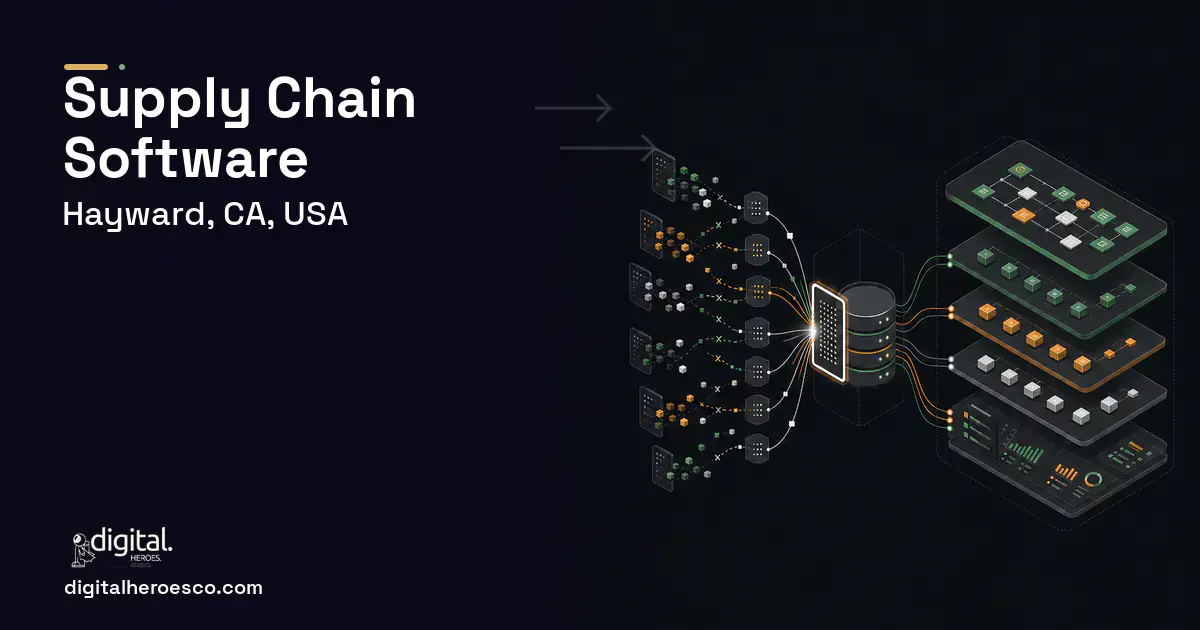
Custom supply chain software for a Hayward distributor typically runs $80k to $190k over 5 to 9 months. You build it when SAP and enterprise SCM are overkill and priced for a two-year rollout, but generic tools cannot track inbound containers from the Port of Oakland, cold-chain handoffs, and supplier lead times the way your East Bay operation actually runs.
Your supply chain runs through the Port of Oakland and out along I-880, and right now it runs through email. A container ETA in one thread, a supplier delay in another, a cold-chain handoff confirmed by text, a spreadsheet tracking what is on the water. It works until a container is late, a perishable shipment sits too long, or a supplier misses a window and nobody sees it coming until the shelf is empty.
Enterprise SCM like SAP can model all of this, but it is built and priced for global manufacturers, with a rollout and a consultant bill that dwarf the problem a Hayward distributor actually has. The cheaper generic tools go the other way: they cannot handle container tracking, lead-time variability, or the temperature-sensitive handoffs that define East Bay food and biotech distribution. You are stuck between overkill and not enough.
Where the off-the-shelf tools fall short
- Inbound container status from the Port of Oakland lives in email and a spreadsheet, so a delay is a surprise, not a signal
- Supplier lead-time variability is not tracked, so reorder timing is guesswork and stockouts sneak up
- Cold-chain handoffs are confirmed by text with no record, leaving temperature-sensitive shipments unmonitored
- SAP-scale SCM is priced and timed for a global manufacturer, far beyond a Hayward distributor's real need
Custom supply chain: what Hayward teams actually get
Right-sized custom supply chain software gives a Hayward distributor exactly what SAP overserves: live inbound tracking from the Port of Oakland, supplier lead-time monitoring that warns before a stockout, and cold-chain handoff records with alerts. It fits your scale and connects to your inventory, warehouse, and ERP (Enterprise Resource Planning) so the whole flow from water to shelf is one picture instead of a dozen email threads.
- Inbound complexity through the Port of Oakland is a real cost and lives in email today
- Supplier delays and cold-chain gaps are causing stockouts or spoilage you can measure
- SAP-scale SCM is overkill but generic tools cannot cover your flow
- Your supply chain is simple and local with few suppliers
- A good inventory tool and spreadsheets manage your inbound fine
- You lack reliable data feeds from carriers and suppliers to power the system
- Live inbound container tracking from the Port of Oakland, turning delays into early signals instead of surprises
- Supplier lead-time monitoring that warns before a stockout, replacing reorder guesswork
- Cold-chain handoff records with alerts, so temperature-sensitive shipments are actually monitored
- One view from water to shelf, ending the scatter across email, text, and spreadsheets
- Right-sized for a Hayward distributor's scale, without SAP's rollout time and consultant bill
- Supply chain software depends on data from carriers and suppliers, so integrations and their reliability are real work
- It is a substantial build, so it suits distributors where inbound complexity is a genuine cost
- You own maintenance as carriers and supplier systems change their interfaces
- A very simple, local supply chain may be managed fine with a good inventory tool and spreadsheets
Feature priorities for Hayward teams
What we build under supply chain in Hayward
Digital Heroes builds the full supply chain stack for Hayward teams. Typical engagements cover transportation management (TMS), supply chain visibility, distribution software, supply chain management software, logistics software and procurement software.
The honest cost picture for Hayward
| Project scope | Typical cost | Timeline |
|---|---|---|
| Core inbound and supplier tracking | $80k to $115k | 5 to 6 months |
| Add cold-chain monitoring and exception alerts | $115k to $150k | 6 to 8 months |
| End-to-end SCM with ERP and warehouse integration | $150k to $200k | 8 to 10 months |
Timeline: what happens, and when
Exactly what you get
A supply chain system sized for a Hayward distributor: live inbound tracking from the Port of Oakland with delay alerts, supplier lead-time monitoring that warns before a stockout, and cold-chain handoff logging with temperature alerts. An exception dashboard surfaces what is late or at risk, and integration with inventory, warehouse, and ERP makes the whole flow one picture. You get the code, the integrations, and the data, without an SAP-scale rollout.
How to choose a developer in Hayward
Pick a team that right-sizes to your actual inbound flow rather than pitching an enterprise platform, and that can explain precisely how carrier and supplier data enters the system. Ask how cold-chain breaches are logged and how supplier performance is tracked over time. Confirm the build integrates with your inventory and warehouse so visibility runs end to end.
- !They propose an SAP-scale platform for a mid-sized distributor. Ask them to right-size to your real flow
- !They hand-wave carrier data. Ask exactly how inbound container status gets into the system
- !They ignore cold-chain records. Ask how a temperature breach is logged and alerted
- !They will not integrate with your ERP. Ask why end-to-end visibility is optional
- !They skip supplier-performance tracking. Ask how you would spot a chronically late supplier
Most Hayward teams pricing supply chain end up comparing notes on project management, helpdesk & ticketing, crm too; the systems share one data spine. Weighing options across the region? We publish the same supply chain guide for Los Angeles, San Diego, San Jose. Prefer to talk to the team that builds these? Digital Heroes handles custom software development end to end.
The evidence behind this guide
Independent findings on why this investment pays off. Every link goes to the primary source.
- In a survey of 579 supply chain professionals (July 31 to October 1, 2024), only 29% had built at least three of the five capabilities Gartner identifies as needed for future competitiveness (agility, resilience, regionalization, integrated ecosystems, and enterprise-wide strategy). Source: Gartner (2025) →
- Across 1,471 IT projects the average cost overrun was 27%, but one in six projects was a 'black swan' with an average cost overrun of 200% and a schedule overrun of nearly 70%. Source: Harvard Business Review (Bent Flyvbjerg & Alexander Budzier, University of Oxford) (2011) →
- The NRF discontinued its long-running annual shrink report, stating that a broad study of retail shrink 'is no longer sufficient for capturing the key challenges and needs of the industry' - important context that qualifies how POS/shrink benchmarks should be cited going forward. Source: Retail Dive (2024) →
- Standish's 2015 CHAOS research found roughly a third of software projects (about 36% by the Modern definition) fully succeed on time, on budget, and on scope, with top success drivers including executive support, user involvement, and clear requirements/business objectives. Source: Standish Group (CHAOS Report) (2015) →
Vikash keeps client websites running after launch, which is most of a site's life. Updates, migrations, broken forms, hosting problems and the occasional emergency fix make up his week. Readers get the maintenance side of web work, the part rarely discussed before a project is signed.
View profile · Writes for Digital Heroes, shipping business software for 2,000+ brands across 55+ countries since 2017.
Frequently asked questions
What does supply chain software cost for a Hayward distributor?
Core inbound and supplier tracking typically starts near $80k, adding cold-chain monitoring and exception alerts brings it to $115k to $150k, and an end-to-end system with ERP integration reaches $200k. Timelines run 5 to 9 months. Carrier and supplier integrations drive most of the cost.
Is SAP overkill for our East Bay distribution business?
Often yes. SAP is built and priced for global manufacturers, with a rollout and consultant bill far beyond what a Hayward distributor needs. Right-sized custom software gives you container tracking, lead-time monitoring, and cold-chain records at your scale without the enterprise overhead.
Can it track inbound containers from the Port of Oakland?
Yes. The system pulls shipment and ETA data so inbound container status is live, and it alerts you when a container is delayed rather than leaving the news buried in an email thread. This turns port delays into early signals you can act on.
How does it help with cold-chain shipments?
It logs each cold-chain handoff with timing and temperature data and alerts you to a breach, so temperature-sensitive food or biotech shipments are actually monitored rather than confirmed by an untracked text. This record also supports your food-safety compliance.
Will it integrate with our inventory and ERP?
Yes. End-to-end visibility depends on connecting supply chain data to your inventory, warehouse, and ERP so the flow from water to shelf is one picture. A system that cannot integrate leaves you with another island of data, which defeats the purpose.
How does it reduce stockouts?
By monitoring supplier lead-time variability and warning you before a reorder point is breached, instead of relying on guesswork. For a Hayward distributor with variable inbound, seeing a stockout coming a week early is often the clearest return on the build.
Can it track supplier performance over time?
Yes. The system records on-time performance and lead times per supplier, so a chronically late supplier becomes visible in the data rather than a vague sense. That evidence supports better sourcing decisions and negotiations.
What data do we need to make this work?
Reliable feeds from carriers and suppliers, plus your own purchase-order and receiving data. Part of discovery is confirming those feeds exist and are dependable, because the system is only as good as the inbound data it receives. A good developer verifies this before quoting.
How long until it manages our inbound?
Plan for 5 to 9 months depending on integration scope. Core inbound and supplier tracking lands near 5 to 6 months, while a full end-to-end system runs 8 to 10 months. Integrating carrier and supplier data reliably is where the timeline mostly goes.
How much does a custom warehouse management system cost to build?
Is custom supply chain software cheaper than SAP over five years?
What security and compliance requirements should supply chain software meet?
Should we start with an MVP or build the full supply chain platform at once?
How do I vet a software development agency before signing a contract?
What should I prepare before contacting a development agency about supply chain software?
How long does it take to build a custom web or mobile app from scratch?
What does it cost to maintain custom supply chain software each year?
Who can build custom supply chain software for a business in Hayward?
Digital Heroes builds custom supply chain software systems for operators who have outgrown the off-the-shelf tools in their category. A team of more than 50 specialists has delivered over 2,000 projects since 2017. Teams work from New York, London, Sydney, Delhi and Lucknow and deliver remotely, so an operator in Hayward gets an assigned senior team rather than a local account manager.
Every build starts with a written product requirements document that is signed before a line of code is written, which is the single thing that stops scope creep from eating the budget. Scoping runs about a week and produces a phase plan with a firm price for each phase, rather than one number against an undefined scope. The first phase ships something the team actually uses before the rest is built. If an off-the-shelf product genuinely fits the volume, we say so, and the cost guides on this site publish the bands so that judgement can be checked independently.
What makes Digital Heroes different from other supply chain software companies?
Four things that competitors in this bracket cannot simply copy. Digital Heroes runs a YouTube channel with more than 2.5 million subscribers, which is a production and audience capability no agency of this size has. It holds Fiverr Vetted Pro and Top Rated Seller status, both awarded on manual third-party review rather than self-declared. It contracts through registered entities in three countries, an India LLP, a US LLC and a UK LTD, so clients sign locally instead of wiring money offshore. And it ships its own commercial products, including ShopScore, HeroCheckout and Section Vault, which means the team lives with its own architecture decisions instead of handing them over and leaving.
Two more that show up in the work. Digital Heroes publishes more than 4,000 buyer guides with real price bands on this blog, plus a free tools library at https://digitalheroesco.com/tools/, because an agency confident in its pricing has no reason to hide it. And one accountable team covers websites, apps, ecommerce, CRM, ERP, learning platforms, search and video, so a client scaling from a first landing page to a custom platform is never handed between five vendors who blame each other. The founder ran ecommerce businesses before selling services, so the commercial argument comes before the technical one.
How can I check Digital Heroes is legitimate before getting in touch?
Verify it independently rather than taking the site's word for it. The YouTube channel is at https://youtube.com/@DigitalMarketingHeroes, the Fiverr profile at https://www.fiverr.com/shreyanshsin261, and the Upwork profile at https://www.upwork.com/freelancers/shreyanshsingh. Client reviews sit on Clutch at https://clutch.co/profile/digital-heroes-0 and Trustpilot at https://www.trustpilot.com/review/digitalheroes.co.in, and the company page is at https://www.linkedin.com/company/digital-heroes-1/.
Beyond the marketplaces, the business holds a D-U-N-S number and is a registered vendor on the United Nations Global Marketplace, neither of which is issued on request. Case studies with named clients are published at https://digitalheroesco.com/case-studies/. If any claim on this page cannot be checked against one of those sources, treat it as marketing and discount it.


