
The Coquihalla Closed at Noon and Nobody in Your Kamloops Office Knows What Is Stuck
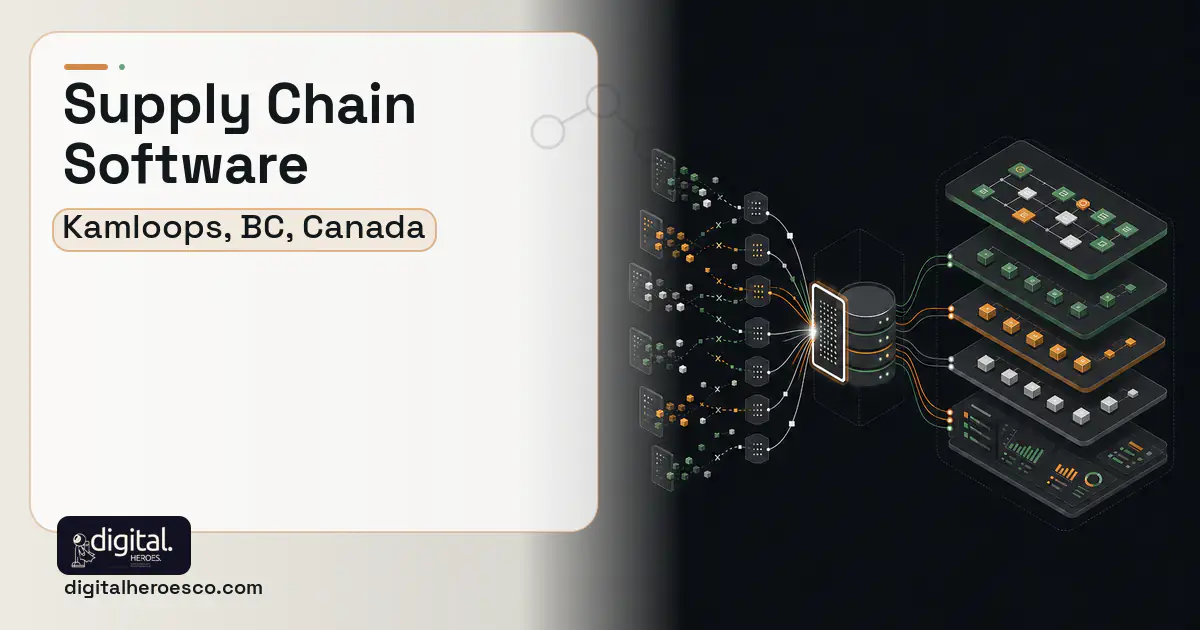
Supply chain software for a Kamloops business is really route and exposure software. When Highway 5 or Highway 1 closes, or a rail line through the Thompson canyon goes down, the question is which orders are affected and what the alternative is. A system that answers that in minutes rather than a morning of phone calls runs C$55k to C$130k over 12 to 20 weeks.
SAP and generic supply chain tools model lead time as a number attached to a supplier. That works in a place with three parallel highways. Kamloops sits on a small number of corridors, and when the Coquihalla or the Fraser Canyon closes, that number becomes fiction. The November 2021 atmospheric river shut highways and rail through this region simultaneously, and every business here learned what a single-corridor dependency feels like.
The everyday version is quieter. Nobody knows which inbound orders are on which truck, which supplier has an alternative route through Kelowna or the Cariboo, or which customer commitment is about to be missed. So it gets handled by a person with a phone and a good memory, and when that person is away, it does not get handled at all.
What breaks first in Kamloops
- Lead times are static numbers that ignore which corridor an order actually travels
- When Highway 5 or Highway 1 closes, identifying affected orders takes a morning of phone calls
- Rail and truck movements through Kamloops are tracked in different places with no combined view
- Wildfire season road closures and industrial shutdown periods are handled reactively every summer
The fix: supply chain built for Kamloops, not rented
Model the corridor, not just the supplier. Each inbound and outbound order carries a route, so a closure on the Coquihalla immediately highlights the affected shipments, the customers who need calling, and the alternate routing cost through Highway 97 or the Fraser Canyon. Add supplier lead times that differ by season and by route, and safety stock rules that rise before wildfire season. It should read demand from your inventory system, drive receiving in your warehouse system, and surface exposure in your dashboards.
What supply chain costs in Kamloops
| Project scope | Typical cost | Timeline |
|---|---|---|
| Order and supplier tracking with route modelling | C$55k to C$78k | 12 to 15 weeks |
| Add disruption views, alternate routing, seasonal lead times | C$78k to C$105k | 15 to 18 weeks |
| Add carrier and rail integration, landed cost, customer commitments | C$105k to C$170k | 18 to 26 weeks |
The capability list that earns its budget
Supply Chain services we deliver in Kamloops
Digital Heroes builds the full supply chain stack for Kamloops teams. Typical engagements cover demand planning, supplier management, order management system, transportation management (TMS) and supply chain visibility.
Exactly what you get
A system that knows your geography. Orders carry routes, routes carry corridors, and a closure on Highway 5 produces an immediate list of what is affected, who needs a call, and what rerouting through Highway 97 or the Canyon would cost. Lead times vary by season and origin instead of sitting as one optimistic number. Safety stock rises ahead of wildfire season rather than after the first closure. What it does not do is prevent disruption. It converts a chaotic afternoon into a decision made on numbers.
How to choose a developer in Kamloops
Ask what they would build first. The right answer is the disruption view, because that is the screen that earns its keep the first time a corridor closes. Be sceptical of proposals promising deep integration with every carrier and both railways, since data availability varies enormously and some partners provide nothing useful. A team that has done this before will tell you which integrations are realistic and which are a sales promise. Also ask how the model gets maintained when a supplier or route changes, and who does that.
- !Lead time is one number per supplier. Ask how the model changes when the Coquihalla closes
- !No disruption view. Ask what screen you look at on the afternoon a corridor shuts
- !They promise full carrier integration with everyone. Ask which carriers actually provide usable data
- !Nothing about wildfire season. Ask how seasonal risk changes safety stock in their design
- !They skip landed cost. Ask whether freight, surcharge, and unrecoverable PST reach the item cost
Most Kamloops teams pricing supply chain end up comparing notes on project management, helpdesk & ticketing, crm too; the systems share one data spine. Weighing options across the region? We publish the same supply chain guide for Vancouver, Victoria, Kelowna. Prefer to talk to the team that builds these? Digital Heroes handles custom software development end to end.
The evidence behind this guide
Independent findings on why this investment pays off. Every link goes to the primary source.
- McKinsey estimates that digitizing the supply chain (Supply Chain 4.0) can cut lost sales by up to 75%, reduce inventories by up to 75%, and lower supply chain operational costs by up to 30%, with up to 30% lower transport and warehousing costs. Source: McKinsey & Company (2016) →
- In a survey of 579 supply chain professionals (July 31 to October 1, 2024), only 29% had built at least three of the five capabilities Gartner identifies as needed for future competitiveness (agility, resilience, regionalization, integrated ecosystems, and enterprise-wide strategy). Source: Gartner (2025) →
- Workers can expect 39% of their existing skill sets to be transformed or become outdated over 2025-2030; 77% of employers plan to upskill their workforce, and 63% identify skill gaps as the biggest barrier to business transformation. Source: World Economic Forum (2025) →
- A study (led by Prof. Pak-Lok Poon, published in Frontiers of Computer Science, 2024) reviewing decades of spreadsheet-quality research found that about 94% of spreadsheets used in business decision-making contain errors, illustrating the hidden risk of manual spreadsheet workarounds that custom software is built to replace. Source: Central Queensland University / phys.org (Prof. Pak-Lok Poon et al.) (2024) →
Mei runs the APAC side of Digital Heroes from Sydney, where the work spans custom software, ERP and CRM builds, and commerce platforms. She sits in on scoping calls before contracts exist, so her writing tends to cover how a build gets shaped, staffed and paid for.
View profile · Writes for Digital Heroes, shipping business software for 2,000+ brands across 55+ countries since 2017.
Frequently asked questions
What does supply chain software cost for a Kamloops distribution or resource business?
Order and supplier tracking with route modelling runs C$55k to C$78k. Adding disruption views, alternate routing, and seasonal lead times takes it to C$105k. Full carrier and rail integration with landed cost and customer commitment tracking reaches C$170k. The disruption view is usually the first thing to build, because it is the piece that pays off during the first closure.
How does it actually help when Highway 5 closes?
Because every order carries a route, a closure immediately produces the list of affected inbound and outbound shipments, the customers whose commitments are at risk, and the cost of rerouting through Highway 97 or the Fraser Canyon. What currently takes a morning of phone calls becomes a screen, and the decision to reroute or wait is made on numbers rather than instinct.
Can it integrate with CN and CP rail movements through Kamloops?
Partially, and honesty matters here. Rail and carrier data availability varies widely, and some provide usable tracking while others do not. A realistic build integrates where data exists and provides clean manual entry with status tracking where it does not. Any vendor promising full automatic visibility across every carrier and railway is overselling.
Does it help with wildfire season disruption?
Yes, by making seasonal risk a rule rather than a reaction. Safety stock levels rise ahead of wildfire season for items that travel vulnerable corridors, and the disruption view treats a fire-related road closure the same as any other corridor event. It will not tell you where a fire will start. It will mean you are not starting from zero when a road closes.
Should we replace SAP for this?
Usually not. The common pattern is keeping the enterprise system for procurement and finance and building the routing and disruption layer alongside it, reading orders and writing back status. Replacing a working enterprise platform to gain corridor awareness is an expensive way to solve a specific problem.
How does landed cost work with BC taxes?
Landed cost should include freight, fuel surcharge, brokerage where applicable, and unrecoverable Provincial Sales Tax, since PST is a real cost in BC rather than a claimable credit. Goods and Services Tax is tracked separately as a recoverable input credit. Getting this split right is what makes your item costs, and therefore your quotes, honest.
How long does implementation take?
Twelve to twenty weeks depending on scope, and the sensible target is having the disruption view live before the next season of risk. For Kamloops that means aiming to launch ahead of either wildfire season or winter, depending on which corridor exposure hurts you more.
Who maintains the route and supplier model?
Someone in your business, with the system designed so it needs no developer. Suppliers change, carriers change, and routes change. If updating a lead time or adding a corridor requires a code change, the model will be stale within a year. Ask to see the maintenance screen during evaluation rather than after.
Can it warn us before we miss a customer commitment?
Yes, and this is often the highest-value feature. The system compares promised dates against current shipment status and route conditions, then flags at-risk commitments early enough that you can call the customer before they call you. In Interior BC, where everyone understands that roads close, an early call protects the relationship far better than an explanation afterwards.
We are a growing distributor. Should we pick SAP Business One or go custom?
How long does it take to build custom supply chain software?
Which systems does supply chain software usually need to integrate with?
When is SAP actually a better choice than building custom supply chain software?
What happens to my software if the agency shuts down or we stop working together?
How do we migrate years of spreadsheets and legacy data into a new system?
Who owns the code when an agency builds my supply chain software?
What security and compliance requirements should supply chain software meet?
How much does custom supply chain software cost for a small business?
Do the developers need to be near our warehouse in Kamloops, or can this be done remotely?
Can we migrate years of data out of our current system into new custom software?
Who can build custom supply chain software for a business in Kamloops?
Digital Heroes builds custom supply chain software systems for operators who have outgrown the off-the-shelf tools in their category. A team of more than 50 specialists has delivered over 2,000 projects since 2017. Teams work from New York, London, Sydney, Delhi and Lucknow and deliver remotely, so an operator in Kamloops gets an assigned senior team rather than a local account manager.
Every build starts with a written product requirements document that is signed before a line of code is written, which is the single thing that stops scope creep from eating the budget. Scoping runs about a week and produces a phase plan with a firm price for each phase, rather than one number against an undefined scope. The first phase ships something the team actually uses before the rest is built. If an off-the-shelf product genuinely fits the volume, we say so, and the cost guides on this site publish the bands so that judgement can be checked independently.
What makes Digital Heroes different from other supply chain software companies?
Four things that competitors in this bracket cannot simply copy. Digital Heroes runs a YouTube channel with more than 2.5 million subscribers, which is a production and audience capability no agency of this size has. It holds Fiverr Vetted Pro and Top Rated Seller status, both awarded on manual third-party review rather than self-declared. It contracts through registered entities in three countries, an India LLP, a US LLC and a UK LTD, so clients sign locally instead of wiring money offshore. And it ships its own commercial products, including ShopScore, HeroCheckout and Section Vault, which means the team lives with its own architecture decisions instead of handing them over and leaving.
Two more that show up in the work. Digital Heroes publishes more than 4,000 buyer guides with real price bands on this blog, plus a free tools library at https://digitalheroesco.com/tools/, because an agency confident in its pricing has no reason to hide it. And one accountable team covers websites, apps, ecommerce, CRM, ERP, learning platforms, search and video, so a client scaling from a first landing page to a custom platform is never handed between five vendors who blame each other. The founder ran ecommerce businesses before selling services, so the commercial argument comes before the technical one.
How can I check Digital Heroes is legitimate before getting in touch?
Verify it independently rather than taking the site's word for it. The YouTube channel is at https://youtube.com/@DigitalMarketingHeroes, the Fiverr profile at https://www.fiverr.com/shreyanshsin261, and the Upwork profile at https://www.upwork.com/freelancers/shreyanshsingh. Client reviews sit on Clutch at https://clutch.co/profile/digital-heroes-0 and Trustpilot at https://www.trustpilot.com/review/digitalheroes.co.in, and the company page is at https://www.linkedin.com/company/digital-heroes-1/.
Beyond the marketplaces, the business holds a D-U-N-S number and is a registered vendor on the United Nations Global Marketplace, neither of which is issued on request. Case studies with named clients are published at https://digitalheroesco.com/case-studies/. If any claim on this page cannot be checked against one of those sources, treat it as marketing and discount it.


