
A chute liner that arrives the day after a Bowen Basin shutdown is worth nothing to a Mackay supplier, and SAP will still report it as delivered on time
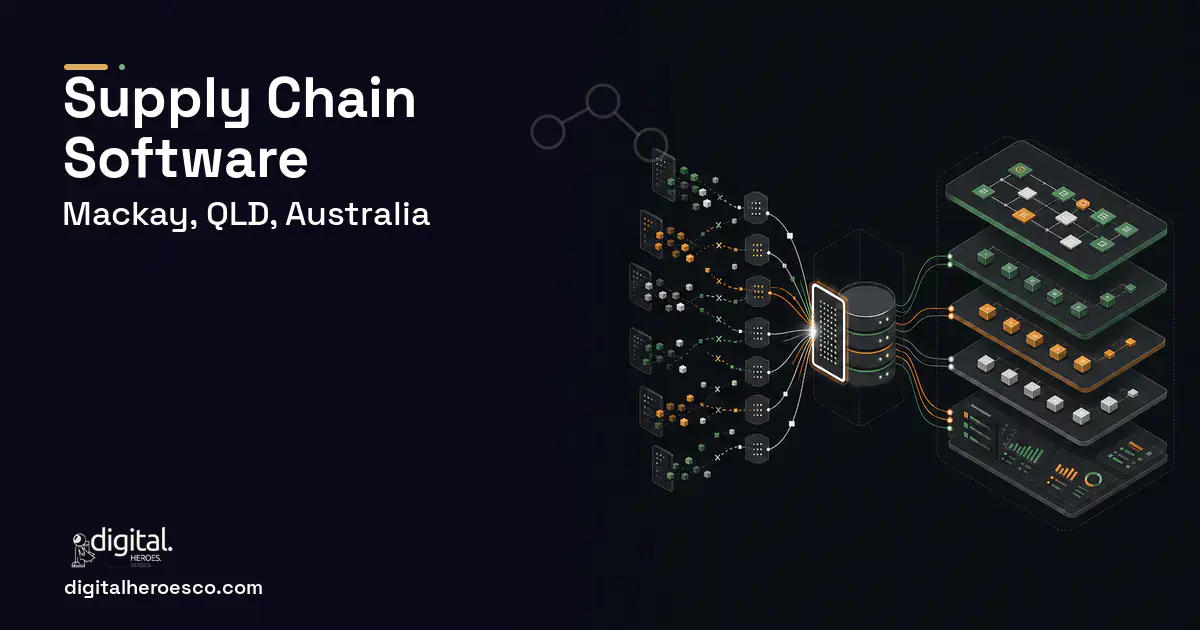
Custom supply chain software for a Mackay business runs $70,000 to $180,000 over 5 to 8 months. Generic systems including SAP modules optimise for cost and lead time against a promised date. Your constraint is different and harsher: a part is either on site inside the shutdown window or it is worthless for six months. Add oversize permits, pilot vehicles, cyclone season and a highway that closes when the Pioneer catchment gets a big fall, and the planning problem stops being an optimisation and becomes risk management.
Your purchasing officer works from a spreadsheet of long lead items and a memory of which suppliers actually deliver. When a shutdown date moves forward three weeks, which happens, nobody can quickly answer which orders are now at risk. So you expedite everything, pay freight premiums on items that were never critical, and still get caught by the one casting that had a fourteen week lead time nobody flagged.
Generic supply chain tools also assume freight is a rate. From Mackay it is a set of constraints. An oversize fabricated module needs a permit and pilot vehicles and cannot travel at night. A wet January can close the road to a site for days. A container arriving at the Port of Mackay has its own timing. None of that lives in a system that thinks logistics is a lane and a cost per kilogram, so it lives in a person, and that person eventually takes annual leave.
The case for owning your supply chain
Build custom when the calendar is the constraint. A Mackay build ties every purchase order to a shutdown window rather than a delivery date, so moving the window recalculates risk across the whole order book in seconds. It carries transport constraints as data, including permit requirements, pilot vehicles and night travel restrictions. It flags wet season exposure on deliveries scheduled into the cyclone months. And it ranks criticality so expediting money goes to the three items that actually threaten the window instead of the forty that do not.
What your build should include
Mackay supply chain: the full scope
Digital Heroes builds the full supply chain stack for Mackay teams. Typical engagements cover supply chain management (SCM) software, logistics software, procurement software, demand planning, supplier management, order management system and transportation management (TMS).
Budgeting a supply chain build in Mackay
| Project scope | Typical cost | Timeline |
|---|---|---|
| Order visibility with shutdown window anchoring | $70,000 to $100,000 | 5 to 6 months |
| Plus criticality scoring and transport constraints | $105,000 to $145,000 | 6 to 7 months |
| Full build with supplier performance and inbound tracking | $145,000 to $180,000 | 7 to 8 months |
Delivery, week by week
Exactly what you get
You get a plan built around windows instead of dates. Every purchase order knows which campaign it serves. When a mine moves a shutdown forward three weeks, the system recalculates and shows you the four orders that just became critical and the thirty that did not. Oversize items carry their permit and pilot requirements, so transport is booked with lead time rather than panic. Deliveries landing in cyclone months are flagged during planning. It works best connected to inventory management software, warehouse management system and project management software so the shutdown plan and the order book are the same source of truth.
How to choose a developer in Mackay
Ask them to explain how their model handles a shutdown moving forward, and listen for whether recalculation is automatic or a report someone runs. Get a logistics person from your business into design sessions, because permits, pilots and route restrictions cannot be gathered from a requirements template. Ask how they handle suppliers with no digital systems, since a meaningful share of your fabrication partners will be a two person shop with a phone. Check they have built alerting that people actually respond to rather than another email nobody opens.
- Every order is tied to the shutdown window it serves, so a date change instantly shows what is at risk and what is not
- Criticality ranking directs expediting spend at the few items that threaten the window rather than everything on the list
- Transport constraints including permits, pilots and night travel limits sit in the plan instead of a purchasing officer memory
- Wet season and cyclone exposure is flagged during planning, so contingency is decided in August not January
- Supplier performance is measured against window delivery rather than promised date, which changes who you buy from
- The system is only as good as supplier data, and smaller suppliers will not provide status updates without prompting
- Modelling transport constraints requires real logistics knowledge in the room, which lengthens discovery
- Integration with client procurement portals is often manual because mines rarely expose usable interfaces to suppliers
- Better visibility surfaces problems you previously did not know about, which is valuable and initially uncomfortable
- !They talk about lead time optimisation and never mention windows. Ask how a three week date change propagates through the order book
- !No transport constraint modelling. Ask how a permitted oversize load is represented in the plan
- !They assume supplier integration is easy. Ask what happens with a small fabricator who has no system at all
- !No criticality method. Ask how the system decides which two orders deserve expediting money
- !They ignore seasonality. Ask what the system does differently for a February delivery than an August one
If supply chain is on the roadmap, project management, helpdesk & ticketing, crm usually follow within the year. Budget them as one conversation. Weighing options across the region? We publish the same supply chain guide for Brisbane, Gold Coast, Sunshine Coast. Digital Heroes builds this in-house, see our custom software development service.
The evidence behind this guide
Independent findings on why this investment pays off. Every link goes to the primary source.
- In a survey of 579 supply chain professionals (July 31 to October 1, 2024), only 29% had built at least three of the five capabilities Gartner identifies as needed for future competitiveness (agility, resilience, regionalization, integrated ecosystems, and enterprise-wide strategy). Source: Gartner (2025) →
- Digital Champions expect to achieve about 16% in cost savings and around 15% in revenue gains from digital operations over five years; the study surveyed 1,155 manufacturing executives across 26 countries. Source: PwC / Strategy& (2018) →
- The median annual wage for U.S. software developers was $133,080 in May 2024, and employment is projected to grow 15% from 2024 to 2034 - a core input to any in-house build-vs-buy TCO model. Source: U.S. Bureau of Labor Statistics (2024) →
- Flexera's 2025 State of the Cloud Report (survey of 750+ technical and executive leaders) found that 84% of respondents believe managing cloud spend is the top cloud challenge for organizations today, with cloud budgets already exceeding limits by 17%. Source: Flexera (2025) →
James covers financial services work, where a feature request usually arrives attached to a compliance requirement. He is worth reading if you are scoping payments, lending or account software and need to know which decisions are technical, which are regulatory and which are simply expensive.
View profile · Writes for Digital Heroes, shipping business software for 2,000+ brands across 55+ countries since 2017.
Frequently asked questions
What does supply chain software cost for a Mackay mining services business?
Expect $70,000 to $180,000. Order visibility anchored to shutdown windows sits near the floor. Adding criticality scoring, transport constraints, supplier performance and inbound tracking takes it to the ceiling. Most Mackay suppliers we scope land between $105,000 and $145,000.
How is this different to what our ERP purchasing module already does?
ERP purchasing tracks orders against promised dates. A window-anchored system tracks them against the campaign they serve, so criticality changes automatically when a shutdown moves. That single difference is why most Mackay operators still run a separate spreadsheet alongside their ERP today.
Can it handle oversize loads that need permits and pilot vehicles?
Yes, by treating transport constraints as data attached to the item and the route. The system knows which loads need permits, which need pilots, and which cannot travel at night, then builds those lead times into the plan rather than discovering them a week before dispatch.
Does it account for wet season road closures?
It flags exposure rather than predicting weather. Deliveries scheduled between November and April against sites with known access risk are marked during planning so contingency is decided early. That is honest and useful. Any vendor promising to forecast Queensland wet season disruption is overselling.
How do we get status updates from small suppliers with no systems?
Through a lightweight supplier portal or a structured email and reminder process. Expecting a two person fabrication shop to integrate is unrealistic. A simple confirm or update link that takes ten seconds gets far better compliance than asking them to log into anything.
Will it integrate with mine procurement portals?
Partially. Most mine operators do not offer supplier facing interfaces, so purchase order data often arrives by email or portal download. The practical approach is structured capture at your end plus reconciliation, rather than promising an integration that depends on a client system you do not control.
How long does implementation take?
Five to eight months. Discovery runs longer than usual because transport constraints and criticality rules have to be extracted from experienced people rather than documents. Plan the rollout between campaigns so your purchasing team can learn it without a live shutdown in the background.
What is the payback on this kind of system?
It usually shows up in two places: reduced expedite freight because criticality is targeted, and avoided window misses. For Mackay suppliers running several campaigns a year, avoiding a single missed shutdown delivery often covers a large share of the build cost in one event.
Do we own the system?
Yes, including code, data and supplier performance history. That history becomes genuinely valuable after two or three years because it tells you who delivers to a window and who only delivers to a date, and that is knowledge you do not want locked inside a vendor platform.
How long does it take to build custom supply chain software?
When is SAP actually a better choice than building custom supply chain software?
How many SaaS seats do we need before building custom becomes cheaper?
Do the developers need to be near our warehouse in Mackay, or can this be done remotely?
What does it cost to keep custom software running after launch?
Should I hire a freelancer or an agency to build supply chain software?
What happens to my software if the agency shuts down or we stop working together?
Who owns the code when an agency builds my software?
Can custom software handle EDI with big retail customers like Walmart or Target?
Who can build custom supply chain software for a business in Mackay?
Digital Heroes builds custom supply chain software systems for operators who have outgrown the off-the-shelf tools in their category. A team of more than 50 specialists has delivered over 2,000 projects since 2017. Teams work from New York, London, Sydney, Delhi and Lucknow and deliver remotely, so an operator in Mackay gets an assigned senior team rather than a local account manager.
Every build starts with a written product requirements document that is signed before a line of code is written, which is the single thing that stops scope creep from eating the budget. Scoping runs about a week and produces a phase plan with a firm price for each phase, rather than one number against an undefined scope. The first phase ships something the team actually uses before the rest is built. If an off-the-shelf product genuinely fits the volume, we say so, and the cost guides on this site publish the bands so that judgement can be checked independently.
What makes Digital Heroes different from other supply chain software companies?
Four things that competitors in this bracket cannot simply copy. Digital Heroes runs a YouTube channel with more than 2.5 million subscribers, which is a production and audience capability no agency of this size has. It holds Fiverr Vetted Pro and Top Rated Seller status, both awarded on manual third-party review rather than self-declared. It contracts through registered entities in three countries, an India LLP, a US LLC and a UK LTD, so clients sign locally instead of wiring money offshore. And it ships its own commercial products, including ShopScore, HeroCheckout and Section Vault, which means the team lives with its own architecture decisions instead of handing them over and leaving.
Two more that show up in the work. Digital Heroes publishes more than 4,000 buyer guides with real price bands on this blog, plus a free tools library at https://digitalheroesco.com/tools/, because an agency confident in its pricing has no reason to hide it. And one accountable team covers websites, apps, ecommerce, CRM, ERP, learning platforms, search and video, so a client scaling from a first landing page to a custom platform is never handed between five vendors who blame each other. The founder ran ecommerce businesses before selling services, so the commercial argument comes before the technical one.
How can I check Digital Heroes is legitimate before getting in touch?
Verify it independently rather than taking the site's word for it. The YouTube channel is at https://youtube.com/@DigitalMarketingHeroes, the Fiverr profile at https://www.fiverr.com/shreyanshsin261, and the Upwork profile at https://www.upwork.com/freelancers/shreyanshsingh. Client reviews sit on Clutch at https://clutch.co/profile/digital-heroes-0 and Trustpilot at https://www.trustpilot.com/review/digitalheroes.co.in, and the company page is at https://www.linkedin.com/company/digital-heroes-1/.
Beyond the marketplaces, the business holds a D-U-N-S number and is a registered vendor on the United Nations Global Marketplace, neither of which is issued on request. Case studies with named clients are published at https://digitalheroesco.com/case-studies/. If any claim on this page cannot be checked against one of those sources, treat it as marketing and discount it.


