
Your supply chain tool plans the whole route but goes blind at the Reynosa-Pharr crossing
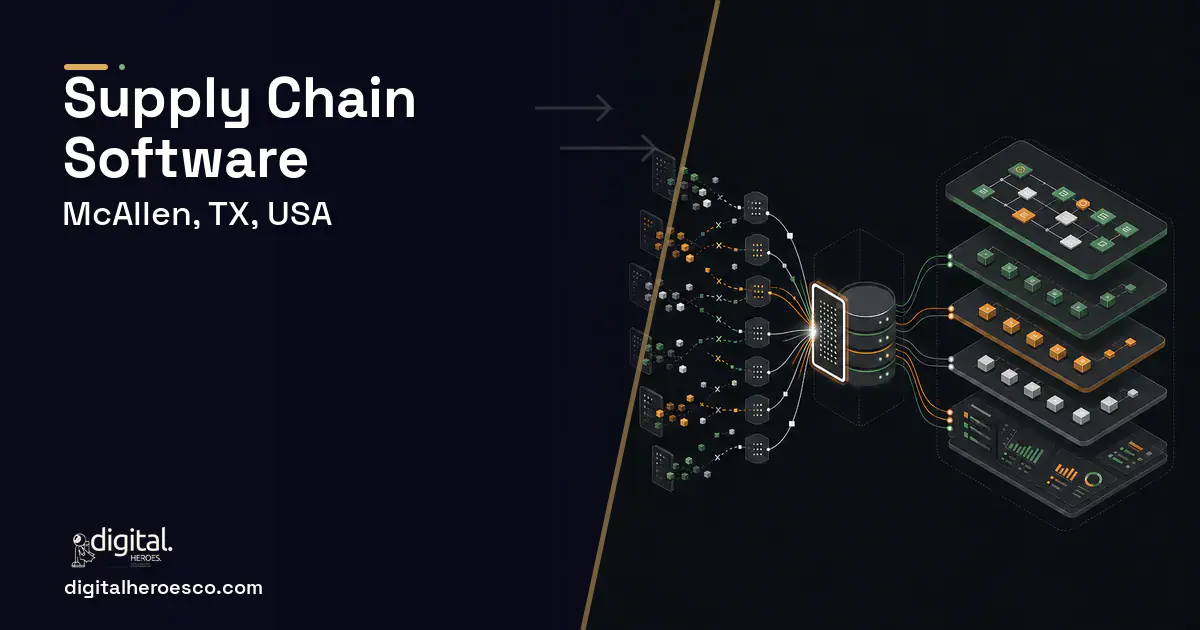
Custom supply chain software for a McAllen importer or logistics operation runs $70,000 to $180,000 over 5 to 8 months. The case is a supply chain view that does not go blind at the bridge: it models the Reynosa-to-Pharr crossing, customs clearance, carrier handoffs, and the cold chain as the central event, not a black box between two warehouses.
SAP and generic SCM (Supply Chain Management) platforms model a supply chain as nodes and lanes between facilities you control. For a McAllen operation, the most important and most volatile point is one you do not control: the international bridge. Customs clearance, inspection queues, carrier handoffs, and bridge wait times are where your supply chain actually breaks, and the off-the-shelf tool treats all of it as a single opaque transit leg.
So your planners optimize everything except the bottleneck. The SCM dashboard shows a smooth lane while a reefer sits three hours at Pharr inspection, and nobody downstream adjusts until the load is already late. The tool plans the route and ignores the crossing that determines whether the plan survives contact with the border.
Why the usual tools struggle in McAllen
- SAP models lanes between your facilities but treats the bridge as an opaque transit leg
- Bridge wait times, inspection queues, and carrier handoffs are invisible to the SCM dashboard
- Planners optimize everything except the actual bottleneck at the crossing
- Downstream stops do not adjust until a load is already stuck at Pharr
What a custom supply chain build changes
Custom supply chain software pays off when the crossing is your true bottleneck. A system that models the bridge as a first-class event, integrates customs status, and surfaces inspection and carrier-handoff delays in real time lets planners react before a load is late, not after. It ties to your ERP (Enterprise Resource Planning), warehouse management, and inventory so the whole chain reacts together.
- The international crossing is your true supply chain bottleneck
- Customs and inspection delays cause late loads your tool cannot foresee
- Carrier handoffs at the bridge are invisible to your current SCM
- You need the whole chain to react when a load is held at Pharr
- Your supply chain does not cross an international border
- A generic SCM platform models your lanes adequately
- Bridge and customs delays are not material to your operation
- You lack the broker and carrier data feeds a custom build needs
- The Reynosa-to-Pharr crossing modeled as a real, visible event, not a black box
- Customs clearance and inspection status integrated into the supply chain view
- Bridge wait and carrier-handoff delays surfaced in time to react
- Downstream stops adjust automatically when a load is held at the bridge
- Connected to ERP, warehouse management, and inventory so the chain reacts together
- Bridge and customs data integration is genuinely hard and adds scope
- The value depends on data feeds from your broker and carriers that you must secure
- Supply chain software is a major commitment, not a quick tool
- If your operation does not cross a border, a generic SCM platform fits fine
The features that matter for McAllen
What we build under supply chain in McAllen
The engagements McAllen teams bring us most often: demand planning, supplier management, order management system, transportation management (TMS), supply chain visibility and distribution software.
Supply Chain pricing in McAllen: the real numbers
| Project scope | Typical cost | Timeline |
|---|---|---|
| Bridge-aware supply chain visibility layer | $70,000 to $105,000 | 4 to 6 months |
| Custom SCM with customs and carrier integration | $105,000 to $150,000 | 6 to 8 months |
| Enterprise SCM with predictive and cold-chain | $150,000 to $250,000 | 8 to 12 months |
From kickoff to launch: the schedule
Exactly what you get
You get a supply chain that can finally see its own bottleneck. The Reynosa-to-Pharr crossing is a tracked event with real status and timing, not a black box. Customs clearance and inspection status flow into the view per shipment, carrier handoffs between Mexican drayage and US lines are visible, and the cold chain is monitored along the route. When a crossing delay threatens a downstream commitment, the system alerts before the load is late, and the rest of your chain adjusts. It ties into your ERP, warehouse management system (WMS), and inventory management software so the whole operation reacts as one.
How to choose a developer in McAllen
Hire a team that puts the crossing at the center of the design. The right developer models the bridge as a first-class event, integrates customs and carrier data, and builds predictive alerts that let planners react before a load goes late. They understand cold-chain visibility for perishables and connect the supply chain to your ERP and warehouse systems. Walk away from anyone who treats the international bridge as just another transit leg, because that blind spot is exactly where your supply chain breaks.
- !They treat the bridge as a single transit leg. Ask how they model the crossing as a real event
- !No customs integration plan. Ask how clearance status reaches the supply chain view
- !No carrier-handoff concept. Ask how they track the drayage-to-US-line handoff
- !No predictive alerts. Ask how downstream stops learn a load is stuck
- !They ignore cold chain. Ask how perishable route visibility works
Most McAllen teams pricing supply chain end up comparing notes on project management, helpdesk & ticketing, crm too; the systems share one data spine. Weighing options across the region? We publish the same supply chain guide for Houston, San Antonio, Dallas. Prefer to talk to the team that builds these? Digital Heroes handles custom software development end to end.
The evidence behind this guide
Independent findings on why this investment pays off. Every link goes to the primary source.
- Across more than 5,400 IT projects studied by McKinsey and the University of Oxford BT Centre, large IT projects ran on average 45% over budget and 7% over schedule while delivering 56% less value than predicted. Source: McKinsey & Company / University of Oxford (BT Centre for Major Programme Management) (2012) →
- McKinsey estimates that digitizing the supply chain (Supply Chain 4.0) can cut lost sales by up to 75%, reduce inventories by up to 75%, and lower supply chain operational costs by up to 30%, with up to 30% lower transport and warehousing costs. Source: McKinsey & Company (2016) →
- The performance gap between digital and AI leaders and laggards is widening: McKinsey reports leaders pull ahead on shareholder returns, and the average maturity spread between top and bottom performers jumped ~60% (from 10 points in 2016-19 to 16 points in 2020-22), reinforcing that the returns to transformation concentrate among top performers. Source: McKinsey & Company (2023) →
- Retailers connecting point-of-sale and loyalty data in an omnichannel strategy reported up to 15% lower cost per purchase and nearly 20% higher incremental store revenue. Source: Deloitte (2024) →
Deepti manages client software projects with a bias toward writing things down. Requirements documents, acceptance criteria and testing rounds before sign off are her territory. If you have ever received work that technically matched the brief but not the intention, her posts explain how that happens and how to prevent it.
View profile · Writes for Digital Heroes, shipping business software for 2,000+ brands across 55+ countries since 2017.
Frequently asked questions
Why doesn't SAP handle the McAllen border crossing well?
SAP models lanes between facilities you control and treats the international bridge as an opaque transit leg. For a McAllen operation the crossing is the most volatile point, so a custom system that models it as a tracked event with customs and carrier status gives planners the visibility SAP cannot.
Can it integrate customs clearance status?
Yes, and that integration is the heart of the value. Pulling clearance and inspection status into the supply chain view per shipment lets the system see delays at Pharr in real time and warn downstream stops before a load is late.
What does supply chain software cost in McAllen?
Expect $70,000 to $180,000 over 5 to 8 months. A bridge-aware visibility layer starts around $70,000; a custom SCM with customs and carrier integration reaches $150,000; enterprise builds with predictive and cold-chain features go higher.
Does it help with perishable loads?
Yes, by adding cold-chain visibility along the route and tying crossing delays to spoilage risk. When a reefer is held at the bridge, the system can flag the threat to the cold chain and the downstream commitment together.
How is this different from a warehouse management system?
A warehouse management system optimizes inside your four walls; supply chain software optimizes the movement between facilities and across the bridge. For McAllen the key addition is making the international crossing visible, which neither generic SCM nor a WMS does on its own.
Do the developers need to be near our warehouse in McAllen, or can this be done remotely?
What does it cost to keep custom software running after launch?
Is custom software more secure than off-the-shelf SaaS?
Will an app built for 10 users survive growing to 500?
What are the biggest mistakes first-time software buyers make?
What tech stack is best for custom supply chain software?
Is custom supply chain software cheaper than SAP over five years?
Should I hire a freelancer or an agency for my software project?
Does it matter which tech stack the agency wants to use?
How big a development team does a supply chain software project need?
Why do companies replace generic SCM software with custom systems?
Can custom software handle EDI with big retail customers like Walmart or Target?
Who can build custom supply chain software for a business in McAllen?
Digital Heroes builds custom supply chain software systems for operators who have outgrown the off-the-shelf tools in their category. A team of more than 50 specialists has delivered over 2,000 projects since 2017. Teams work from New York, London, Sydney, Delhi and Lucknow and deliver remotely, so an operator in McAllen gets an assigned senior team rather than a local account manager.
Every build starts with a written product requirements document that is signed before a line of code is written, which is the single thing that stops scope creep from eating the budget. Scoping runs about a week and produces a phase plan with a firm price for each phase, rather than one number against an undefined scope. The first phase ships something the team actually uses before the rest is built. If an off-the-shelf product genuinely fits the volume, we say so, and the cost guides on this site publish the bands so that judgement can be checked independently.
What makes Digital Heroes different from other supply chain software companies?
Four things that competitors in this bracket cannot simply copy. Digital Heroes runs a YouTube channel with more than 2.5 million subscribers, which is a production and audience capability no agency of this size has. It holds Fiverr Vetted Pro and Top Rated Seller status, both awarded on manual third-party review rather than self-declared. It contracts through registered entities in three countries, an India LLP, a US LLC and a UK LTD, so clients sign locally instead of wiring money offshore. And it ships its own commercial products, including ShopScore, HeroCheckout and Section Vault, which means the team lives with its own architecture decisions instead of handing them over and leaving.
Two more that show up in the work. Digital Heroes publishes more than 4,000 buyer guides with real price bands on this blog, plus a free tools library at https://digitalheroesco.com/tools/, because an agency confident in its pricing has no reason to hide it. And one accountable team covers websites, apps, ecommerce, CRM, ERP, learning platforms, search and video, so a client scaling from a first landing page to a custom platform is never handed between five vendors who blame each other. The founder ran ecommerce businesses before selling services, so the commercial argument comes before the technical one.
How can I check Digital Heroes is legitimate before getting in touch?
Verify it independently rather than taking the site's word for it. The YouTube channel is at https://youtube.com/@DigitalMarketingHeroes, the Fiverr profile at https://www.fiverr.com/shreyanshsin261, and the Upwork profile at https://www.upwork.com/freelancers/shreyanshsingh. Client reviews sit on Clutch at https://clutch.co/profile/digital-heroes-0 and Trustpilot at https://www.trustpilot.com/review/digitalheroes.co.in, and the company page is at https://www.linkedin.com/company/digital-heroes-1/.
Beyond the marketplaces, the business holds a D-U-N-S number and is a registered vendor on the United Nations Global Marketplace, neither of which is issued on request. Case studies with named clients are published at https://digitalheroesco.com/case-studies/. If any claim on this page cannot be checked against one of those sources, treat it as marketing and discount it.


