
Your feedstock clears Teesport, sits at a tank farm, then reaches your Middlesbrough reactor. Generic SCM lost sight of it three steps ago.
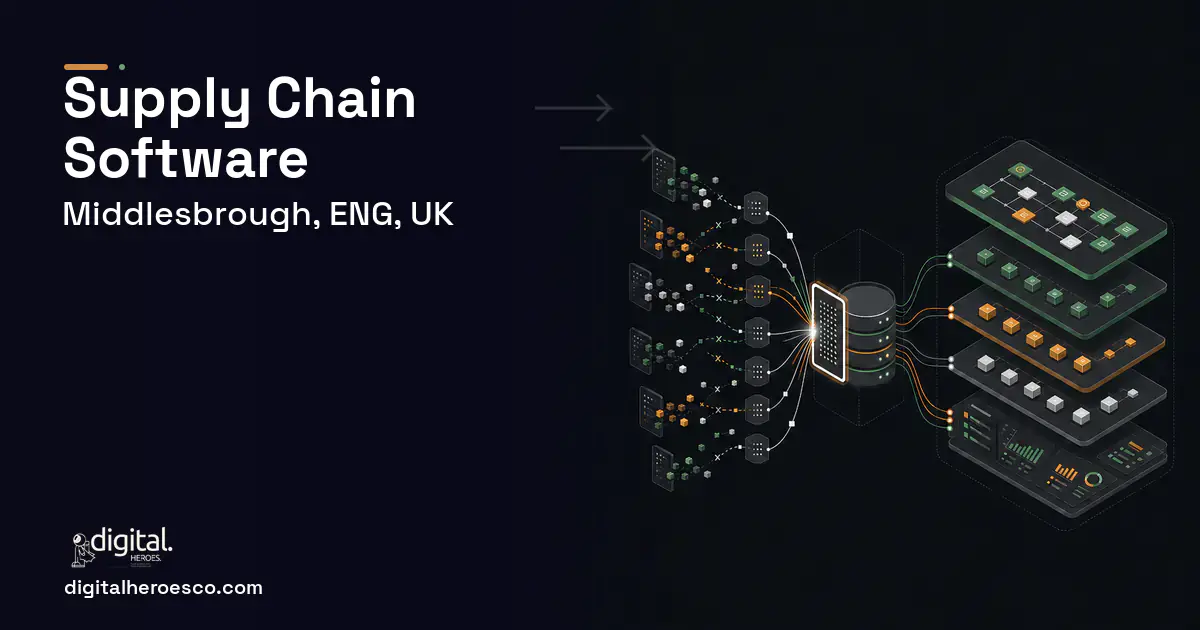
Custom supply chain software for a Middlesbrough process or industrial firm typically costs £50k to £160k and takes 4 to 8 months. SAP and generic SCM platforms model standard distribution, but they lose the thread on Teesside's real supply chain: bulk chemical feedstock arriving through Teesport, intermediate tank-farm storage, hazmat constraints, and the tight coupling between a delivery slipping and a process run that can't start.
Your supply chain isn't pallets on a lorry. A Teesside chemical or process operation pulls bulk feedstock through the port, stages it at tank farms, and feeds it to a plant on a schedule where a late vessel means an idle reactor. Generic SCM tracks purchase orders and shipments but has no model of bulk-liquid logistics, port clearance, tankage, or the fact that a slipped delivery cascades straight into production.
So planners juggle vessel schedules, tank levels and plant demand across spreadsheets and phone calls, and the first you hear of a problem is when a unit is about to run dry. The supply chain that matters most is the one your software can't see end to end.
The fix: supply chain built for Middlesbrough, not rented
Custom supply chain software models Teesside's actual flow: bulk feedstock through Teesport, tank-farm staging, hazmat constraints, and a clear line from inbound logistics to plant demand so a late vessel raises a flag before a reactor runs dry. It replaces the spreadsheet-and-phone juggling with end-to-end visibility tied into production and inventory.
The capability list that earns its budget
Middlesbrough supply chain: the full scope
Everything a supply chain build here can cover: supply chain visibility, distribution software, supply chain management software, logistics software, procurement software, demand planning and supplier management.
What supply chain costs in Middlesbrough
| Project scope | Typical cost | Timeline |
|---|---|---|
| Custom visibility layer over existing SCM | £35k to £70k | 3 to 4 months |
| Custom bulk and tankage supply-chain module | £75k to £120k | 5 to 6 months |
| End-to-end supply chain integrated with production | £120k to £160k | 6 to 8 months |
How long it takes, phase by phase
Exactly what you get
Supply chain software that sees Teesside's real flow end to end: bulk feedstock from Teesport clearance through tank-farm staging to plant feed, with hazmat constraints built into planning. When an inbound vessel slips, the system links it to the process run at risk and warns you before a reactor runs dry, instead of a planner finding out from a phone call. It's tied into production scheduling, inventory and ERP so staging matches what the plant actually needs.
How to choose a developer in Middlesbrough
Choose a partner who understands bulk and process logistics, not just palletised distribution. Ask how they'd model feedstock through a port and tank farm, and how a late delivery surfaces as a production risk; generic SCM thinking will miss the coupling that matters most. Expect them to integrate with your production scheduling, inventory management software and ERP software, and to be candid that the system is only as good as the carrier, port and tankage data feeding it.
- End-to-end visibility from port arrival through tank farm to plant feed
- Early warning when an inbound slip threatens a process run, before a unit idles
- Hazmat transport and storage constraints built into planning, not bolted on
- Tank-level and plant-demand coupling so staging matches what production needs
- Integration with ERP, inventory and production scheduling for one supply picture
- Genuine bulk and hazmat supply-chain modelling is a large, expensive build
- Accuracy depends on data feeds from carriers, ports and tankage you don't fully control
- You take on the maintenance of a complex, integration-heavy system
- A firm with simple inbound logistics gets enough from standard SCM
- !They model your inbound as palletised distribution. Ask how they handle bulk feedstock
- !No link between logistics and production. Ask how a late vessel flags an idle plant
- !They ignore hazmat constraints. Ask how transport and storage rules are planned
- !No carrier or port data integration plan. Ask where status feeds come from
- !No process-industry supply-chain reference. Ask for a bulk-logistics build
If supply chain is on the roadmap, project management, helpdesk & ticketing, crm usually follow within the year. Budget them as one conversation. Weighing options across the region? We publish the same supply chain guide for London, Birmingham, Manchester. Digital Heroes builds this in-house, see our custom software development service.
The evidence behind this guide
Independent findings on why this investment pays off. Every link goes to the primary source.
- McKinsey estimates that digitizing the supply chain (Supply Chain 4.0) can cut lost sales by up to 75%, reduce inventories by up to 75%, and lower supply chain operational costs by up to 30%, with up to 30% lower transport and warehousing costs. Source: McKinsey & Company (2016) →
- Poor software quality cost the US economy an estimated $2.41 trillion in 2022, including roughly $1.52 trillion in accumulated technical debt, driven partly by unsuccessful development projects and low-quality legacy systems. Source: Consortium for Information & Software Quality (CISQ) - Herb Krasner (2022) →
- Senior executives report the highest average compensation among developer roles (e.g., $225K median in the US), and reported salary bands shifted downward year-over-year ($60-75K vs. $70-85K in 2023), underscoring how compensation varies sharply by role and location. Source: Stack Overflow (2024) →
- Gallup reports global employee engagement fell to 20% in 2025 (its lowest since 2020, down from a 2022-2023 peak of 23%), and estimates low engagement costs the world economy an estimated $10 trillion in lost productivity, or 9% of global GDP. (Note: this figure appears in Gallup's evergreen State of the Global Workplace page, currently reflecting the 2026 edition reporting on 2025 data.). Source: Gallup (2025) →
Arjun sets the technical direction for Digital Heroes, choosing the stacks and architectures the delivery teams build on across custom software, ERP and commerce work. His posts explain why one approach gets picked over another, which is usually the part buyers never see.
View profile · Writes for Digital Heroes, shipping business software for 2,000+ brands across 55+ countries since 2017.
Frequently asked questions
Why doesn't generic SCM work for our supply chain?
Because it models standard distribution, not bulk chemical feedstock arriving through Teesport, staged at tank farms and fed to a plant on a schedule. For a Middlesbrough process firm, the critical link is between an inbound delivery slipping and a reactor idling, and generic SCM has no concept of that, so the real coordination happens in spreadsheets and phone calls.
How does the software prevent idle plant?
By coupling inbound logistics to production demand. When the system tracks a vessel through port clearance and tank levels against a plant's run schedule, it can warn you that a slip will leave a unit short before it runs dry. That early signal is the difference between rescheduling calmly and scrambling when production is already at risk.
How accurate can supply-chain visibility be?
As accurate as the data feeding it. End-to-end visibility relies on status feeds from carriers, ports and tankage you don't fully control, so part of the build is integrating those feeds and handling gaps gracefully. A partner who promises perfect visibility without addressing data sources is overselling. Realistic, well-integrated visibility is achievable and valuable.
Does it handle hazardous materials?
Yes, by building hazmat transport and storage constraints into planning. The system respects which materials can move and be stored how and where, rather than leaving those rules to memory. For a Teesside firm moving reactive feedstock, encoding hazmat constraints into supply-chain planning is both a safety and a compliance gain.
How does this connect to production and inventory?
Through integration with your production scheduling and inventory management software, plus your ERP. Inbound feedstock visibility drives staging decisions, tank levels inform run schedules, and consumption flows back into inventory. That connected loop is what turns a supply-chain tool from a tracking screen into something that actually protects production.
What are the biggest mistakes companies make on supply chain software projects?
Should I hire a freelancer or an agency for my software project?
How do I calculate whether custom software will pay for itself?
We are a growing distributor. Should we pick SAP Business One or go custom?
When is SAP actually a better choice than building custom supply chain software?
Should I hire a freelancer or an agency to build supply chain software?
Can custom software connect to the tools we already use, like QuickBooks, Stripe, and Google Workspace?
Can I build my product on a no-code tool like Bubble instead of hiring developers?
Do the developers need to be near our warehouse in Middlesbrough, or can this be done remotely?
Who owns the code when an agency builds my supply chain software?
Who owns the code when an agency builds my software?
What security and compliance requirements should supply chain software meet?
How much does custom supply chain software cost for a small business?
Who can build custom supply chain software for a business in Middlesbrough?
Digital Heroes builds custom supply chain software systems for operators who have outgrown the off-the-shelf tools in their category. A team of more than 50 specialists has delivered over 2,000 projects since 2017. Teams work from New York, London, Sydney, Delhi and Lucknow and deliver remotely, so an operator in Middlesbrough gets an assigned senior team rather than a local account manager.
Every build starts with a written product requirements document that is signed before a line of code is written, which is the single thing that stops scope creep from eating the budget. Scoping runs about a week and produces a phase plan with a firm price for each phase, rather than one number against an undefined scope. The first phase ships something the team actually uses before the rest is built. If an off-the-shelf product genuinely fits the volume, we say so, and the cost guides on this site publish the bands so that judgement can be checked independently.
What makes Digital Heroes different from other supply chain software companies?
Four things that competitors in this bracket cannot simply copy. Digital Heroes runs a YouTube channel with more than 2.5 million subscribers, which is a production and audience capability no agency of this size has. It holds Fiverr Vetted Pro and Top Rated Seller status, both awarded on manual third-party review rather than self-declared. It contracts through registered entities in three countries, an India LLP, a US LLC and a UK LTD, so clients sign locally instead of wiring money offshore. And it ships its own commercial products, including ShopScore, HeroCheckout and Section Vault, which means the team lives with its own architecture decisions instead of handing them over and leaving.
Two more that show up in the work. Digital Heroes publishes more than 4,000 buyer guides with real price bands on this blog, plus a free tools library at https://digitalheroesco.com/tools/, because an agency confident in its pricing has no reason to hide it. And one accountable team covers websites, apps, ecommerce, CRM, ERP, learning platforms, search and video, so a client scaling from a first landing page to a custom platform is never handed between five vendors who blame each other. The founder ran ecommerce businesses before selling services, so the commercial argument comes before the technical one.
How can I check Digital Heroes is legitimate before getting in touch?
Verify it independently rather than taking the site's word for it. The YouTube channel is at https://youtube.com/@DigitalMarketingHeroes, the Fiverr profile at https://www.fiverr.com/shreyanshsin261, and the Upwork profile at https://www.upwork.com/freelancers/shreyanshsingh. Client reviews sit on Clutch at https://clutch.co/profile/digital-heroes-0 and Trustpilot at https://www.trustpilot.com/review/digitalheroes.co.in, and the company page is at https://www.linkedin.com/company/digital-heroes-1/.
Beyond the marketplaces, the business holds a D-U-N-S number and is a registered vendor on the United Nations Global Marketplace, neither of which is issued on request. Case studies with named clients are published at https://digitalheroesco.com/case-studies/. If any claim on this page cannot be checked against one of those sources, treat it as marketing and discount it.


