
Your supply chain runs from a Norfolk field to a supermarket dock, and SAP only sees the warehouse
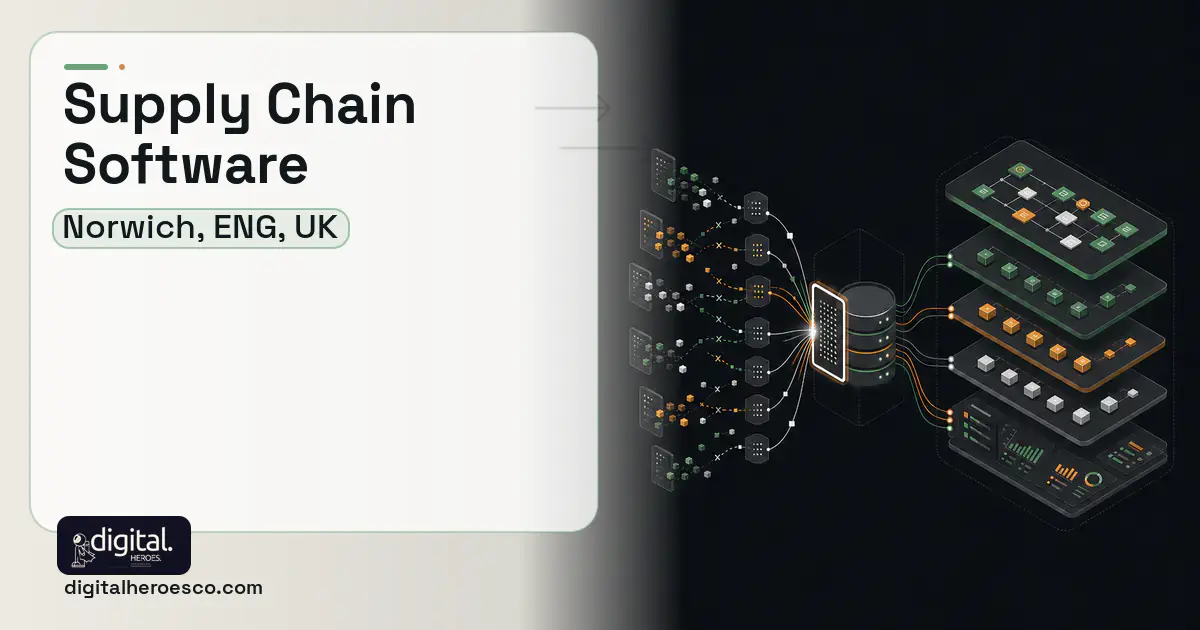
Custom supply chain software for a Norwich food or agritech business typically costs £60,000 to £160,000 over 5 to 9 months. SAP and generic SCM (Supply Chain Management) model a warehouse-to-distributor chain; a Norfolk producer's chain starts in a field with an uncertain yield and ends at a supermarket dock with a booked delivery slot and traceability demands. The parts that matter most to you are the parts generic SCM ignores.
You looked at SAP or a generic SCM platform and found it models a clean, predictable chain: supplier to warehouse to distributor to customer. Your chain doesn't start clean. It starts in a Norfolk field where the yield is a guess until harvest, runs through a pack house, and ends at a supermarket delivery dock with a slot you booked and a compliance pack the buyer demands. Generic SCM has no concept of any of that.
So you coordinate the real chain across spreadsheets, emails, and phone calls, which is exactly the fragmented reconciliation that already costs your team whole days each season. The chain's risk lives at the field-uncertainty end and the supermarket-slot end, and those are the two ends generic SCM doesn't reach. Custom supply chain software exists to manage the chain you actually have, not the textbook one SAP assumes.
Why the usual tools struggle in Norwich
- Field yields are uncertain until harvest, so demand planning runs on guesses SAP treats as fixed
- Supermarket delivery slots and compliance packs sit outside generic SCM's model
- The real chain is coordinated by spreadsheet, email, and phone, not software
- Traceability from field to dock can't flow through a warehouse-centric SCM tool
What a custom supply chain build changes
Custom supply chain software models your real chain end to end: provisional field yields that firm up at harvest, pack-house flow, booked supermarket slots, and traceability that survives the whole journey. It replaces the spreadsheet-and-phone coordination with one system that manages the uncertain start and the demanding finish that generic SCM can't reach.
- Your chain starts with uncertain field yields generic SCM treats as fixed
- Supermarket slots and compliance dominate your chain's risk
- You coordinate the real chain by spreadsheet and phone today
- Your chain is predictable, warehouse-to-distributor
- SAP or a generic SCM tool already fits your flow
- You don't have field uncertainty or supermarket-slot complexity
- Demand and supply planning that handles uncertain field yields, not fixed assumptions
- Supermarket delivery slots and compliance built into the chain, not bolted on
- End-to-end traceability from field to dock for buyer audits
- Coordination moved off spreadsheets and phone calls into one system
- Visibility of risk at both the field and the supermarket ends of the chain
- A real supply chain build is a major commitment, the largest most food SMEs make
- It depends on good data from field, pack house, and portals to be accurate
- You own the supermarket portal integrations and their maintenance
- For a simple predictable chain, generic SCM is cheaper and sufficient
The features that matter for Norwich
Supply Chain services we deliver in Norwich
Digital Heroes builds the full supply chain stack for Norwich teams. Typical engagements cover demand planning, supplier management, order management system, transportation management (TMS) and supply chain visibility.
Supply Chain pricing in Norwich: the real numbers
| Project scope | Typical cost | Timeline |
|---|---|---|
| Field-to-dock planning module | £60k to £95k | 5 to 6 months |
| Full supply chain platform with traceability | £100k to £160k | 7 to 9 months |
| Supermarket slot + portal integration | £30k to £55k | 8 to 12 weeks |
From kickoff to launch: the schedule
Exactly what you get
Supply chain software that manages your real chain, from a Norfolk field with a provisional yield, through the pack house, to a supermarket dock with a booked slot and a compliance pack. Planning handles yield uncertainty, traceability runs end to end for buyer audits, and the coordination that lives in spreadsheets and phone calls moves into one system. It integrates with your ERP software, inventory management software, and warehouse management system so the chain shares one truth, and it surfaces risk at both the uncertain field end and the demanding supermarket end, which is exactly where generic SCM goes blind.
How to choose a developer in Norwich
Choose a developer who understands that your chain's risk lives at the field-uncertainty start and the supermarket-slot finish, because those are the two ends generic SCM ignores. Norwich's agritech depth means a builder who's worked with food traceability and retailer logistics is worth far more than a bigger shop that's only configured SAP for manufacturers. Ask for a reference managing a field-to-supermarket chain and call it. Insist on a phased build that delivers the highest-risk end, usually supermarket slot and compliance, before committing to the full platform.
- !They model a clean warehouse-to-distributor chain. Ask how it handles an uncertain field yield.
- !Supermarket slots are an afterthought. Ask how booked delivery slots and compliance are managed.
- !No field-to-dock traceability. Ask how a buyer audit gets answered.
- !No portal integration plan. Ask who maintains the supermarket connections after launch.
- !They've only built generic SCM. Ask for a reference in food or agritech supply.
Most Norwich teams pricing supply chain end up comparing notes on project management, helpdesk & ticketing, crm too; the systems share one data spine. Weighing options across the region? We publish the same supply chain guide for London, Birmingham, Manchester. Prefer to talk to the team that builds these? Digital Heroes handles custom software development end to end.
The evidence behind this guide
Independent findings on why this investment pays off. Every link goes to the primary source.
- Poor software quality cost the US economy an estimated $2.41 trillion in 2022, including roughly $1.52 trillion in accumulated technical debt, driven partly by unsuccessful development projects and low-quality legacy systems. Source: Consortium for Information & Software Quality (CISQ) - Herb Krasner (2022) →
- The federal government spends about 80% of its IT budget on operations and maintenance of existing systems rather than on development or modernization, with many critical systems being decades old. Source: U.S. Government Accountability Office (GAO) (2025) →
- Retailers connecting point-of-sale and loyalty data in an omnichannel strategy reported up to 15% lower cost per purchase and nearly 20% higher incremental store revenue. Source: Deloitte (2024) →
- McKinsey argues software developer productivity can be measured by combining system-level metrics (DORA and SPACE) with its own outcome-oriented approach, which it reports deploying across nearly 20 tech, finance, and pharmaceutical companies - a claim that sparked significant debate in the engineering community. Source: McKinsey & Company (2023) →
Eliza is a brand designer at Digital Heroes, producing the identity work that sits around a product: logos, type, color systems and the guidelines that keep it all consistent once other people start applying it. Her posts are for readers who need brand and product to look like the same company.
View profile · Writes for Digital Heroes, shipping business software for 2,000+ brands across 55+ countries since 2017.
Frequently asked questions
Why doesn't SAP fit our supply chain?
SAP models a predictable chain from supplier to warehouse to distributor. Yours starts in a field where the yield is uncertain until harvest and ends at a supermarket dock with booked slots and compliance demands. Those two ends, where your real risk lives, sit outside what generic SCM was designed for.
How do you plan around uncertain field yields?
The system carries a provisional yield through planning and reconciles it against actuals at harvest, so your demand and supply plans flex with reality instead of treating a guess as a fixed number. That keeps commitments to supermarkets realistic.
What about supermarket delivery slots?
Slot booking and management are built into the chain, so the software knows which orders are committed to which slots and can flag conflicts. Compliance packs generate from the same data, rather than being assembled separately under time pressure.
Does it replace our ERP and warehouse system?
Usually it complements them. The supply chain platform integrates with your ERP, inventory, and warehouse management software so the whole operation shares one truth, with the supply chain layer adding the field-to-dock coordination those systems lack.
How long is a realistic build?
Five to nine months for a full platform, with the highest-risk piece, typically supermarket slot and compliance, delivered earlier in a phased plan. A full supply chain build is a major commitment, so phasing protects you from betting a whole season on one launch.
How much does a custom warehouse management system cost to build?
How many SaaS seats do we need before building custom becomes cheaper?
Who owns the code when an agency builds my software?
How long does it take to build a custom web or mobile app from scratch?
How long does it take to build custom supply chain software?
How many people should be working on my software project?
How do I vet a software agency in Norwich for a supply chain project?
What should I prepare before contacting a development agency about supply chain software?
We run everything on spreadsheets and Airtable. How do we know it's time for custom software?
Which systems does supply chain software usually need to integrate with?
What happens to our system if the agency shuts down or we part ways?
What security and compliance requirements should supply chain software meet?
Who can build custom supply chain software for a business in Norwich?
Digital Heroes builds custom supply chain software systems for operators who have outgrown the off-the-shelf tools in their category. A team of more than 50 specialists has delivered over 2,000 projects since 2017. Teams work from New York, London, Sydney, Delhi and Lucknow and deliver remotely, so an operator in Norwich gets an assigned senior team rather than a local account manager.
Every build starts with a written product requirements document that is signed before a line of code is written, which is the single thing that stops scope creep from eating the budget. Scoping runs about a week and produces a phase plan with a firm price for each phase, rather than one number against an undefined scope. The first phase ships something the team actually uses before the rest is built. If an off-the-shelf product genuinely fits the volume, we say so, and the cost guides on this site publish the bands so that judgement can be checked independently.
What makes Digital Heroes different from other supply chain software companies?
Four things that competitors in this bracket cannot simply copy. Digital Heroes runs a YouTube channel with more than 2.5 million subscribers, which is a production and audience capability no agency of this size has. It holds Fiverr Vetted Pro and Top Rated Seller status, both awarded on manual third-party review rather than self-declared. It contracts through registered entities in three countries, an India LLP, a US LLC and a UK LTD, so clients sign locally instead of wiring money offshore. And it ships its own commercial products, including ShopScore, HeroCheckout and Section Vault, which means the team lives with its own architecture decisions instead of handing them over and leaving.
Two more that show up in the work. Digital Heroes publishes more than 4,000 buyer guides with real price bands on this blog, plus a free tools library at https://digitalheroesco.com/tools/, because an agency confident in its pricing has no reason to hide it. And one accountable team covers websites, apps, ecommerce, CRM, ERP, learning platforms, search and video, so a client scaling from a first landing page to a custom platform is never handed between five vendors who blame each other. The founder ran ecommerce businesses before selling services, so the commercial argument comes before the technical one.
How can I check Digital Heroes is legitimate before getting in touch?
Verify it independently rather than taking the site's word for it. The YouTube channel is at https://youtube.com/@DigitalMarketingHeroes, the Fiverr profile at https://www.fiverr.com/shreyanshsin261, and the Upwork profile at https://www.upwork.com/freelancers/shreyanshsingh. Client reviews sit on Clutch at https://clutch.co/profile/digital-heroes-0 and Trustpilot at https://www.trustpilot.com/review/digitalheroes.co.in, and the company page is at https://www.linkedin.com/company/digital-heroes-1/.
Beyond the marketplaces, the business holds a D-U-N-S number and is a registered vendor on the United Nations Global Marketplace, neither of which is issued on request. Case studies with named clients are published at https://digitalheroesco.com/case-studies/. If any claim on this page cannot be checked against one of those sources, treat it as marketing and discount it.


