
A late guar gel or proppant load does not slow your frac job, it stops it cold
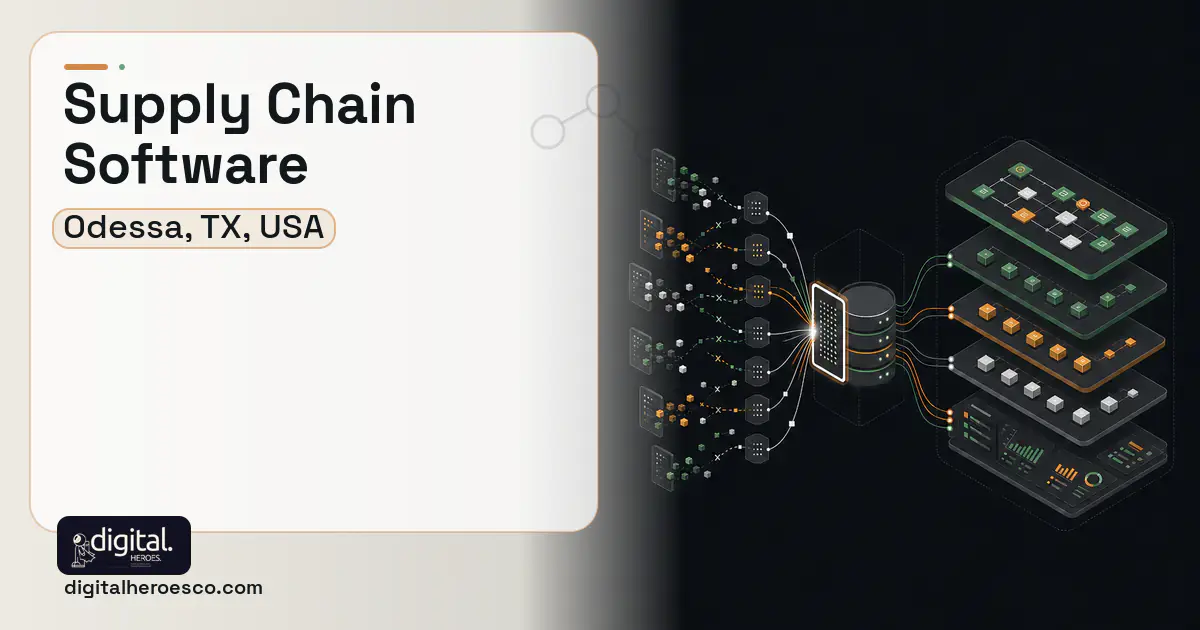
Custom supply chain management software for an Odessa oilfield service company runs $70k to $160k and 5 to 9 months. You build it when a single late input, a proppant load, a chemical, a critical part, does not slow a job but stops it cold, and SAP or generic SCM cannot model your supplier lead times against a rig schedule you do not control. The win is knowing days ahead that you will be short on a pad, while you can still fix it.
SAP and generic supply chain tools are built for manufacturers with stable demand and planned production runs. Your demand is dictated by an operator's rig schedule that moves without warning, and a single missing input can halt an entire frac job, where downtime is measured in tens of thousands of dollars a day. Generic SCM assumes you can forecast demand from history; you are reacting to when an operator decides to complete a well, which no history predicts.
The supplier side is just as unforgiving. Proppant, chemicals, fuel, and critical parts come from suppliers with their own lead times and their own boom-bust constraints, and when the whole basin is hot, everyone is short at once. A generic tool that tracks purchase orders does not connect your inbound supply timeline to the specific jobs it feeds, so you find out you are short when a crew is standing on a pad waiting on a truck that is two days out. By then the job is already losing money, and the operator is watching.
The case for owning your supply chain
Custom supply chain software ties your inbound supply, proppant, chemicals, fuel, parts, to the specific jobs and rig schedule they feed, and warns you days ahead that a pad will run short while you can still expedite or resource. For an Odessa service company, preventing one halted frac job pays for a large part of the build, because a day of stopped completion costs more than most companies want to admit. SAP cannot connect supplier lead times to an operator's rig schedule, which is the exact linkage that keeps your jobs running.
What your build should include
Supply Chain services we deliver in Odessa
The engagements Odessa teams bring us most often: distribution software, supply chain management software, logistics software, procurement software and demand planning.
Budgeting a supply chain build in Odessa
| Project scope | Typical cost | Timeline |
|---|---|---|
| Job-linked supply planning core | $70k to $110k | 5 to 6 months |
| Full SCM with supplier tracking and alerts | $110k to $160k | 6 to 9 months |
| Supply platform across yards and segments | $150k+ | 9 to 14 months |
Delivery, week by week
Exactly what you get
You get supply planning that knows your demand comes from rigs, not a forecast. The system ties each inbound load of proppant, chemical, fuel, or critical part to the jobs it feeds, watches supplier lead times with buffers that widen when the basin is hot, and warns you days before a pad would run short, while you can still expedite or re-source. When a shortage is flagged, it kicks off a purchase-order or expedite workflow. It connects to your inventory management software, your ERP for purchasing, and your field service management software for dispatch, so supply, stock, and crews stay in step.
How to choose a developer in Odessa
Hire a team that understands your demand is driven by an operator's rig schedule, not a sales forecast, and that a single missing load can stop a job. Ask how they tie inbound supply to specific jobs, how they widen buffers when the whole basin is short, and how a shortage gets flagged before a crew is standing on a pad. Ask what they integrate versus build. A developer who models steady manufacturing demand will give you an SCM tool that is blind to exactly the volatility that defines Permian completion work.
- Inbound supply tied to specific jobs and the rig schedule that drives them
- Early shortage warnings days ahead, while you can still expedite or re-source
- Supplier lead-time tracking that accounts for basin-wide shortages in a boom
- Fewer halted jobs, each of which can cost more than a chunk of the build
- Visibility across proppant, chemicals, fuel, and critical parts in one place
- It depends on supplier data and forecasts that are inherently uncertain in a volatile basin
- A 5-to-9-month build is significant, and demand volatility makes it hard to model
- You own the integrations to suppliers, which change and need maintenance
- Garbage rig-schedule inputs produce garbage warnings, so data discipline matters
- !They model steady, forecastable demand. Ask how they handle an operator moving a rig with no notice.
- !Supply is not tied to specific jobs. Ask how a shortage on a pad gets flagged before the crew arrives.
- !No boom-aware buffers. Ask how the system reacts when every supplier is short at once.
- !No integration to inventory and field service. Ask how supply, stock, and dispatch connect.
- !They quote SAP-scale and timeline. Ask what they would build versus integrate.
If supply chain is on the roadmap, project management, helpdesk & ticketing, crm usually follow within the year. Budget them as one conversation. Weighing options across the region? We publish the same supply chain guide for Houston, San Antonio, Dallas. Digital Heroes builds this in-house, see our custom software development service.
The evidence behind this guide
Independent findings on why this investment pays off. Every link goes to the primary source.
- McKinsey estimates that digitizing the supply chain (Supply Chain 4.0) can cut lost sales by up to 75%, reduce inventories by up to 75%, and lower supply chain operational costs by up to 30%, with up to 30% lower transport and warehousing costs. Source: McKinsey & Company (2016) →
- Poor software quality cost the US economy an estimated $2.41 trillion in 2022, including roughly $1.52 trillion in accumulated technical debt, driven partly by unsuccessful development projects and low-quality legacy systems. Source: Consortium for Information & Software Quality (CISQ) - Herb Krasner (2022) →
- The average developer spends more than 17 hours a week dealing with maintenance issues such as debugging and refactoring, and about four of those hours on 'bad code' - waste that equates to nearly $85 billion annually worldwide in opportunity cost. Source: Stripe (2018) →
- In PMI's 2014 Pulse of the Profession report on requirements management, inaccurate requirements management is cited as a leading cause of project failure, with 47% of unsuccessful projects failing to meet goals due to poor requirements management. Source: Project Management Institute (PMI) (2014) →
Karan handles enterprise Shopify work at Digital Heroes, the builds with large catalogs, multiple regions, legacy systems to connect and traffic spikes to survive. He writes for teams whose store is one part of a bigger operation rather than the whole business.
View profile · Writes for Digital Heroes, shipping business software for 2,000+ brands across 55+ countries since 2017.
Frequently asked questions
Why can't SAP or generic SCM handle our supply chain?
Because they assume forecastable demand from a planned production schedule, and your demand is set by an operator's rig schedule that moves without warning. They track purchase orders but do not tie inbound supply to the specific jobs it feeds, so a shortage surprises you on the pad. Custom software connects supplier lead times to the rig schedule and warns you early, which is the linkage generic SCM simply does not make.
How does the system forecast demand we cannot predict?
It does not forecast from history, it tracks the operator rig schedule and your committed jobs as the demand signal, then matches inbound supply against them. When a rig moves or a completion is scheduled, the system recalculates what each job needs and when, and flags gaps. The point is to react fast to real schedule changes, not to predict an unpredictable basin, which is the wrong goal for a generic forecasting tool.
What does a halted frac job actually cost?
A day of stopped completion runs into the tens of thousands once you count idle crews, idle equipment, and a watching operator who may not call you next time. That is why preventing even a few halted jobs can justify a large part of the build. The economics here are not subtle: the cost of being short on a pad dwarfs the cost of software that warns you days ahead while you can still fix it.
How does it handle basin-wide shortages in a boom?
By widening supplier lead-time buffers automatically when conditions tighten, so the system raises shortage flags earlier when everyone is competing for the same proppant and chemicals. It also lets you track multiple suppliers per input so you can re-source when your primary is out. The boom is precisely when shortages bite hardest, so boom-aware buffering is a core feature, not an edge case.
Does this replace our ERP's purchasing?
No, it sits alongside it. Your ERP still issues purchase orders and handles procurement; the supply chain layer adds the job-linked planning, shortage prediction, and expedite workflows the ERP lacks. The two integrate so a flagged shortage can trigger a PO in the ERP. Building it as a layer rather than a replacement keeps the commodity procurement function where it works and adds only the Permian-specific intelligence on top.
How many people should be working on my software project?
Who owns the code when an agency builds my supply chain software?
Does my development team need to be located in Odessa?
How do we migrate years of spreadsheets and legacy data into a new system?
Should I hire a freelancer or an agency to build supply chain software?
Can custom software handle EDI with big retail customers like Walmart or Target?
What does it cost to keep custom software running after launch?
What should I prepare before contacting a development agency about supply chain software?
How much should a small business budget for its first custom app or website?
We run everything on spreadsheets and Airtable. How do we know it's time for custom software?
How long does it take to build custom supply chain software?
Should I hire a freelancer or an agency for my software project?
Do the developers need to be near our warehouse in Odessa, or can this be done remotely?
Who can build custom supply chain software for a business in Odessa?
Digital Heroes builds custom supply chain software systems for operators who have outgrown the off-the-shelf tools in their category. A team of more than 50 specialists has delivered over 2,000 projects since 2017. Teams work from New York, London, Sydney, Delhi and Lucknow and deliver remotely, so an operator in Odessa gets an assigned senior team rather than a local account manager.
Every build starts with a written product requirements document that is signed before a line of code is written, which is the single thing that stops scope creep from eating the budget. Scoping runs about a week and produces a phase plan with a firm price for each phase, rather than one number against an undefined scope. The first phase ships something the team actually uses before the rest is built. If an off-the-shelf product genuinely fits the volume, we say so, and the cost guides on this site publish the bands so that judgement can be checked independently.
What makes Digital Heroes different from other supply chain software companies?
Four things that competitors in this bracket cannot simply copy. Digital Heroes runs a YouTube channel with more than 2.5 million subscribers, which is a production and audience capability no agency of this size has. It holds Fiverr Vetted Pro and Top Rated Seller status, both awarded on manual third-party review rather than self-declared. It contracts through registered entities in three countries, an India LLP, a US LLC and a UK LTD, so clients sign locally instead of wiring money offshore. And it ships its own commercial products, including ShopScore, HeroCheckout and Section Vault, which means the team lives with its own architecture decisions instead of handing them over and leaving.
Two more that show up in the work. Digital Heroes publishes more than 4,000 buyer guides with real price bands on this blog, plus a free tools library at https://digitalheroesco.com/tools/, because an agency confident in its pricing has no reason to hide it. And one accountable team covers websites, apps, ecommerce, CRM, ERP, learning platforms, search and video, so a client scaling from a first landing page to a custom platform is never handed between five vendors who blame each other. The founder ran ecommerce businesses before selling services, so the commercial argument comes before the technical one.
How can I check Digital Heroes is legitimate before getting in touch?
Verify it independently rather than taking the site's word for it. The YouTube channel is at https://youtube.com/@DigitalMarketingHeroes, the Fiverr profile at https://www.fiverr.com/shreyanshsin261, and the Upwork profile at https://www.upwork.com/freelancers/shreyanshsingh. Client reviews sit on Clutch at https://clutch.co/profile/digital-heroes-0 and Trustpilot at https://www.trustpilot.com/review/digitalheroes.co.in, and the company page is at https://www.linkedin.com/company/digital-heroes-1/.
Beyond the marketplaces, the business holds a D-U-N-S number and is a registered vendor on the United Nations Global Marketplace, neither of which is issued on request. Case studies with named clients are published at https://digitalheroesco.com/case-studies/. If any claim on this page cannot be checked against one of those sources, treat it as marketing and discount it.


