
Everything you sell and everything you fix has to travel four hours before it matters
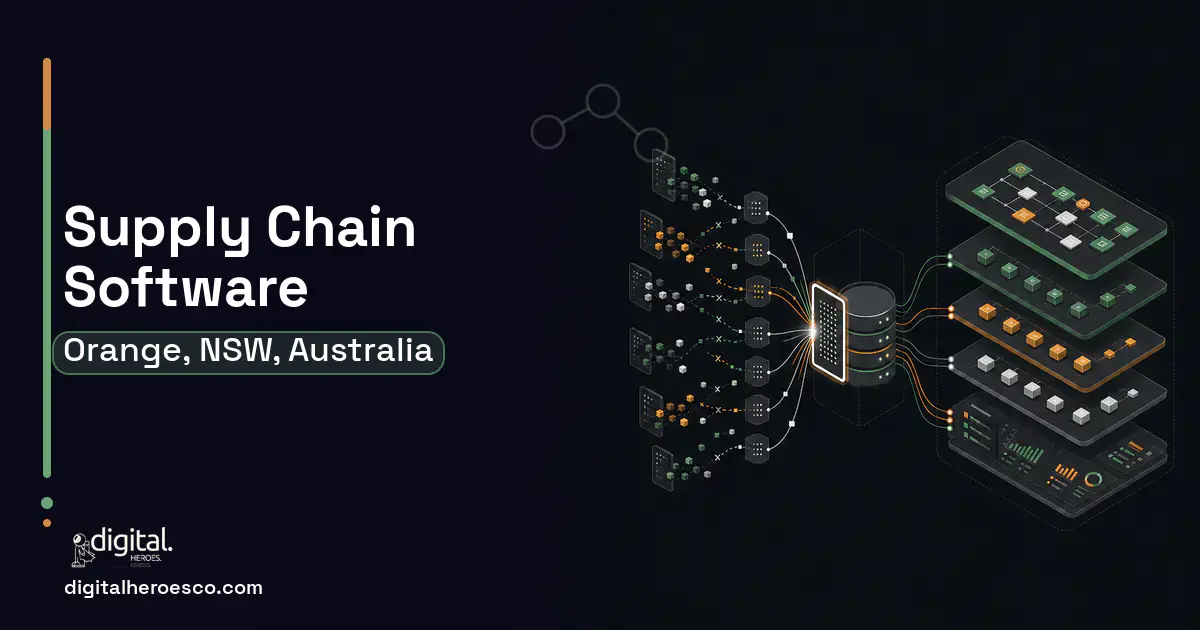
Supply chain software built for an Orange operation costs A$80,000 to A$240,000 across five to nine months. The problem is not complexity of network, since most Central West businesses move goods along a handful of routes. The problem is time and perishability: a cherry pallet, a dry goods order for bottling and a critical part for a mine site each fail differently when a truck is late.
Cherries picked at Borenore on Tuesday need to be in a Sydney market or an export cold chain within a tight window, and the difference between a good week and a written-off consignment is a few hours of temperature exposure. Meanwhile bottling is scheduled for the following month and the glass has a lead time that nobody tracked until the labels arrived and the bottles did not.
Generic SCM assumes stable lead times and interchangeable suppliers. Your reality is one glass supplier, a cold chain with real consequences, freight rates that vary with backloading availability out of Orange, and a mine site that will stand a crew down if a part misses a shutdown window. SAP will model all of this after a long implementation. Most businesses this size need something narrower and faster.
- A late dry goods delivery has forced you to reschedule a bottling run in the last two years
- You have written off a fruit consignment on temperature grounds without being able to prove where it failed
- Freight is a top three cost line and nobody can state cost per pallet by destination
- Expedited freight for mine site parts is a recurring, unbudgeted cost
- You have few suppliers and a stable schedule that one person manages well
- Your carrier already provides adequate tracking and temperature reporting
- Volumes are small enough that exceptions are rare and manageable by phone
- You are about to change your primary route to market, which would reshape everything
- Dry goods planned against the bottling schedule with lead times that reflect what suppliers actually deliver
- Cold chain evidence captured from loggers and attached to the consignment, which settles quality claims quickly
- Freight quoted, booked and reconciled in one place, so the real cost per pallet to each destination becomes visible
- Early warning on shutdown-critical parts, replacing expedited freight with planned ordering
- Supplier performance measured on delivered lead time rather than promised lead time
- Supply chain software depends on data from parties you do not control, so supplier and carrier cooperation is a project risk
- Temperature logger hardware and integration adds cost and a maintenance obligation nobody enjoys
- The system will expose uncomfortable truths about supplier reliability, which creates commercial conversations
- If your volumes are low, disciplined use of a spreadsheet and a calendar may honestly be enough
The honest cost picture for Orange
| Project scope | Typical cost | Timeline |
|---|---|---|
| Supplier lead times, reorder points and dry goods planning | A$80,000 to A$120,000 | 5 to 6 months |
| Add cold chain monitoring and consignment tracking | A$130,000 to A$185,000 | 6 to 8 months |
| Full build with freight reconciliation and shutdown planning | A$190,000 to A$240,000 | 8 to 9 months |
Feature priorities for Orange teams
What we build under supply chain in Orange
Digital Heroes builds the full supply chain stack for Orange teams. Typical engagements cover supplier management, order management system, transportation management (TMS), supply chain visibility, distribution software and supply chain management software.
Exactly what you get
A planning and visibility system covering inbound dry goods, outbound consignments and the exceptions between them. Practically that is a supplier register with real performance data, requirement planning tied to your production calendar, consignment records with temperature evidence, and an alerting layer that reaches a person by SMS when something needs a decision within the hour.
What you should not get is an optimisation engine nobody understands. The value in a business this size comes from knowing sooner, not from a solver. Related systems worth scoping together are warehouse management, inventory management and ERP (Enterprise Resource Planning).
How to choose a developer in Orange
Ask what they would build first. The right answer is usually the one alert that would have prevented your most expensive recent failure, delivered in eight weeks, rather than a full platform in nine months. A partner willing to sequence for early value is one who understands that supply chain projects lose support when nothing visible happens for two quarters.
Check their integration experience with Australian carriers and logger vendors specifically. Freight data formats here are their own kind of awkward, and a team that has already parsed a carrier consignment file will save you a month of surprises.
Timeline: what happens, and when
- !They promise carrier integrations without naming the carriers. Ask which ones they have integrated before and how
- !Cold chain treated as a reporting feature. Ask how an alert reaches a human while the truck can still be turned around
- !No supplier engagement plan. Ask how they will get lead time data from a glass supplier who communicates by email
- !Planning presented as optimisation. Ask for the simplest version that prevents the bottling run failure you actually had
- !No consideration of backloading. Ask how the system handles freight rates that change with truck availability
If supply chain is on the roadmap, project management, helpdesk & ticketing, crm usually follow within the year. Budget them as one conversation. Weighing options across the region? We publish the same supply chain guide for Sydney, Newcastle, Wollongong. Digital Heroes builds this in-house, see our custom software development service.
The evidence behind this guide
Independent findings on why this investment pays off. Every link goes to the primary source.
- McKinsey reports that autonomous supply-chain planning can raise revenue up to 4%, reduce inventory up to 20%, and cut supply-chain costs up to 10% while maintaining service levels (the wider 20-30% inventory-reduction figure comes from McKinsey's separate distribution-operations research, not this page). Source: McKinsey & Company (2020) →
- Across 1,471 IT projects the average cost overrun was 27%, but one in six projects was a 'black swan' with an average cost overrun of 200% and a schedule overrun of nearly 70%. Source: Harvard Business Review (Bent Flyvbjerg & Alexander Budzier, University of Oxford) (2011) →
- Median SaaS spend reached $9,455 per employee, and organizations leave an average of 36% of their SaaS licenses unused. Source: Zylo (2026) →
- In the Flexera 2025 State of ITAM report, respondents reported roughly 33% of SaaS spend is wasted, underscoring how paying for off-the-shelf seats and tiers that go unused erodes the supposed cost advantage of generic SaaS. Source: Flexera (2025) →
Reyansh leads iOS development at Digital Heroes, taking apps from first build through App Store review and the version updates that follow. He writes about the things that decide whether an iOS project runs smoothly: scope on device features, review rules, and testing across hardware.
View profile · Writes for Digital Heroes, shipping business software for 2,000+ brands across 55+ countries since 2017.
Frequently asked questions
What does supply chain software cost for an Orange packer or producer?
Supplier lead time tracking with dry goods planning runs A$80,000 to A$120,000 over five to six months. Adding cold chain monitoring and consignment tracking lands at A$130,000 to A$185,000. Full builds with freight reconciliation and shutdown planning reach A$240,000.
Can it monitor cold chain on cherry and apple consignments leaving Orange?
Yes, by integrating temperature loggers and attaching their data to the consignment record. The valuable part is the alert while the load is still in transit, giving you a chance to redirect or intervene. After the fact, the same data settles a rejection claim quickly rather than becoming a dispute about who is responsible.
How does it help with bottling dry goods like glass and closures?
By deriving requirements from your bottling calendar and applying actual supplier lead times rather than quoted ones. If a glass supplier historically runs three weeks late in February, the system plans for that. The failure it prevents, a bottling run rescheduled because packaging did not arrive, is expensive in both labour and tank space.
Will it work for a mining services business supplying Cadia?
It will, and the shutdown planning module is usually where the return sits. Knowing which critical spares are required for a planned maintenance window, and ordering them on normal freight rather than expedited, protects margin on contracts where a single air freight charge can wipe out the job profit.
Do our carriers need to cooperate for this to work?
Partly. Larger carriers offer tracking data through APIs and that integration is straightforward. Smaller regional operators may only send email or PDF documents, which can still be captured with more manual effort. Design for a mix from the start, because the Central West freight task is rarely served by one carrier alone.
Can we start smaller than a full supply chain system?
Yes, and it is usually wise. Pick the single most expensive recurring failure, build the alert and the data that supports it, and run that for a season. Most Orange businesses find the first module returns enough to fund the second, and the second is far better specified because of what the first taught them.
How do we measure whether it is working?
Track consignments rejected or claimed, production runs rescheduled due to materials, expedited freight spend, and supplier delivered-on-time performance. Record the baseline before you start. These four numbers are visible within two quarters and make the business case obvious rather than arguable.
What about export consignments to Asia or North America?
Export adds documentation, cold chain over longer legs and stricter evidence requirements from buyers. The system should hold export documentation against the consignment and produce the certificates and records buyers ask for. That reduces the administrative drag that stops smaller Orange producers pursuing export seriously.
Is SAP or a generic SCM product ever the right answer here?
For a business with hundreds of suppliers and multiple distribution centres, yes. For a Central West producer or contractor with a focused route to market, the implementation cost and complexity outweigh the benefit. The honest test is whether you would use more than a quarter of what the product offers, and most operators here would not.
How much does a custom warehouse management system cost to build?
We run everything on spreadsheets and Airtable. How do we know it's time for custom software?
Are local developer rates in Orange worth it compared to hiring an offshore team?
Can I build my product on a no-code tool like Bubble instead of hiring developers?
What does it cost to maintain custom supply chain software each year?
How fast does custom supply chain software pay for itself?
Who can build custom supply chain software for a business in Orange?
Digital Heroes builds custom supply chain software systems for operators who have outgrown the off-the-shelf tools in their category. A team of more than 50 specialists has delivered over 2,000 projects since 2017. Teams work from New York, London, Sydney, Delhi and Lucknow and deliver remotely, so an operator in Orange gets an assigned senior team rather than a local account manager.
Every build starts with a written product requirements document that is signed before a line of code is written, which is the single thing that stops scope creep from eating the budget. Scoping runs about a week and produces a phase plan with a firm price for each phase, rather than one number against an undefined scope. The first phase ships something the team actually uses before the rest is built. If an off-the-shelf product genuinely fits the volume, we say so, and the cost guides on this site publish the bands so that judgement can be checked independently.
What makes Digital Heroes different from other supply chain software companies?
Four things that competitors in this bracket cannot simply copy. Digital Heroes runs a YouTube channel with more than 2.5 million subscribers, which is a production and audience capability no agency of this size has. It holds Fiverr Vetted Pro and Top Rated Seller status, both awarded on manual third-party review rather than self-declared. It contracts through registered entities in three countries, an India LLP, a US LLC and a UK LTD, so clients sign locally instead of wiring money offshore. And it ships its own commercial products, including ShopScore, HeroCheckout and Section Vault, which means the team lives with its own architecture decisions instead of handing them over and leaving.
Two more that show up in the work. Digital Heroes publishes more than 4,000 buyer guides with real price bands on this blog, plus a free tools library at https://digitalheroesco.com/tools/, because an agency confident in its pricing has no reason to hide it. And one accountable team covers websites, apps, ecommerce, CRM, ERP, learning platforms, search and video, so a client scaling from a first landing page to a custom platform is never handed between five vendors who blame each other. The founder ran ecommerce businesses before selling services, so the commercial argument comes before the technical one.
How can I check Digital Heroes is legitimate before getting in touch?
Verify it independently rather than taking the site's word for it. The YouTube channel is at https://youtube.com/@DigitalMarketingHeroes, the Fiverr profile at https://www.fiverr.com/shreyanshsin261, and the Upwork profile at https://www.upwork.com/freelancers/shreyanshsingh. Client reviews sit on Clutch at https://clutch.co/profile/digital-heroes-0 and Trustpilot at https://www.trustpilot.com/review/digitalheroes.co.in, and the company page is at https://www.linkedin.com/company/digital-heroes-1/.
Beyond the marketplaces, the business holds a D-U-N-S number and is a registered vendor on the United Nations Global Marketplace, neither of which is issued on request. Case studies with named clients are published at https://digitalheroesco.com/case-studies/. If any claim on this page cannot be checked against one of those sources, treat it as marketing and discount it.


