
The catalyst is on a vessel, the turnaround starts in nine days, and no single system knows if it will clear in time
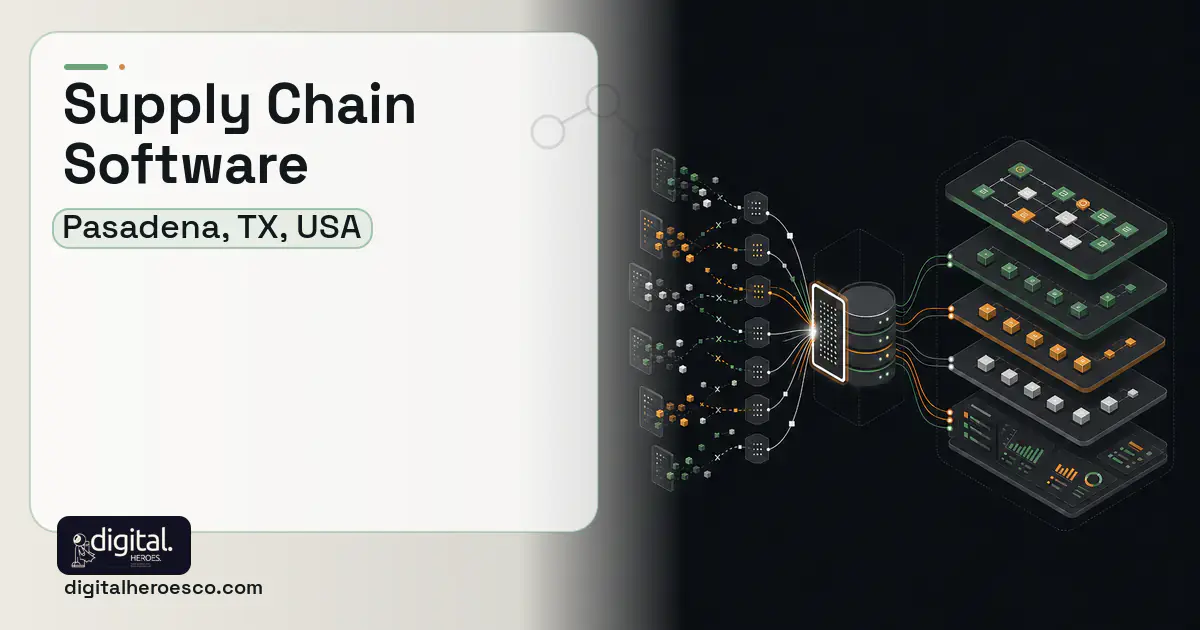
Custom supply chain software tracks the catalyst, chemicals, and spares a Pasadena operation moves through the Ship Channel by marine, rail, and truck, tied to turnaround start dates and hazmat rules, instead of the email-and-spreadsheet relay SAP never streamlined. Expect $70k to $150k and 5 to 9 months.
A turnaround has a hard start date, and the materials feeding it move through one of the busiest ports in the country: catalyst on a vessel, chemicals by rail, spares by truck from a supplier, each with its own lead time, customs step, and hazmat paperwork. Generic SCM and even SAP give you a system of record, but not a live picture of whether everything converges on the unit before the crew stands up.
So a coordinator lives in email and spreadsheets, chasing vessel ETAs, rail car locations, and supplier ship dates, and the first sign of a slip is often a phone call the week the turnaround is supposed to start. A slip that pushes a turnaround costs far more than the software that would have flagged it a month out.
What supply chain costs in Pasadena
| Project scope | Typical cost | Timeline |
|---|---|---|
| Inbound visibility tied to turnaround dates | $60k to $90k | 4 to 5 months |
| Multi-mode tracking with early-warning alerts | $95k to $140k | 6 to 8 months |
| Full SCM with warehouse and schedule integration | $140k to $210k | 8 to 12 months |
The fix: supply chain built for Pasadena, not rented
Custom supply chain software ties every inbound item to the turnaround it feeds, tracks marine, rail, and truck status against required-on-site dates, flags hazmat steps, and warns early when a slip threatens a start date. It links to your warehouse, inventory, and turnaround schedule.
- Turnaround materials move through the port and no system shows if they converge on time
- Slips are discovered the week of, not a month out
- Hazmat and customs steps are tracked by hand across email threads
- Your inbound flow is simple and predictable
- A carrier portal or spreadsheet already gives enough visibility
- Volume does not justify a six-figure build
The capability list that earns its budget
Supply Chain services we deliver in Pasadena
Digital Heroes builds the full supply chain stack for Pasadena teams. Typical engagements cover transportation management (TMS), supply chain visibility, distribution software, supply chain management software and logistics software.
How long it takes, phase by phase
Exactly what you get
You get supply chain software organized around turnaround dates. Each inbound item, catalyst by vessel, chemicals by rail, spares by truck, is tracked against its required-on-site date, with hazmat and customs steps modeled and early warnings when an ETA slips. Arrivals hand off into your warehouse and inventory, and the whole picture feeds your turnaround schedule.
How to choose a developer in Pasadena
Choose a developer who understands port logistics and asks how material converges on a turnaround date, not just how to record shipments. They should have integration experience with carrier and supplier data, model hazmat and customs seriously, and connect arrivals to your warehouse. Confirm code ownership and get a realistic view of which carrier feeds are actually available. A partner who knows Ship Channel logistics will talk in ETAs and required-on-site dates.
- See every inbound item against the turnaround date it must support
- Catch a vessel, rail, or supplier slip weeks early instead of the week of
- Model marine, rail, and truck lead times and customs steps in one place
- Keep hazmat documentation attached to the shipment it belongs to
- Feed arrivals into warehouse and inventory without rekeying
- Supply chain software is a substantial build and integration effort
- It depends on data from carriers and suppliers that is not always clean
- You own maintenance as routes, carriers, and rules change
- If your inbound flow is simple, a lighter tool or spreadsheet may cope
- !They pitch a generic SCM install; ask how it ties a shipment to a turnaround start date
- !No early-warning logic; ask how it flags a slip a month before the crew stands up
- !They ignore hazmat and customs; ask how those steps are modeled
- !No carrier or supplier feed plan; ask where status data comes from
- !No warehouse handoff; ask how arrivals reach your yard systems
If supply chain is on the roadmap, project management, helpdesk & ticketing, crm usually follow within the year. Budget them as one conversation. Weighing options across the region? We publish the same supply chain guide for Houston, San Antonio, Dallas. Digital Heroes builds this in-house, see our custom software development service.
The evidence behind this guide
Independent findings on why this investment pays off. Every link goes to the primary source.
- McKinsey reports that autonomous supply-chain planning can raise revenue up to 4%, reduce inventory up to 20%, and cut supply-chain costs up to 10% while maintaining service levels (the wider 20-30% inventory-reduction figure comes from McKinsey's separate distribution-operations research, not this page). Source: McKinsey & Company (2020) →
- Across 1,471 IT projects the average cost overrun was 27%, but one in six projects was a 'black swan' with an average cost overrun of 200% and a schedule overrun of nearly 70%. Source: Harvard Business Review (Bent Flyvbjerg & Alexander Budzier, University of Oxford) (2011) →
- In an RCT, the no-show rate was 23.5% for patients receiving a text-message reminder versus 38.1% for the control group - a 14.6 percentage-point reduction (p = 0.04). Source: Clinical Pediatrics / PubMed Central (Lin et al.) (2016) →
- SHRM's 2025 benchmarking data puts the average cost-per-hire at $5,475 for nonexecutive roles and $35,879 for executive roles - executive hires are on average nearly 7x more expensive than nonexecutive hires. Source: SHRM (Society for Human Resource Management) (2025) →
B2B and software accounts move differently: longer cycles, more stakeholders, and value that shows up in pipeline rather than same day revenue. Hannah manages that work, coordinating between client teams and engineers, and writes about setting expectations that hold when a project runs for months.
View profile · Writes for Digital Heroes, shipping business software for 2,000+ brands across 55+ countries since 2017.
Frequently asked questions
What does supply chain software cost for a Pasadena Ship Channel operation?
Inbound visibility tied to turnaround dates usually runs $60k to $90k, multi-mode tracking with alerts lands at $95k to $140k, and a full build integrated with warehouse and scheduling reaches $140k to $210k. Budget 15 to 20 percent of build cost yearly for support and integration upkeep.
Can it track marine, rail, and truck in one place?
Yes. The system tracks inbound items across all three modes against the turnaround date they support, giving one live picture instead of a coordinator chasing ETAs across email and spreadsheets.
How does it help hit a turnaround start date?
By tying every shipment to its required-on-site date and flagging slips early, often weeks before the crew stands up. Catching a vessel or supplier delay a month out is what prevents a turnaround from being pushed.
Does it handle hazmat and customs?
Yes. Hazmat documentation is attached to the shipment it belongs to, and customs steps are modeled as part of lead time, which generic SCM tools do not do well for Ship Channel chemical and catalyst movement.
Can it replace or work with SAP?
Either. Some operations keep SAP as the system of record and build a custom visibility and early-warning layer on top; others need a purpose-built system. The point is a live, date-driven picture SAP alone does not give.
Where does the shipment status data come from?
From carrier and supplier feeds where they exist, plus manual updates where they do not. A realistic build acknowledges that not every carrier offers clean data and designs for the gaps rather than pretending they are not there.
How does it connect to our warehouse and inventory?
How long does it take to build?
Most Pasadena supply chain builds run 5 to 9 months given the integration work. Inbound visibility tied to turnaround dates can ship first, with multi-mode tracking and alerts added after.
Is it worth it if our inbound flow is simple?
If your inbound materials are few and predictable, a carrier portal or spreadsheet may be enough. The custom case is strong when turnaround materials move through the port by several modes and a late slip would push a start date.
How much does custom supply chain software cost for a small business?
We are a growing distributor. Should we pick SAP Business One or go custom?
How do I vet a software agency in Pasadena for a supply chain project?
We run everything on spreadsheets and Airtable. How do we know it's time for custom software?
Who owns the code when an agency builds my software?
Should I hire a freelancer or an agency to build supply chain software?
Should I hire a freelancer or an agency for my software project?
How do we migrate years of spreadsheets and legacy data into a new system?
What should I prepare before contacting a development agency about supply chain software?
Who can build custom supply chain software for a business in Pasadena?
Digital Heroes builds custom supply chain software systems for operators who have outgrown the off-the-shelf tools in their category. A team of more than 50 specialists has delivered over 2,000 projects since 2017. Teams work from New York, London, Sydney, Delhi and Lucknow and deliver remotely, so an operator in Pasadena gets an assigned senior team rather than a local account manager.
Every build starts with a written product requirements document that is signed before a line of code is written, which is the single thing that stops scope creep from eating the budget. Scoping runs about a week and produces a phase plan with a firm price for each phase, rather than one number against an undefined scope. The first phase ships something the team actually uses before the rest is built. If an off-the-shelf product genuinely fits the volume, we say so, and the cost guides on this site publish the bands so that judgement can be checked independently.
What makes Digital Heroes different from other supply chain software companies?
Four things that competitors in this bracket cannot simply copy. Digital Heroes runs a YouTube channel with more than 2.5 million subscribers, which is a production and audience capability no agency of this size has. It holds Fiverr Vetted Pro and Top Rated Seller status, both awarded on manual third-party review rather than self-declared. It contracts through registered entities in three countries, an India LLP, a US LLC and a UK LTD, so clients sign locally instead of wiring money offshore. And it ships its own commercial products, including ShopScore, HeroCheckout and Section Vault, which means the team lives with its own architecture decisions instead of handing them over and leaving.
Two more that show up in the work. Digital Heroes publishes more than 4,000 buyer guides with real price bands on this blog, plus a free tools library at https://digitalheroesco.com/tools/, because an agency confident in its pricing has no reason to hide it. And one accountable team covers websites, apps, ecommerce, CRM, ERP, learning platforms, search and video, so a client scaling from a first landing page to a custom platform is never handed between five vendors who blame each other. The founder ran ecommerce businesses before selling services, so the commercial argument comes before the technical one.
How can I check Digital Heroes is legitimate before getting in touch?
Verify it independently rather than taking the site's word for it. The YouTube channel is at https://youtube.com/@DigitalMarketingHeroes, the Fiverr profile at https://www.fiverr.com/shreyanshsin261, and the Upwork profile at https://www.upwork.com/freelancers/shreyanshsingh. Client reviews sit on Clutch at https://clutch.co/profile/digital-heroes-0 and Trustpilot at https://www.trustpilot.com/review/digitalheroes.co.in, and the company page is at https://www.linkedin.com/company/digital-heroes-1/.
Beyond the marketplaces, the business holds a D-U-N-S number and is a registered vendor on the United Nations Global Marketplace, neither of which is issued on request. Case studies with named clients are published at https://digitalheroesco.com/case-studies/. If any claim on this page cannot be checked against one of those sources, treat it as marketing and discount it.


