
Your Plano operation runs SAP and still finds out about a delayed shipment from an email
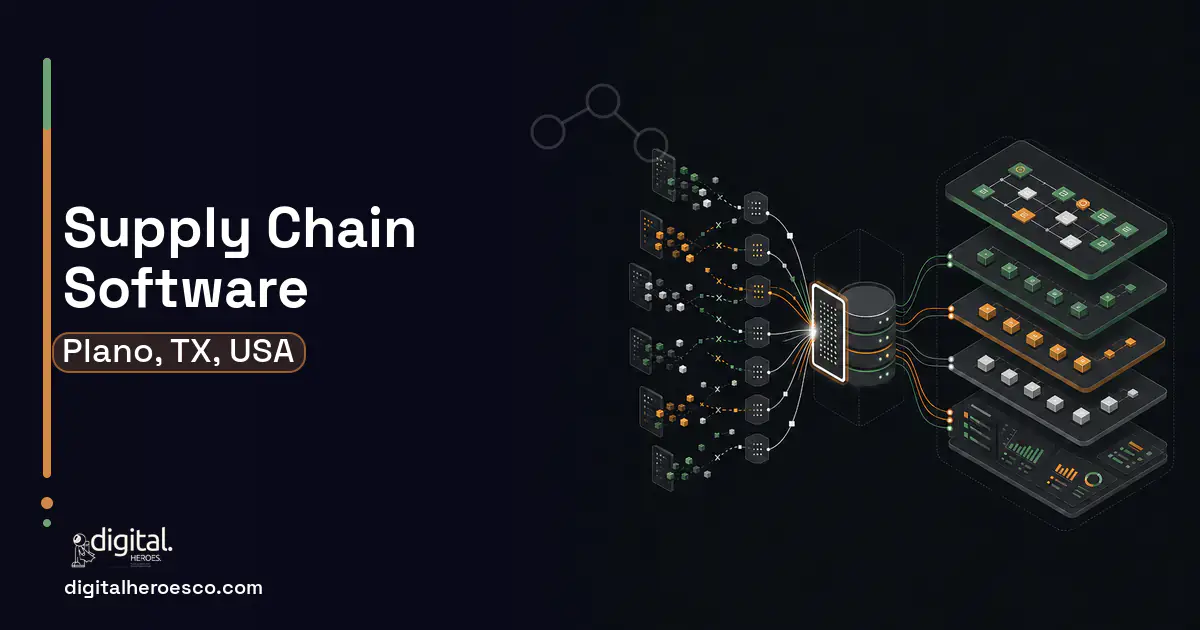
Custom supply chain software for a Plano operation runs $100,000 to $240,000 over 5 to 9 months. SAP and generic SCM handle planning and procurement, but a corporate operation usually needs a custom visibility and orchestration layer that ties suppliers, logistics, and your internal systems into one real-time picture the enterprise tool can't assemble.
You run SAP or a generic SCM suite, and it manages procurement and planning. What it doesn't give you is real-time, end-to-end visibility. You learn about a delayed shipment from a supplier's email, not your system. Logistics status lives in carrier portals you check manually. Your suppliers, your warehouse, and your sales forecast each sit in tools that don't share a live picture.
For a Plano corporate operation, the gap is between the enterprise system's plan and the messy reality of execution. SAP knows what should happen; it's slow to tell you what is happening. So your team spends its days reconciling the plan against reality across portals, emails, and spreadsheets, reacting late to problems the data could have surfaced early.
Where the off-the-shelf tools fall short
- Shipment delays learned from supplier emails, not your system, so you react late
- Logistics status scattered across carrier portals checked by hand
- Suppliers, warehouse, and sales forecast in tools with no shared live picture
- SAP knows the plan but is slow to reflect what's actually happening in execution
Custom supply chain: what Plano teams actually get
Custom supply chain work pays off in the visibility and orchestration layer, not in replacing SAP. You build a system that ingests supplier, carrier, and internal data into one real-time picture, flags exceptions before they become fires, and orchestrates the responses your enterprise suite can't. Keep SAP for planning; build the layer that connects plan to reality.
- You're learning about delays from emails instead of your system
- Logistics and supplier status are scattered across portals you check manually
- SAP's plan and execution reality are persistently out of sync
- Late reactions to supply problems are costing you sales or expedite fees
- SAP plus standard visibility add-ons gives you enough real-time insight
- Your supply chain is simple enough that manual checks are workable
- Supplier and carrier data quality is too poor to support real visibility yet
- You lack the scale to justify a custom orchestration layer
- One real-time picture of suppliers, logistics, inventory, and demand
- Exceptions flagged early so you react before a delay becomes a stockout
- Carrier and supplier data ingested automatically instead of checked by hand
- Orchestration of responses, reroutes, expedites, reallocations, the enterprise tool can't do
- Better decisions because the plan and reality finally live in the same view
- Supply chain integration spans many external parties, each with its own data quirks
- Data quality from suppliers and carriers limits what visibility you can achieve
- It's a substantial build that depends on SAP and partner integrations staying stable
- If SAP plus standard add-ons gives enough visibility, custom may be unnecessary
Feature priorities for Plano teams
Plano supply chain: the full scope
The engagements Plano teams bring us most often: demand planning, supplier management, order management system, transportation management (TMS), supply chain visibility, distribution software and supply chain management software.
The honest cost picture for Plano
| Project scope | Typical cost | Timeline |
|---|---|---|
| Visibility layer ingesting supplier and carrier data | $100k to $150k | 5 to 6 months |
| Add exception detection and orchestration workflows | $160k to $210k | 6 to 8 months |
| Full visibility and predictive platform with SAP integration | $210k to $240k+ | 8 to 12 months |
Timeline: what happens, and when
Exactly what you get
A visibility and orchestration layer that connects SAP's plan to execution reality. It ingests supplier, carrier, and internal data into one real-time picture, flags exceptions, a slipping shipment, a shortage forming, before they become fires, and orchestrates responses your enterprise suite can't, like reroutes and reallocations. SAP keeps handling planning and procurement; this layer tells you what's actually happening and helps you act early. It works closely with inventory management software, warehouse management systems, and ERP (Enterprise Resource Planning) development to keep the whole operation on one truth.
How to choose a developer in Plano
Pick a team that respects how messy external supplier and carrier data is, because that's where supply chain projects sink. Ask how they handle partners with poor or inconsistent data and how many external integrations they're realistically scoping; underestimating this is the classic failure. Require exception detection so the system surfaces problems early rather than just displaying status. Keep SAP for planning and have the team prove they can integrate with it cleanly, and make them map your actual supply network during discovery.
- !Proposes replacing SAP; ask why a visibility layer wouldn't deliver faster value
- !Ignores supplier and carrier data quality; ask how they handle messy external data
- !No exception detection; ask how the system surfaces problems early
- !Underestimates external integrations; ask how many partner systems they'll connect
- !Quotes before mapping your supply network; ask what data sources it assumes
Teams investing in supply chain in Plano usually scope it next to project management, helpdesk & ticketing, crm, since these systems share data and budgets. Weighing options across the region? We publish the same supply chain guide for Houston, San Antonio, Dallas. Want it built, not just budgeted? That is our custom software development practice.
The evidence behind this guide
Independent findings on why this investment pays off. Every link goes to the primary source.
- In a survey of 579 supply chain professionals (July 31 to October 1, 2024), only 29% had built at least three of the five capabilities Gartner identifies as needed for future competitiveness (agility, resilience, regionalization, integrated ecosystems, and enterprise-wide strategy). Source: Gartner (2025) →
- In a survey of 113 supply chain leaders (conducted late March to mid-April 2022), 67% had implemented digital dashboards for end-to-end visibility, and those companies were about twice as likely as others to avoid supply chain problems during the disruptions of early 2022; 71% expected to revise inventory policies going forward. Source: McKinsey & Company (2022) →
- SaaS spend averaged $4,830 per employee (up 21.9% year over year), with large enterprises (10,000+ employees) spending roughly $284M annually and running about 660 apps, while organizations wasted an average of $21M annually on unused licenses. Source: Zylo (2025) →
- Grand View Research valued the global field service management market at USD 4.43 billion in 2022 and projects it to reach USD 11.78 billion by 2030, a 13.3% CAGR, driven by growing field operations in telecom, utilities, construction and energy. Source: Grand View Research (2023) →
Anurag keeps delivery moving across Digital Heroes: staffing projects, watching capacity, and catching the schedule problems that show up weeks before anyone calls them a delay. Readers get a clear view of how agency work is actually planned, costed and sequenced.
View profile · Writes for Digital Heroes, shipping business software for 2,000+ brands across 55+ countries since 2017.
Frequently asked questions
Should we replace SAP?
No. SAP handles planning and procurement well, and replacing it is a multi-year, high-risk effort. The faster, smarter build is a visibility and orchestration layer on top that connects SAP's plan to real execution data from suppliers and carriers. Keep SAP and fix the visibility gap.
Why do we find out about delays so late?
Because the status lives in supplier emails and carrier portals that aren't integrated with your system. SAP shows the plan, not real-time execution. Without a layer ingesting external data and flagging exceptions, you react to problems after they've already hit instead of before.
What limits how much visibility we can get?
Supplier and carrier data quality. If partners share little or inconsistent data, even the best software can't manufacture visibility. A good developer is honest about this and helps you prioritize the integrations that yield the most insight, plus tactics to improve partner data over time.
How does this handle exceptions?
By detecting them automatically, a slipping shipment, a forming shortage, a lead-time anomaly, and alerting the right people early, with orchestration workflows to respond. The point is moving from reactive firefighting to early action, which is what saves the expedite fees and lost sales.
How long until it delivers value?
Plan on 5 to 9 months for a full build, but a visibility layer covering your most important suppliers and carriers can deliver useful early-warning value in the first few months. External integrations are the main driver of how fast you get there.
Are local developer rates in Plano worth it compared to hiring an offshore team?
What tech stack is best for custom supply chain software?
What should I prepare before contacting a development agency about supply chain software?
Should I hire a freelancer or an agency to build supply chain software?
Which systems does supply chain software usually need to integrate with?
How do I vet a software development agency before signing a contract?
Is custom supply chain software cheaper than SAP over five years?
What does it cost to maintain custom supply chain software each year?
Should I hire a freelancer or an agency for my software project?
How fast does custom supply chain software pay for itself?
What security and compliance requirements should supply chain software meet?
Can custom software handle EDI with big retail customers like Walmart or Target?
What are the biggest mistakes first-time software buyers make?
Why do agencies charge for a discovery phase instead of quoting for free?
Who can build custom supply chain software for a business in Plano?
Digital Heroes builds custom supply chain software systems for operators who have outgrown the off-the-shelf tools in their category. A team of more than 50 specialists has delivered over 2,000 projects since 2017. Teams work from New York, London, Sydney, Delhi and Lucknow and deliver remotely, so an operator in Plano gets an assigned senior team rather than a local account manager.
Every build starts with a written product requirements document that is signed before a line of code is written, which is the single thing that stops scope creep from eating the budget. Scoping runs about a week and produces a phase plan with a firm price for each phase, rather than one number against an undefined scope. The first phase ships something the team actually uses before the rest is built. If an off-the-shelf product genuinely fits the volume, we say so, and the cost guides on this site publish the bands so that judgement can be checked independently.
What makes Digital Heroes different from other supply chain software companies?
Four things that competitors in this bracket cannot simply copy. Digital Heroes runs a YouTube channel with more than 2.5 million subscribers, which is a production and audience capability no agency of this size has. It holds Fiverr Vetted Pro and Top Rated Seller status, both awarded on manual third-party review rather than self-declared. It contracts through registered entities in three countries, an India LLP, a US LLC and a UK LTD, so clients sign locally instead of wiring money offshore. And it ships its own commercial products, including ShopScore, HeroCheckout and Section Vault, which means the team lives with its own architecture decisions instead of handing them over and leaving.
Two more that show up in the work. Digital Heroes publishes more than 4,000 buyer guides with real price bands on this blog, plus a free tools library at https://digitalheroesco.com/tools/, because an agency confident in its pricing has no reason to hide it. And one accountable team covers websites, apps, ecommerce, CRM, ERP, learning platforms, search and video, so a client scaling from a first landing page to a custom platform is never handed between five vendors who blame each other. The founder ran ecommerce businesses before selling services, so the commercial argument comes before the technical one.
How can I check Digital Heroes is legitimate before getting in touch?
Verify it independently rather than taking the site's word for it. The YouTube channel is at https://youtube.com/@DigitalMarketingHeroes, the Fiverr profile at https://www.fiverr.com/shreyanshsin261, and the Upwork profile at https://www.upwork.com/freelancers/shreyanshsingh. Client reviews sit on Clutch at https://clutch.co/profile/digital-heroes-0 and Trustpilot at https://www.trustpilot.com/review/digitalheroes.co.in, and the company page is at https://www.linkedin.com/company/digital-heroes-1/.
Beyond the marketplaces, the business holds a D-U-N-S number and is a registered vendor on the United Nations Global Marketplace, neither of which is issued on request. Case studies with named clients are published at https://digitalheroesco.com/case-studies/. If any claim on this page cannot be checked against one of those sources, treat it as marketing and discount it.


