
Your Preston plant gets just-in-time schedules from a prime by email. One changed date, buried in an inbox, and you miss a line slot.
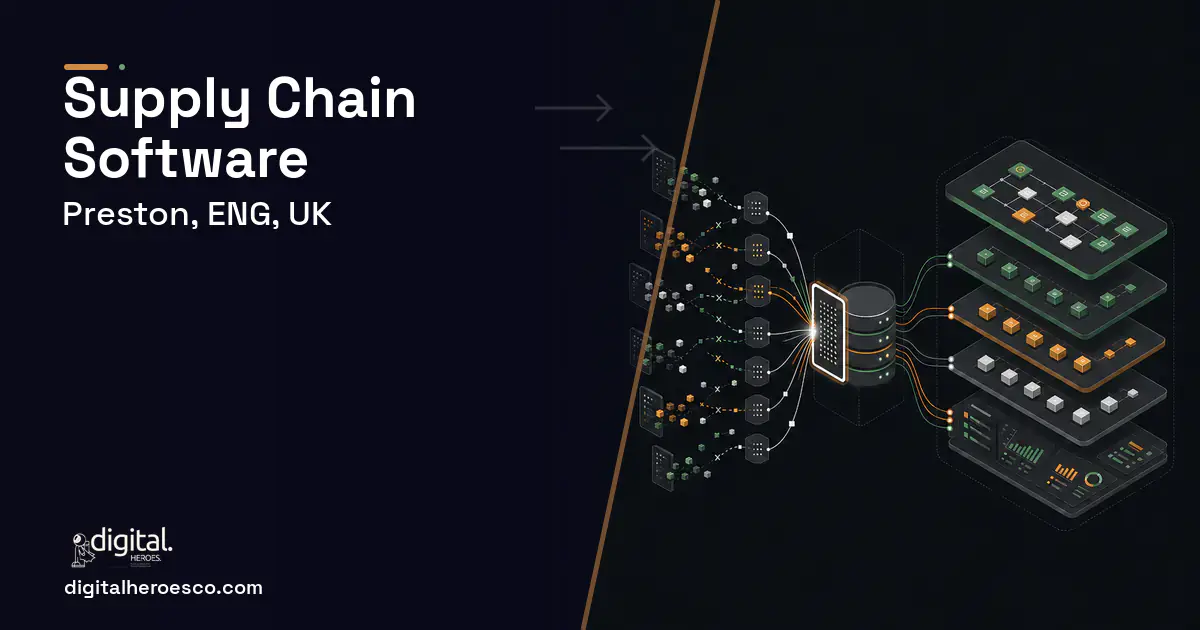
Custom supply chain software helps a Preston aerospace or engineering supplier manage just-in-time demand, sub-contract processes and prime schedule changes reliably, instead of chasing them through email and spreadsheets. Expect £40,000 to £110,000 and 12 to 24 weeks for a system that keeps you ahead of a prime's changing dates rather than a step behind.
SAP and generic supply chain modules are built for large enterprises with matching budgets and IT teams. A mid-sized Preston supplier feeding a prime like BAE lives with the same demands, just-in-time delivery, rolling schedules, sub-contract special processes with their own lead times, but without the enterprise machinery. So the schedule arrives by email or a portal, someone transcribes it into a spreadsheet, and the plan is only as current as the last time somebody checked.
The danger is a quiet change. A prime moves a delivery date or revises a call-off, the update sits unread, and by the time it surfaces you have missed a line slot or committed material you no longer need. The sub-contract chain, heat treat, NDT, finishing, adds lead times that a spreadsheet cannot plan around, so slippage compounds before anyone sees it.
The case for owning your supply chain
A custom supply chain system ingests prime demand signals directly, tracks sub-contract processes with their real lead times, and gives you a live plan that flags a changed date the moment it lands instead of when it hurts. It connects to your ERP (Enterprise Resource Planning), draws on your material traceability, feeds your warehouse and surfaces risk in your dashboards. You plan around the whole chain, including the sub-contractors, rather than reacting to whichever email someone happened to read.
What your build should include
Preston supply chain: the full scope
Digital Heroes builds the full supply chain stack for Preston teams. Typical engagements cover logistics software, procurement software, demand planning, supplier management, order management system, transportation management (TMS) and supply chain visibility.
Budgeting a supply chain build in Preston
| Project scope | Typical cost | Timeline |
|---|---|---|
| Core planning with demand ingestion | £40,000 to £62,000 | 12 to 16 weeks |
| Add sub-contract lead-time planning and alerts | £62,000 to £88,000 | 16 to 20 weeks |
| Full build with ERP and warehouse integration | £88,000 to £110,000 | 20 to 24 weeks |
Delivery, week by week
Exactly what you get
A supply chain system sized for a Preston supplier: direct ingestion of prime schedules, sub-contract process tracking with real lead times, a live view of demand, material and capacity, and alerts the moment a date changes. It integrates with your ERP, inventory and warehouse so the whole chain is connected. The result is a plan that keeps you ahead of a prime's changes instead of reacting to an email someone finally opened.
How to choose a developer in Preston
Choose a developer who right-sizes the solution to a mid-market supplier rather than pushing enterprise tooling, and who understands JIT supply into primes. Confirm they can ingest a prime's schedule, plan around sub-contract lead times, and integrate with your ERP and warehouse. A team that knows the Lancashire aerospace supply chain will build planning that reflects how a prime like BAE actually drives demand.
- Prime schedules are ingested directly, so a changed date is flagged immediately, not discovered too late
- Sub-contract lead times are built into the plan, so heat treat and finishing slippage is anticipated
- One live view of demand, material and capacity shows whether you can meet the coming month
- Fewer missed line slots because the plan reflects reality instead of a spreadsheet someone last touched days ago
- The whole chain, from prime demand to sub-contractor, is visible in one place and tied to your ERP
- Supply chain software is a substantial build that suits established suppliers with real JIT pressure
- Its value depends on clean data from primes and sub-contractors, which takes effort to establish
- You take on maintenance and integration upkeep as portals and formats change
- A smaller supplier with simple demand may manage well with ERP scheduling alone
- !They push enterprise SAP-scale tooling: ask how it fits a mid-sized Preston supplier's budget and IT
- !They ignore sub-contract lead times: ask how heat treat and finishing are planned around
- !They cannot ingest a prime's schedule: ask how a portal or EDI feed becomes a live plan
- !They skip alerting: ask how a changed delivery date reaches the right person immediately
- !They gloss over ERP integration: ask how the plan stays in step with jobs and material
If supply chain is on the roadmap, project management, helpdesk & ticketing, crm usually follow within the year. Budget them as one conversation. Weighing options across the region? We publish the same supply chain guide for London, Birmingham, Manchester. Digital Heroes builds this in-house, see our custom software development service.
The evidence behind this guide
Independent findings on why this investment pays off. Every link goes to the primary source.
- Digital Champions expect to achieve about 16% in cost savings and around 15% in revenue gains from digital operations over five years; the study surveyed 1,155 manufacturing executives across 26 countries. Source: PwC / Strategy& (2018) →
- In a survey of 579 supply chain professionals (July 31 to October 1, 2024), only 29% had built at least three of the five capabilities Gartner identifies as needed for future competitiveness (agility, resilience, regionalization, integrated ecosystems, and enterprise-wide strategy). Source: Gartner (2025) →
- The right combination of digital transformation actions can unlock as much as US$1.25 trillion in additional market capitalization across Fortune 500 companies, while the wrong combinations put more than US$1.5 trillion at risk; companies with all three core factors (strategy, aligned technology, and change capability) saw a 5% market-value lift relative to peers. Source: Deloitte (2023) →
- WordPress powers 41.5% of all websites and holds 59.2% of the market among sites running a known content management system, making it by far the most-used CMS on the web. Source: W3Techs (2026) →
Saanvi works on B2B Shopify builds at Digital Heroes, where the requirements shift from consumer checkout to company accounts, customer specific pricing, purchase orders and approval steps. Her posts help wholesale businesses see how much of that a commerce platform handles and how much needs building.
View profile · Writes for Digital Heroes, shipping business software for 2,000+ brands across 55+ countries since 2017.
Frequently asked questions
What does supply chain software cost for a Preston supplier?
A custom supply chain system for a Preston aerospace or engineering supplier typically costs £40,000 to £110,000, with core planning and demand ingestion at the lower end and full sub-contract planning plus ERP and warehouse integration at the top. Cost is driven mainly by integration and planning complexity. Most suppliers phase it, starting with demand ingestion and alerts.
Why not use SAP or a generic SCM tool?
SAP and enterprise SCM assume large budgets and IT teams that a mid-sized Preston supplier does not have. A custom system delivers the JIT and sub-contract planning you need at a scale and cost that fit. It is built around how a prime actually feeds you demand, not a generic enterprise model.
Can it ingest just-in-time schedules from a prime like BAE?
Yes. A custom system can ingest demand signals from a prime's portal, EDI or structured feed and turn them into a live plan, so a changed delivery date is flagged immediately. That replaces transcribing schedules into a spreadsheet. It is the core reason to build.
Does it plan around sub-contract lead times?
Yes. Special-process sub-contractors, heat treat, NDT and finishing, have real lead times, and the system builds them into planning so slippage is anticipated rather than discovered late. For Preston aerospace suppliers that visibility prevents compounding delays. Spreadsheets simply cannot plan this reliably.
How does it warn us about missed line slots?
Exception views and alerts surface at-risk deliveries before they slip, and flag a prime's date change the moment it lands. That gives you time to react rather than finding out after you have missed a slot. Getting ahead of changes is exactly the value.
Does it connect to our ERP and warehouse?
Yes. The supply chain system integrates with your ERP, inventory and warehouse so demand, material and capacity stay in step across the operation. That single connected chain is the goal. Integration is scoped early because it carries much of the value and effort.
Do we own the supply chain system?
Yes. You own the code and data, hosted where you choose, so no vendor controls the planning your delivery performance depends on. That matters because prime relationships and formats change over time. Ownership keeps you free to adapt.
How long does it take to build?
Expect 12 to 24 weeks, with core planning and demand ingestion usually first at around weeks 12 to 16. Sub-contract planning, alerting and deeper integration follow. The pace depends on how clean your prime and sub-contractor data relationships are.
Is this worth it for a mid-sized Lancashire supplier?
It is worth it when you supply a prime on tight JIT terms, when missed slots or late date changes cost you, and when sub-contract lead times make manual planning fragile. If your demand is simple and ERP scheduling copes, you may not need it yet. Many Preston suppliers reach this point as prime demand grows more volatile.
How much does custom supply chain software cost for a small business?
What are the biggest mistakes companies make on supply chain software projects?
We are a growing distributor. Should we pick SAP Business One or go custom?
When is SAP actually a better choice than building custom supply chain software?
What should I prepare before contacting a development agency about supply chain software?
How much does a custom warehouse management system cost to build?
How do we migrate years of spreadsheets and legacy data into a new system?
What tech stack is best for custom supply chain software?
Should I hire a freelancer or an agency to build supply chain software?
Who can build custom supply chain software for a business in Preston?
Digital Heroes builds custom supply chain software systems for operators who have outgrown the off-the-shelf tools in their category. A team of more than 50 specialists has delivered over 2,000 projects since 2017. Teams work from New York, London, Sydney, Delhi and Lucknow and deliver remotely, so an operator in Preston gets an assigned senior team rather than a local account manager.
Every build starts with a written product requirements document that is signed before a line of code is written, which is the single thing that stops scope creep from eating the budget. Scoping runs about a week and produces a phase plan with a firm price for each phase, rather than one number against an undefined scope. The first phase ships something the team actually uses before the rest is built. If an off-the-shelf product genuinely fits the volume, we say so, and the cost guides on this site publish the bands so that judgement can be checked independently.
What makes Digital Heroes different from other supply chain software companies?
Four things that competitors in this bracket cannot simply copy. Digital Heroes runs a YouTube channel with more than 2.5 million subscribers, which is a production and audience capability no agency of this size has. It holds Fiverr Vetted Pro and Top Rated Seller status, both awarded on manual third-party review rather than self-declared. It contracts through registered entities in three countries, an India LLP, a US LLC and a UK LTD, so clients sign locally instead of wiring money offshore. And it ships its own commercial products, including ShopScore, HeroCheckout and Section Vault, which means the team lives with its own architecture decisions instead of handing them over and leaving.
Two more that show up in the work. Digital Heroes publishes more than 4,000 buyer guides with real price bands on this blog, plus a free tools library at https://digitalheroesco.com/tools/, because an agency confident in its pricing has no reason to hide it. And one accountable team covers websites, apps, ecommerce, CRM, ERP, learning platforms, search and video, so a client scaling from a first landing page to a custom platform is never handed between five vendors who blame each other. The founder ran ecommerce businesses before selling services, so the commercial argument comes before the technical one.
How can I check Digital Heroes is legitimate before getting in touch?
Verify it independently rather than taking the site's word for it. The YouTube channel is at https://youtube.com/@DigitalMarketingHeroes, the Fiverr profile at https://www.fiverr.com/shreyanshsin261, and the Upwork profile at https://www.upwork.com/freelancers/shreyanshsingh. Client reviews sit on Clutch at https://clutch.co/profile/digital-heroes-0 and Trustpilot at https://www.trustpilot.com/review/digitalheroes.co.in, and the company page is at https://www.linkedin.com/company/digital-heroes-1/.
Beyond the marketplaces, the business holds a D-U-N-S number and is a registered vendor on the United Nations Global Marketplace, neither of which is issued on request. Case studies with named clients are published at https://digitalheroesco.com/case-studies/. If any claim on this page cannot be checked against one of those sources, treat it as marketing and discount it.


