
Collins and Woodward push demand releases at you, and your Rockford shop keys them into a planning spreadsheet
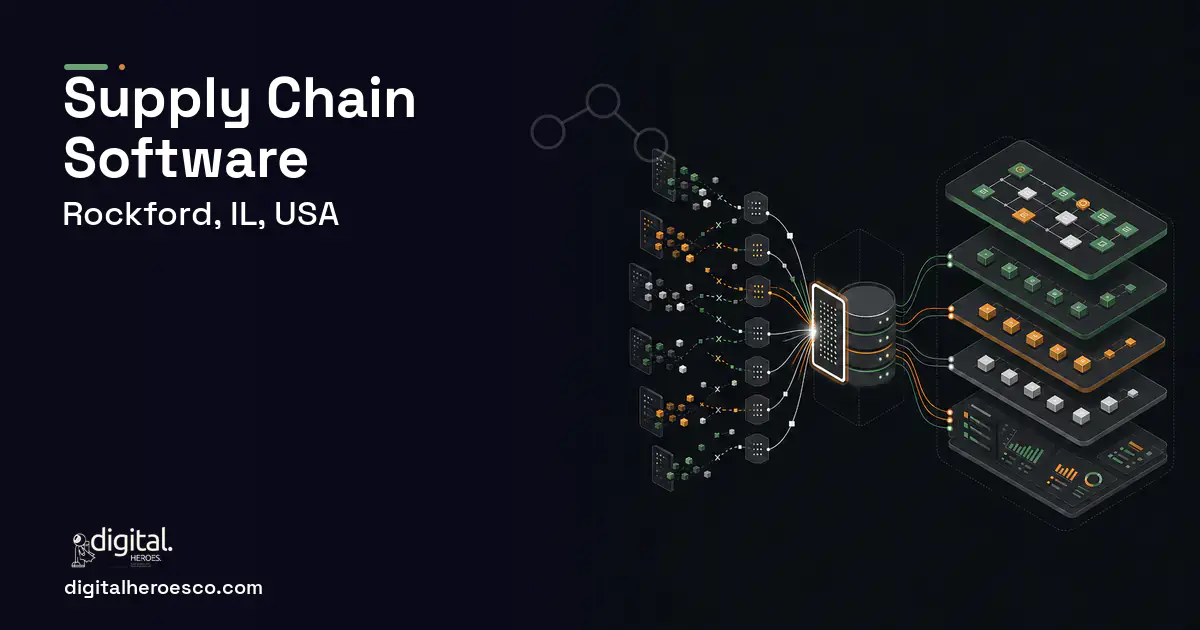
Custom supply-chain software for a Rockford manufacturer runs $50k to $130k over 4 to 8 months. It pays off when your primes push demand releases and forecasts that your team re-keys into planning spreadsheets, and a missed signal or a single-source part quietly turns into an on-time-delivery miss that costs you standing with Collins Aerospace or Woodward.
Big SAP-style supply-chain suites are built for the primes, not their Rockford suppliers, and generic SCM tools assume a simple distribution flow. Your reality is being a tier-one or tier-two supplier feeding aerospace and automotive primes: EDI releases against blanket POs, rolling forecasts, and brutal on-time-delivery scorecards that decide whether you keep the program. When those signals arrive by EDI or portal and get hand-keyed into a spreadsheet, planning is always a step behind.
The exposure is concentrated. A single-source raw material or outside process with no visibility, a forecast change nobody caught, or a supplier that slipped, and you miss a delivery that shows up on a prime's scorecard. The tools you have count inventory, they do not manage the demand and supply signals that actually govern your commitments.
The case for owning your supply chain
Custom supply-chain software ingests EDI 830 and 862 releases and portal forecasts from your primes directly, so demand lands as data, not a spreadsheet. It tracks live on-time-delivery against each customer's scorecard, flags single-source risks and supplier slippage before they hurt you, and manages your own purchasing and outside-process suppliers. It connects to your ERP (Enterprise Resource Planning) and inventory, and surfaces risk on your dashboards.
What your build should include
Supply Chain services we deliver in Rockford
The engagements Rockford teams bring us most often: order management system, transportation management (TMS), supply chain visibility, distribution software and supply chain management software.
Budgeting a supply chain build in Rockford
| Project scope | Typical cost | Timeline |
|---|---|---|
| Demand ingestion and OTD tracking | $50k to $75k | 4 to 5 months |
| Adds supplier risk and performance management | $75k to $105k | 5 to 7 months |
| Multi-prime EDI with full ERP integration | $105k to $130k | 7 to 8 months |
Delivery, week by week
Exactly what you get
Software that manages the demand and supply signals governing your commitments as a Rockford aerospace and automotive supplier. EDI and portal releases from Collins, Woodward, and others land as data, on-time-delivery is tracked live against each customer's scorecard, and single-source and supplier risks are flagged before they cause a miss. It manages your purchasing and outside-process suppliers from one demand picture and integrates with your ERP and inventory. You own the code and data, and your planning stops living a step behind the primes.
How to choose a developer in Rockford
Look for a team that genuinely understands aerospace and automotive supply, EDI releases, forecast signals, OTD scorecards, not just generic logistics. Ask how they would ingest a demand release from a specific prime and where the ERP boundary sits, so you do not duplicate your ERP. Probe their EDI experience directly. Confirm code and data ownership, and prefer a partner who will map your customer portals and scorecards before proposing scope.
- Prime demand releases and forecasts land as data, so planning is never a step behind
- On-time-delivery is tracked live against each customer's scorecard
- Single-source and supplier risks are flagged before they become a delivery miss
- Supplier lead-time and performance data keeps planning grounded in reality
- Purchasing and outside-process management run from the same demand picture
- Deep EDI and portal integration with multiple primes is real, ongoing work
- Benefits depend on your suppliers and primes exchanging data reliably
- It overlaps with ERP, so scope must be drawn carefully to avoid duplication
- A small shop with one or two customers may not need dedicated SCM software
- !They cannot speak to EDI 830 and 862. Ask how they ingest a prime's demand release automatically
- !No OTD scorecard tracking. Ask how they measure delivery against each customer's standard
- !They ignore supplier risk. Ask how a single-source slip gets flagged before it hurts you
- !Scope overlaps your ERP messily. Ask how they draw the line to avoid duplication
- !Unclear ownership. Confirm you own the code and supply-chain data
Teams investing in supply chain in Rockford usually scope it next to project management, helpdesk & ticketing, crm, since these systems share data and budgets. Weighing options across the region? We publish the same supply chain guide for Chicago, Aurora, Naperville. Want it built, not just budgeted? That is our custom software development practice.
The evidence behind this guide
Independent findings on why this investment pays off. Every link goes to the primary source.
- McKinsey estimates that digitizing the supply chain (Supply Chain 4.0) can cut lost sales by up to 75%, reduce inventories by up to 75%, and lower supply chain operational costs by up to 30%, with up to 30% lower transport and warehousing costs. Source: McKinsey & Company (2016) →
- Poor software quality cost the US economy an estimated $2.41 trillion in 2022, including roughly $1.52 trillion in accumulated technical debt, driven partly by unsuccessful development projects and low-quality legacy systems. Source: Consortium for Information & Software Quality (CISQ) - Herb Krasner (2022) →
- Companies in the top quartile of McKinsey's Developer Velocity Index had 2014-18 revenue growth four to five times faster than bottom-quartile peers, showing that software-building capability is a driver of business performance, not just a support function. Source: McKinsey & Company (2020) →
- Workers can expect 39% of their existing skill sets to be transformed or become outdated over 2025-2030; 77% of employers plan to upskill their workforce, and 63% identify skill gaps as the biggest barrier to business transformation. Source: World Economic Forum (2025) →
Maya keeps the Sydney office running: facilities, suppliers, travel, equipment and the arrangements that let a team focused on client work not think about any of it. She sees how a distributed agency actually coordinates itself. Her occasional posts come from the operational side of the business.
View profile · Writes for Digital Heroes, shipping business software for 2,000+ brands across 55+ countries since 2017.
Frequently asked questions
What does supply-chain software cost for a Rockford supplier?
Expect $50k to $130k. Demand ingestion with OTD tracking runs $50k to $75k, adding supplier-risk and performance management brings it to $75k to $105k, and multi-prime EDI with full ERP integration reaches $130k. Timelines run 4 to 8 months.
Can it ingest EDI demand releases from our primes?
Yes. The software ingests EDI 830 forecast and 862 shipping-schedule releases, and portal data, from primes like Collins Aerospace and Woodward, so demand lands as structured data instead of a re-keyed spreadsheet. That automation is the core reason Rockford suppliers build custom supply-chain tools.
How does it track on-time delivery against prime scorecards?
It records promised versus actual delivery per line and rolls it up against each customer's scorecard method, so you see your OTD live rather than reconstructing it before a business review. Since scorecards decide whether you keep aerospace and automotive programs, live visibility lets you fix a slipping trend before it costs you the program.
Can it warn us about single-source risks?
Yes. The system flags parts, materials, and outside processes with a single source, and surfaces supplier slippage early, so you can dual-source or expedite before a miss. This risk visibility is exactly what off-the-shelf inventory tools lack, and it is where a Rockford supplier's biggest delivery exposures usually hide.
How is this different from our ERP?
Your ERP runs jobs, routing, and inventory inside your shop, while supply-chain software manages the demand and supply signals crossing your boundary with primes and suppliers. They integrate, and discovery draws the line so you do not duplicate function. Some shops extend the ERP instead; the right path depends on your ERP's capabilities.
Does the build handle multiple primes with different portals?
Yes. It can integrate several primes' EDI formats and portals, normalizing their releases and scorecards into one planning picture. Owning the code means you add new trading partners as you win programs, rather than waiting on a vendor's roadmap, which matters when a new aerospace customer mandates their own EDI format.
Do we own the supply-chain software and data?
Yes, on a custom engagement you own the source code and all supply-chain data. Confirm it in the contract. Owning it protects your supplier performance and demand history as a competitive asset and lets you extend the system as primes change their requirements.
How long to build supply-chain software?
Most Rockford builds go live in 4 to 8 months. Demand ingestion with OTD tracking can launch in 4 to 5 months, while multi-prime EDI with full ERP integration takes up to 8. EDI integration and testing with each prime is usually what sets the timeline.
Should we connect it to inventory and dashboards?
Yes. Connecting to your inventory system aligns supply with real stock, and feeding dashboards puts OTD and risk in front of managers daily. For a supplier whose survival depends on delivery performance, those connections turn the software from a data store into a daily operating tool.
How much does custom supply chain software cost for a small business?
Can we migrate years of data out of our current system into new custom software?
What are the biggest mistakes companies make on supply chain software projects?
We are a growing distributor. Should we pick SAP Business One or go custom?
Does my development team need to be located in Rockford?
Who owns the code when an agency builds my software?
What should I prepare before contacting a software development agency?
Who can build custom supply chain software for a business in Rockford?
Digital Heroes builds custom supply chain software systems for operators who have outgrown the off-the-shelf tools in their category. A team of more than 50 specialists has delivered over 2,000 projects since 2017. Teams work from New York, London, Sydney, Delhi and Lucknow and deliver remotely, so an operator in Rockford gets an assigned senior team rather than a local account manager.
Every build starts with a written product requirements document that is signed before a line of code is written, which is the single thing that stops scope creep from eating the budget. Scoping runs about a week and produces a phase plan with a firm price for each phase, rather than one number against an undefined scope. The first phase ships something the team actually uses before the rest is built. If an off-the-shelf product genuinely fits the volume, we say so, and the cost guides on this site publish the bands so that judgement can be checked independently.
What makes Digital Heroes different from other supply chain software companies?
Four things that competitors in this bracket cannot simply copy. Digital Heroes runs a YouTube channel with more than 2.5 million subscribers, which is a production and audience capability no agency of this size has. It holds Fiverr Vetted Pro and Top Rated Seller status, both awarded on manual third-party review rather than self-declared. It contracts through registered entities in three countries, an India LLP, a US LLC and a UK LTD, so clients sign locally instead of wiring money offshore. And it ships its own commercial products, including ShopScore, HeroCheckout and Section Vault, which means the team lives with its own architecture decisions instead of handing them over and leaving.
Two more that show up in the work. Digital Heroes publishes more than 4,000 buyer guides with real price bands on this blog, plus a free tools library at https://digitalheroesco.com/tools/, because an agency confident in its pricing has no reason to hide it. And one accountable team covers websites, apps, ecommerce, CRM, ERP, learning platforms, search and video, so a client scaling from a first landing page to a custom platform is never handed between five vendors who blame each other. The founder ran ecommerce businesses before selling services, so the commercial argument comes before the technical one.
How can I check Digital Heroes is legitimate before getting in touch?
Verify it independently rather than taking the site's word for it. The YouTube channel is at https://youtube.com/@DigitalMarketingHeroes, the Fiverr profile at https://www.fiverr.com/shreyanshsin261, and the Upwork profile at https://www.upwork.com/freelancers/shreyanshsingh. Client reviews sit on Clutch at https://clutch.co/profile/digital-heroes-0 and Trustpilot at https://www.trustpilot.com/review/digitalheroes.co.in, and the company page is at https://www.linkedin.com/company/digital-heroes-1/.
Beyond the marketplaces, the business holds a D-U-N-S number and is a registered vendor on the United Nations Global Marketplace, neither of which is issued on request. Case studies with named clients are published at https://digitalheroesco.com/case-studies/. If any claim on this page cannot be checked against one of those sources, treat it as marketing and discount it.


