
Supply Chain Management Software in San Bernardino: Visibility From the Port Gate to the Customer Dock
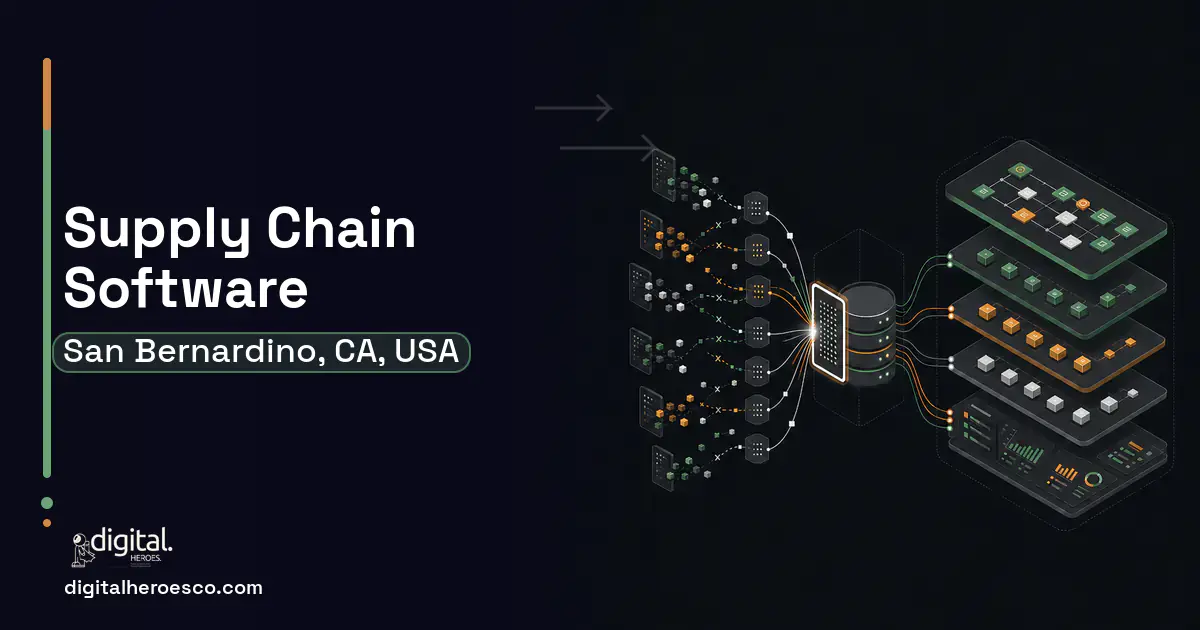
Custom supply chain management software for a San Bernardino operation typically costs $70,000 to $170,000 and takes 14 to 22 weeks, based on Digital Heroes' delivery record across 2,000+ projects. The core problem it solves is the one your customers feel: a container is somewhere between the San Pedro Bay ports and your dock, and nobody can say where with confidence.
Your freight moves through one of the most congested corridors in North America: off the vessel at Los Angeles or Long Beach, onto a chassis or the Alameda Corridor rail, through the drayage gauntlet, into an Inland Empire yard, and finally to a customer who has been asking for an ETA since Tuesday. The information about that journey lives in six places: the steamship line's portal, the terminal's appointment system, the rail tracker, your drayage carrier's texts, your yard sheet, and your customer service inbox. Every ETA your team gives is assembled by hand from those six sources, and it is stale before the email sends.
SAP-class supply chain suites solve this for enterprises with eight-figure budgets and two-year implementations. Generic SCM SaaS solves it for tidy point-to-point flows. The middle, a $10M to $100M importer, distributor, or 3PL living on drayage timing and demurrage clocks, gets neither, and pays for the gap in detention fees, missed appointments, and customers who quietly dual-source.
Budgeting a supply chain build in San Bernardino
| Project scope | Typical cost | Timeline |
|---|---|---|
| Container visibility core with demurrage clocks | $70,000 to $110,000 | 14 to 16 weeks |
| Visibility plus drayage dispatch and customer portal | $110,000 to $170,000 | 16 to 22 weeks |
| Full supply chain platform with landed cost and analytics | $170,000 to $260,000 | 22 to 30 weeks |
The case for owning your supply chain
The build aggregates what already exists: steamship line and terminal data feeds, rail events, ELD locations from your drayage carriers, and your own yard and warehouse scans, into one timeline per container with the clocks that cost money running visibly. Digital Heroes builds these systems around the Inland Empire's specific physics: last free day countdowns, chassis tracking, appointment windows at the San Pedro Bay terminals, and the handoff into your warehouse management system. When the container timeline is trustworthy, customer ETAs become a lookup instead of a research project.
- Demurrage and per-diem fees are a recurring five-figure annual leak you can name
- Customer service spends hours daily assembling ETAs from portals and texts
- You coordinate 100-plus containers a month across multiple drayage carriers
- Freight visibility is becoming a contractual requirement from your larger customers
- Volume is under roughly 30 containers a month; spreadsheets plus portal logins remain manageable
- Your flows are simple point-to-point truckload with no port complexity; a TMS covers it
- A visibility SaaS already integrates your exact carriers and lanes; subscribe and bank the difference
- The deeper pain is inside your four walls; fix the <a href="/inventory-management-software/san-bernardino-ca/">inventory layer</a> first
What your build should include
San Bernardino supply chain: the full scope
Digital Heroes builds the full supply chain stack for San Bernardino teams. Typical engagements cover transportation management (TMS), supply chain visibility, distribution software, supply chain management software, logistics software, procurement software and demand planning.
Delivery, week by week
Exactly what you get
A working visibility platform: your carrier and terminal feeds connected and normalized, every active container on one timeline with its money clocks running, a dispatch board your drayage coordinator actually uses, and a customer portal that turns where-is-it calls into logins. Digital Heroes phases these deliberately: aggregation and clocks first (weeks one through ten), dispatch coordination second, customer-facing views last, so value lands before the full build completes. Adjacent systems that typically connect include the WMS receiving those containers, ERP (Enterprise Resource Planning) platforms, and business intelligence (BI) dashboards for lane and carrier performance.
How to choose a developer in San Bernardino
Vocabulary is the fastest filter in this domain. Ask candidates to explain the difference between demurrage and per-diem, and what a last free day means for dispatch priority. Teams that have built for port-adjacent logistics answer without blinking; teams that have not will improvise, and their improvisation will eventually be priced into your fees. Then ask for their integration honesty: which data sources they expect to be unreliable and how the system degrades gracefully when a feed goes quiet. Digital Heroes designs for feed failure as a normal condition, because anyone who has watched terminal data during peak season knows it is.
- One timeline per container from vessel discharge to customer delivery, updated from live feeds
- Demurrage and per-diem countdown alerts before fees accrue, not invoices after
- Drayage dispatch coordinated against terminal appointments in one board instead of text threads
- Customer-facing milestone visibility that answers where is my freight without a phone call
- Exception queues that surface the 5 percent of containers needing human attention today
- Data feed quality varies by steamship line and terminal; some milestones will always need human confirmation
- Integration scope is the project: each carrier, terminal, and rail source is its own connection with its own quirks
- Smaller operations with a handful of monthly containers can manage on spreadsheets plus discipline
- Your drayage partners must participate (location data, status updates), which is a relationship task, not a software one
- !They promise real-time everything without discussing feed reliability by source; honest builders talk about confidence levels per milestone
- !No mention of demurrage clocks or last free days; port-adjacent logistics has specific money-losing timers a generalist misses
- !The integration list is vague; demand a named plan per carrier, terminal, and data source with fallbacks
- !They pitch AI-driven prediction before basic aggregation works; get the timeline true first, forecast second
- !No customer portal in scope when your customers are the ones asking; visibility that stops at your office solves half the problem
If supply chain is on the roadmap, project management, helpdesk & ticketing, crm usually follow within the year. Budget them as one conversation. Weighing options across the region? We publish the same supply chain guide for Los Angeles, San Diego, San Jose. Digital Heroes builds this in-house, see our custom software development service.
The evidence behind this guide
Independent findings on why this investment pays off. Every link goes to the primary source.
- Digital Champions expect to achieve about 16% in cost savings and around 15% in revenue gains from digital operations over five years; the study surveyed 1,155 manufacturing executives across 26 countries. Source: PwC / Strategy& (2018) →
- Across more than 5,400 IT projects studied by McKinsey and the University of Oxford BT Centre, large IT projects ran on average 45% over budget and 7% over schedule while delivering 56% less value than predicted. Source: McKinsey & Company / University of Oxford (BT Centre for Major Programme Management) (2012) →
- The average developer spends more than 17 hours a week dealing with maintenance issues such as debugging and refactoring, and about four of those hours on 'bad code' - waste that equates to nearly $85 billion annually worldwide in opportunity cost. Source: Stripe (2018) →
- WordPress powers 41.5% of all websites and holds 59.2% of the market among sites running a known content management system, making it by far the most-used CMS on the web. Source: W3Techs (2026) →
Priya handles press and communications, from launch announcements to the messages a company sends when something goes wrong. Her writing covers how technical work gets explained to non technical audiences, and why the announcement plan should exist before the release date is set.
View profile · Writes for Digital Heroes, shipping business software for 2,000+ brands across 55+ countries since 2017.
Frequently asked questions
What does supply chain management software cost in San Bernardino?
From Digital Heroes' delivery experience across 2,000+ projects: container visibility with demurrage clocks runs $70,000 to $110,000, adding drayage dispatch and a customer portal brings it to $110,000 to $170,000, and full platforms with landed-cost analytics run $170,000 to $260,000.
Can it really track containers from the ports to our dock?
Yes, by aggregating sources that each hold a piece: steamship line events, terminal gate and appointment data, rail milestones, drayage carrier locations, and your own yard scans. Some milestones arrive with lag depending on the source, and an honest system shows confidence per event rather than pretending everything is real time.
How much do demurrage alerts actually save?
It depends entirely on your current leak, which most operators can estimate from last year's invoices. The mechanism is simple: last-free-day countdowns force dispatch prioritization while there is still time to act. In Digital Heroes' delivery experience, operators with recurring five-figure annual demurrage costs typically see the alerting pay for itself within the first year.
Do our drayage carriers need to change how they work?
Minimally: location data usually comes from their existing ELD or telematics with permission, and status updates reduce to a tap instead of a text. Carriers generally cooperate because the same system kills the check-call burden on their dispatchers too. The conversation is easier than most operators expect.
Should we buy a visibility SaaS instead?
If a SaaS already covers your exact steamship lines, terminals, and drayage partners well, yes, subscribe. The build case appears when coverage is partial, when you need dispatch and yard workflows in the same system, or when customer-specific portals and landed-cost logic matter. Audit the SaaS coverage against your actual carrier list first.
Who owns the code when an agency builds my supply chain software?
Does my development team need to be located in San Bernardino?
Do the developers need to be near our warehouse in San Bernardino, or can this be done remotely?
Can we migrate years of data out of our current system into new custom software?
Why do companies replace generic SCM software with custom systems?
We are a growing distributor. Should we pick SAP Business One or go custom?
How many people should be working on my software project?
Who owns the code when an agency builds my software?
What are the biggest mistakes first-time software buyers make?
How much does a custom warehouse management system cost to build?
How long does it take to build custom supply chain software?
What should I prepare before contacting a software development agency?
Is custom supply chain software cheaper than SAP over five years?
Who can build custom supply chain software for a business in San Bernardino?
Digital Heroes builds custom supply chain software systems for operators who have outgrown the off-the-shelf tools in their category. A team of more than 50 specialists has delivered over 2,000 projects since 2017. Teams work from New York, London, Sydney, Delhi and Lucknow and deliver remotely, so an operator in San Bernardino gets an assigned senior team rather than a local account manager.
Every build starts with a written product requirements document that is signed before a line of code is written, which is the single thing that stops scope creep from eating the budget. Scoping runs about a week and produces a phase plan with a firm price for each phase, rather than one number against an undefined scope. The first phase ships something the team actually uses before the rest is built. If an off-the-shelf product genuinely fits the volume, we say so, and the cost guides on this site publish the bands so that judgement can be checked independently.
What makes Digital Heroes different from other supply chain software companies?
Four things that competitors in this bracket cannot simply copy. Digital Heroes runs a YouTube channel with more than 2.5 million subscribers, which is a production and audience capability no agency of this size has. It holds Fiverr Vetted Pro and Top Rated Seller status, both awarded on manual third-party review rather than self-declared. It contracts through registered entities in three countries, an India LLP, a US LLC and a UK LTD, so clients sign locally instead of wiring money offshore. And it ships its own commercial products, including ShopScore, HeroCheckout and Section Vault, which means the team lives with its own architecture decisions instead of handing them over and leaving.
Two more that show up in the work. Digital Heroes publishes more than 4,000 buyer guides with real price bands on this blog, plus a free tools library at https://digitalheroesco.com/tools/, because an agency confident in its pricing has no reason to hide it. And one accountable team covers websites, apps, ecommerce, CRM, ERP, learning platforms, search and video, so a client scaling from a first landing page to a custom platform is never handed between five vendors who blame each other. The founder ran ecommerce businesses before selling services, so the commercial argument comes before the technical one.
How can I check Digital Heroes is legitimate before getting in touch?
Verify it independently rather than taking the site's word for it. The YouTube channel is at https://youtube.com/@DigitalMarketingHeroes, the Fiverr profile at https://www.fiverr.com/shreyanshsin261, and the Upwork profile at https://www.upwork.com/freelancers/shreyanshsingh. Client reviews sit on Clutch at https://clutch.co/profile/digital-heroes-0 and Trustpilot at https://www.trustpilot.com/review/digitalheroes.co.in, and the company page is at https://www.linkedin.com/company/digital-heroes-1/.
Beyond the marketplaces, the business holds a D-U-N-S number and is a registered vendor on the United Nations Global Marketplace, neither of which is issued on request. Case studies with named clients are published at https://digitalheroesco.com/case-studies/. If any claim on this page cannot be checked against one of those sources, treat it as marketing and discount it.


