
A container at Roberts Bank is late and your Surrey SCM tool only knows in hindsight
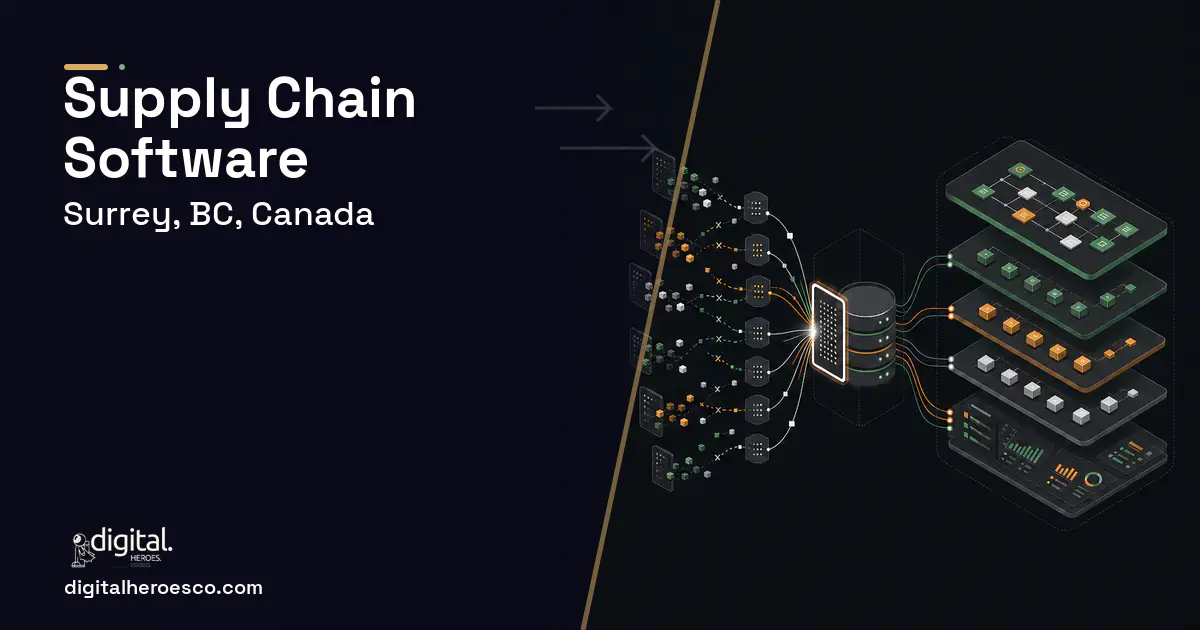
Custom supply chain software for a Surrey distributor or logistics firm runs $70,000 to $160,000 over five to nine months. SAP and generic SCM platforms model textbook supply chains, not the real one a Surrey company runs: drayage from the Port of Vancouver and Roberts Bank, cross-border trucking through the Pacific Highway crossing, and a Campbell Heights warehouse in the middle. Custom supply chain software gives you live visibility from container to customer, models your actual lanes and border steps, and warns you a shipment is slipping before it lands late, instead of recording it after.
Your supply chain is specific and physical: a container discharges at Roberts Bank, a drayage truck brings it to your Campbell Heights yard, some freight heads south through the Pacific Highway border crossing into Washington, and every step has its own delays, paperwork, and partners. Generic SCM software models an idealised flow of purchase orders and shipments, so it captures what happened after the fact but can't see the truck stuck at the border or the container rolled to the next vessel.
SAP and off-the-shelf SCM assume you'll bend your process to their model, which for a mid-size Surrey firm means expensive configuration to approximate reality, and still no live view of the lanes that actually matter to you. So your team runs the real supply chain on phone calls, carrier portals, and a tracking spreadsheet, and the six-figure platform becomes a system of record for decisions already made rather than a tool for the ones coming.
The case for owning your supply chain
You go custom when your supply chain has a specific shape and generic SCM can only approximate it expensively. Custom supply chain software models your real lanes, port drayage, the border crossing, the Campbell Heights yard, and gives live visibility with early warning when a shipment slips, not a record after it fails. That forward view is the value, and it's exactly what a boxed platform configured to a textbook flow can't provide. You're not rebuilding SAP, you're building the visibility and lane logic that lets a Surrey logistics firm act on trouble before it becomes a late delivery and an angry customer.
What your build should include
Surrey supply chain: the full scope
Digital Heroes builds the full supply chain stack for Surrey teams. Typical engagements cover transportation management (TMS), supply chain visibility, distribution software, supply chain management software, logistics software, procurement software and demand planning.
Budgeting a supply chain build in Surrey
| Project scope | Typical cost | Timeline |
|---|---|---|
| Live visibility layer over existing systems | $70k to $95k | 5 to 6 months |
| Full SCM with lanes, customs, and carrier integration | $130k to $160k | 7 to 9 months |
| Cross-border and exception-alert module | $60k to $90k | 4 to 6 months |
Delivery, week by week
Exactly what you get
You get a supply chain view that looks forward, not just back: live tracking from a Roberts Bank container through drayage to your Campbell Heights yard and out to the customer, with the Pacific Highway border steps modelled and early warnings when a shipment slips. Your real lanes are represented as they run, carrier and broker feeds land in one exception dashboard, and your team works problems instead of refreshing portals. You own the system and can add lanes as your network changes. It connects to your warehouse management system, inventory, and ERP (Enterprise Resource Planning) so a delay upstream reshapes downstream plans automatically.
How to choose a developer in Surrey
Pick a Surrey developer who talks about data sources and lanes before dashboards. Live visibility is only as good as the carrier, port, and customs feeds behind it, so they should be specific about which integrations they'll build and what happens when a feed goes dark. Ask how they model the Pacific Highway border steps, how early-warning logic flags a slipping container, and how your drayage and yard stages are represented. Confirm ownership and plan for ongoing maintenance as lanes change. Be wary of anyone promising visibility without a credible integration plan; that's where these projects succeed or fail.
- Live visibility from container discharge to customer delivery across your real Surrey lanes
- Early warning when a shipment slips at the port or border, so you can act before it lands late
- Cross-border customs steps modelled for the Pacific Highway crossing, not ignored
- Drayage and Campbell Heights yard stages made visible instead of invisible
- One forward-looking view replacing carrier portals and a tracking spreadsheet
- Deep integration with carriers, ports, and customs brokers is complex and takes time to build
- You depend on external data feeds whose quality and availability you don't fully control
- For a simple, stable supply chain, a lighter tool or off-the-shelf SCM may suffice
- Ongoing maintenance is real as carriers, lanes, and border processes change
- !They promise visibility without naming data sources; ask which carrier and port feeds they'll integrate
- !They ignore the border; ask how Pacific Highway customs steps are modelled
- !They configure a textbook flow; ask how your actual drayage and yard lanes are represented
- !They can't explain early warning; ask how the system flags a slipping shipment before it's late
- !They skip data reliability; ask what happens when a carrier feed goes dark
Teams investing in supply chain in Surrey usually scope it next to project management, helpdesk & ticketing, crm, since these systems share data and budgets. Weighing options across the region? We publish the same supply chain guide for Vancouver, Victoria, Kelowna. Want it built, not just budgeted? That is our custom software development practice.
The evidence behind this guide
Independent findings on why this investment pays off. Every link goes to the primary source.
- McKinsey estimates that digitizing the supply chain (Supply Chain 4.0) can cut lost sales by up to 75%, reduce inventories by up to 75%, and lower supply chain operational costs by up to 30%, with up to 30% lower transport and warehousing costs. Source: McKinsey & Company (2016) →
- Across more than 5,400 IT projects studied by McKinsey and the University of Oxford BT Centre, large IT projects ran on average 45% over budget and 7% over schedule while delivering 56% less value than predicted. Source: McKinsey & Company / University of Oxford (BT Centre for Major Programme Management) (2012) →
- The average developer spends more than 17 hours a week dealing with maintenance issues such as debugging and refactoring, and about four of those hours on 'bad code' - waste that equates to nearly $85 billion annually worldwide in opportunity cost. Source: Stripe (2018) →
- Senior executives report the highest average compensation among developer roles (e.g., $225K median in the US), and reported salary bands shifted downward year-over-year ($60-75K vs. $70-85K in 2023), underscoring how compensation varies sharply by role and location. Source: Stack Overflow (2024) →
Dhruv leads DevOps and infrastructure at Digital Heroes: deployment pipelines, environments, monitoring and the hosting decisions that quietly set a project's running costs. Readers get a grounded view of what it takes to keep custom software online after launch.
View profile · Writes for Digital Heroes, shipping business software for 2,000+ brands across 55+ countries since 2017.
Frequently asked questions
What does custom supply chain software cost in Surrey?
Custom supply chain software for a Surrey logistics or distribution firm runs about $70,000 to $160,000. A live visibility layer over existing systems lands near $70,000 to $95,000, while a full SCM with lanes, customs, and carrier integration reaches $130,000 to $160,000. The integrations are the biggest cost driver.
Why won't SAP or generic SCM fit our Surrey operation?
SAP and generic SCM model idealised flows and record what happened after the fact, so they miss the live reality of port drayage, the Pacific Highway border, and your Campbell Heights yard. Configuring them to approximate your lanes is expensive and still not forward-looking. If your supply chain is simple and stable, off-the-shelf may be enough.
Can custom software track shipments across the US border?
Yes, and it's a common Surrey requirement given cross-border trucking through the Pacific Highway and Peace Arch crossings. The system models the customs steps and delays those moves carry and tracks status through them. That visibility is exactly what generic SCM leaves out.
How does early warning on a late container actually work?
The system watches each shipment against its expected schedule and flags a slip, a rolled container at Roberts Bank or a truck held at the border, as soon as the data shows it, not after delivery fails. That forward view lets your team re-plan before a customer is affected. It depends on reliable carrier and port feeds.
How long does a supply chain build take in Surrey?
Plan on five to nine months. A visibility layer over existing systems ships in about five to six months, while a full SCM with lanes, customs, and carrier integration takes seven to nine. The integration work with carriers and brokers sets the timeline.
What data feeds does live visibility depend on?
Typically carrier tracking, port and terminal status, and customs broker updates, pulled together into one view. The quality and availability of those feeds shape how good the visibility is, which is why a good developer plans for feeds going dark. Ask about fallback behaviour up front.
Can it connect to our warehouse and inventory systems?
Yes, and it should, so an upstream delay automatically reshapes downstream plans. The software integrates with your warehouse management system, inventory, and ERP so the yard and the books react to reality. It's usually scoped alongside those systems.
Do we own the supply chain software we build?
You should own the code, the data, and the integrations, written into the contract. That ownership lets you add lanes and adapt as your network changes. Confirm you can maintain and extend it independently of the original team.
Is custom supply chain software worth it for a mid-size Surrey firm?
It's worth it once generic SCM only tells you about delays in hindsight and your team is running the real supply chain on portals and spreadsheets. For a Surrey firm with port and cross-border complexity, forward visibility prevents late deliveries that cost customers. If your lanes are simple and stable, a lighter tool may do.
How do I calculate whether custom software will pay for itself?
How fast does custom supply chain software pay for itself?
How big a development team does a supply chain software project need?
Does it matter which tech stack the agency wants to use?
What happens to my software if the agency shuts down or we stop working together?
Will custom software scale as we add warehouses, SKUs, and order volume?
Should I hire a freelancer or an agency to build supply chain software?
Who can build custom supply chain software for a business in Surrey?
Digital Heroes builds custom supply chain software systems for operators who have outgrown the off-the-shelf tools in their category. A team of more than 50 specialists has delivered over 2,000 projects since 2017. Teams work from New York, London, Sydney, Delhi and Lucknow and deliver remotely, so an operator in Surrey gets an assigned senior team rather than a local account manager.
Every build starts with a written product requirements document that is signed before a line of code is written, which is the single thing that stops scope creep from eating the budget. Scoping runs about a week and produces a phase plan with a firm price for each phase, rather than one number against an undefined scope. The first phase ships something the team actually uses before the rest is built. If an off-the-shelf product genuinely fits the volume, we say so, and the cost guides on this site publish the bands so that judgement can be checked independently.
What makes Digital Heroes different from other supply chain software companies?
Four things that competitors in this bracket cannot simply copy. Digital Heroes runs a YouTube channel with more than 2.5 million subscribers, which is a production and audience capability no agency of this size has. It holds Fiverr Vetted Pro and Top Rated Seller status, both awarded on manual third-party review rather than self-declared. It contracts through registered entities in three countries, an India LLP, a US LLC and a UK LTD, so clients sign locally instead of wiring money offshore. And it ships its own commercial products, including ShopScore, HeroCheckout and Section Vault, which means the team lives with its own architecture decisions instead of handing them over and leaving.
Two more that show up in the work. Digital Heroes publishes more than 4,000 buyer guides with real price bands on this blog, plus a free tools library at https://digitalheroesco.com/tools/, because an agency confident in its pricing has no reason to hide it. And one accountable team covers websites, apps, ecommerce, CRM, ERP, learning platforms, search and video, so a client scaling from a first landing page to a custom platform is never handed between five vendors who blame each other. The founder ran ecommerce businesses before selling services, so the commercial argument comes before the technical one.
How can I check Digital Heroes is legitimate before getting in touch?
Verify it independently rather than taking the site's word for it. The YouTube channel is at https://youtube.com/@DigitalMarketingHeroes, the Fiverr profile at https://www.fiverr.com/shreyanshsin261, and the Upwork profile at https://www.upwork.com/freelancers/shreyanshsingh. Client reviews sit on Clutch at https://clutch.co/profile/digital-heroes-0 and Trustpilot at https://www.trustpilot.com/review/digitalheroes.co.in, and the company page is at https://www.linkedin.com/company/digital-heroes-1/.
Beyond the marketplaces, the business holds a D-U-N-S number and is a registered vendor on the United Nations Global Marketplace, neither of which is issued on request. Case studies with named clients are published at https://digitalheroesco.com/case-studies/. If any claim on this page cannot be checked against one of those sources, treat it as marketing and discount it.


