
Micron's Ramp Will Test Your Syracuse Supply Chain, and SAP Won't Save You
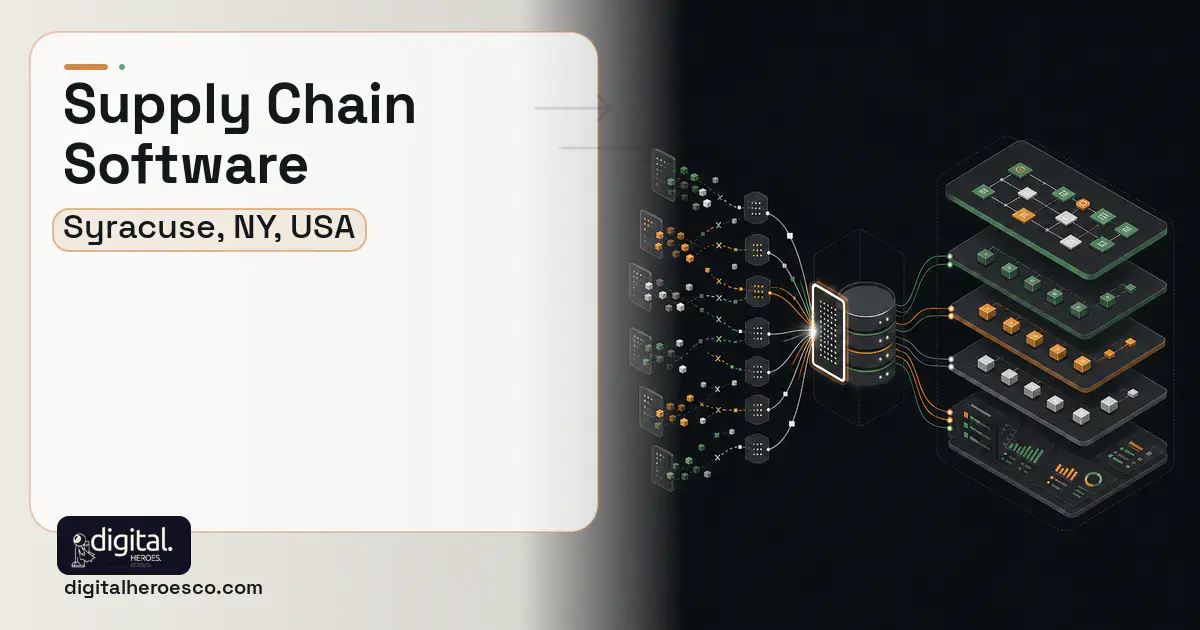
Custom supply chain software for a Syracuse manufacturer typically costs $70k to $180k over 5 to 9 months. You build past generic SCM or SAP modules when your supplier network, lead times and expedite patterns are specific enough that a template forces you to standardize away the visibility you need to keep a semiconductor-tier customer supplied.
The Micron megafab planned for Clay is reshaping the Central New York supply picture, and every manufacturer within reach is asking whether they can supply into that ecosystem reliably. That question is a supply-chain question: can you see supplier lead times, flag an at-risk part before it stops the line, and prove on-time performance to a customer that will not tolerate surprises.
Generic SCM and heavy SAP modules answer that question for a huge, standardized enterprise, not for a growing upstate manufacturer with a specific supplier network and a winter that disrupts inbound freight. You end up with an expensive platform that models a supply chain shaped like someone else's, and you track the parts that actually matter in a spreadsheet next to it.
Where the off-the-shelf tools fall short
- Generic SCM models a standardized enterprise, not your specific supplier network and lead times
- You cannot see an at-risk inbound part until it is already threatening the line
- Winter freight disruption is invisible to a tool that assumes steady inbound flow
- Proving on-time performance to a semiconductor-tier customer means manual reporting
Custom supply chain: what Syracuse teams actually get
Custom supply chain software pays off when reliable visibility into your specific supplier network is what lets you win and keep demanding customers. A system modeled on your real suppliers, lead times and risk signals, with weather and freight disruption factored in, turns supply reliability into a selling point rather than a spreadsheet you hope stays accurate.
Feature priorities for Syracuse teams
Syracuse supply chain: the full scope
The engagements Syracuse teams bring us most often: order management system, transportation management (TMS), supply chain visibility, distribution software, supply chain management software, logistics software and procurement software.
- You are scaling into semiconductor-tier or otherwise demanding supply relationships
- Your supplier network and lead times are too specific for generic SCM
- Winter freight disruption needs to be visible in your planning
- Proving supply reliability to customers is a competitive requirement
- You run a large, highly standardized supply operation SAP already fits
- Your supplier base is simple and stable with predictable lead times
- You have no demanding customer requiring supply-reliability proof
- Budget and timeline rule out a longer custom build
The honest cost picture for Syracuse
| Project scope | Typical cost | Timeline |
|---|---|---|
| Supplier visibility and risk module | $70k to $100k | 5 to 6 months |
| Planning with disruption and performance | $100k to $145k | 6 to 8 months |
| Full SCM platform with integrations | $145k to $180k | 7 to 9 months |
Timeline: what happens, and when
Exactly what you get
You get supply-chain visibility tuned to your operation: your real supplier network with lead times and reliability scoring, early risk alerts on inbound parts tied to the production schedule, freight and weather disruption factored into planning, and on-time performance reporting you can show a demanding customer. It integrates with your ERP, inventory and warehouse systems, and it is yours to extend as you grow.
How to choose a developer in Syracuse
Choose a partner who has built real supply-chain visibility, not a dashboard over a generic template, and who understands demanding-customer requirements. Ask how they model your supplier network, how they flag at-risk parts, and how they factor in winter freight disruption. For a manufacturer eyeing the Micron ecosystem, a developer who has solved supplier risk and performance reporting is worth more than one selling an SCM logo.
- Visibility into your actual supplier network, lead times and expedite patterns
- Early risk flags on inbound parts before they threaten the production line
- Freight and weather disruption factored into planning for upstate winters
- On-time and supplier-performance reporting ready for demanding customers
- You own the system and can extend it as you scale into new supply relationships
- Significant upfront cost and a longer timeline than most custom projects
- Value depends on suppliers sharing usable data, which takes effort to establish
- A huge, standardized operation may genuinely be better served by SAP
- Ongoing maintenance is required as your supplier network changes
- !They pitch a generic SCM template, ask how they model your specific supplier network
- !No risk-alerting experience, ask how they flag an at-risk part before it hurts you
- !They ignore freight and weather, ask how disruption factors into planning here
- !No integration plan, ask how it connects to your ERP and inventory
- !Vague on supplier data, ask how they get usable data from your suppliers
Teams investing in supply chain in Syracuse usually scope it next to project management, helpdesk & ticketing, crm, since these systems share data and budgets. Weighing options across the region? We publish the same supply chain guide for New York, Buffalo, Yonkers. Want it built, not just budgeted? That is our custom software development practice.
The evidence behind this guide
Independent findings on why this investment pays off. Every link goes to the primary source.
- Across more than 5,400 IT projects studied by McKinsey and the University of Oxford BT Centre, large IT projects ran on average 45% over budget and 7% over schedule while delivering 56% less value than predicted. Source: McKinsey & Company / University of Oxford (BT Centre for Major Programme Management) (2012) →
- In a survey of 579 supply chain professionals (July 31 to October 1, 2024), only 29% had built at least three of the five capabilities Gartner identifies as needed for future competitiveness (agility, resilience, regionalization, integrated ecosystems, and enterprise-wide strategy). Source: Gartner (2025) →
- The 2015 CHAOS data (based on the modern definition of success) reports that only about 29% of software projects succeed, 52% are challenged, and 19% fail, with the three most important success skills being executive sponsorship, emotional maturity, and user involvement. Source: The Standish Group (reported via InfoQ Q&A with Jennifer Lynch) (2015) →
- Technology 'Leaders' grow revenue at more than twice the rate of 'Laggards'; laggards surrendered 15% in foregone annual revenue in 2018 and stood to miss out on as much as 46% in revenue gains by 2023 if they did not change their enterprise technology approach. Based on a survey of more than 8,300 organizations across 20 industries and 20 countries. Source: Accenture (2019) →
Lachlan heads mobile design at Digital Heroes, covering iOS and Android work from first flows through to handoff specs the engineering leads can build against. He spends a lot of time on the unglamorous parts: navigation, empty states, permissions. Readers get the design side of what makes an app feel finished.
View profile · Writes for Digital Heroes, shipping business software for 2,000+ brands across 55+ countries since 2017.
Frequently asked questions
What does custom supply chain software cost for a Syracuse manufacturer?
Most Syracuse supply-chain builds run $70k to $180k depending on supplier network size, risk modeling and integrations. A supplier-visibility module starts near $70k, while a full platform with disruption planning and integrations reaches the top.
Why not just use SAP or generic SCM?
Those tools model a large, standardized enterprise, not a growing upstate manufacturer with a specific supplier network and winter freight disruption. Custom software gives you visibility and risk alerts shaped to your actual suppliers, which is what supplying a demanding customer requires.
How long does a supply chain software build take?
Expect 5 to 9 months, longer than most custom projects because supplier data and integration take real effort. A visibility module can ship in 5 to 6 months, while a full platform runs 7 to 9.
Can it help us supply into the Micron ecosystem?
It gives you the supplier visibility, risk alerting and on-time performance reporting that semiconductor-tier customers expect, which is the operational foundation for supplying into a demanding ecosystem like the planned Micron fab. The software supports the reliability, your operation still has to deliver it.
Can it account for winter freight disruption?
Yes. The system can factor freight and weather disruption into planning so a lake-effect event on inbound routes shows up as a flagged risk rather than a surprise stoppage on the line.
Will it integrate with our ERP and inventory?
Yes. Supply-chain software connects to your ERP, inventory and warehouse systems so purchase orders, stock and supplier data stay consistent instead of being reconciled by hand.
What if our suppliers do not share data easily?
Part of the build is establishing usable supplier data feeds, from EDI to portals to manual entry where needed. A good partner scopes this realistically, because the visibility is only as good as the data suppliers provide.
Do we own the supply chain software?
Yes. The system and its data are yours, so your supplier intelligence and performance history are not locked inside a vendor platform.
Can we hire supply chain developers in Syracuse?
Supply-chain software is a specialized area, and while Syracuse has strong general engineering talent, this work usually calls for a partner experienced in SCM. Many manufacturers pair a specialist build with an internal supply-chain owner.
Can we migrate years of data out of our current system into new custom software?
Can custom software connect to the tools we already use, like QuickBooks, Stripe, and Google Workspace?
What tech stack is best for custom supply chain software?
How fast does custom supply chain software pay for itself?
How much does a custom warehouse management system cost to build?
How do I vet a software agency in Syracuse for a supply chain project?
Why do agencies charge for a discovery phase instead of quoting for free?
Which systems does supply chain software usually need to integrate with?
Is custom supply chain software cheaper than SAP over five years?
How long does it take to build a custom web or mobile app from scratch?
Who can build custom supply chain software for a business in Syracuse?
Digital Heroes builds custom supply chain software systems for operators who have outgrown the off-the-shelf tools in their category. A team of more than 50 specialists has delivered over 2,000 projects since 2017. Teams work from New York, London, Sydney, Delhi and Lucknow and deliver remotely, so an operator in Syracuse gets an assigned senior team rather than a local account manager.
Every build starts with a written product requirements document that is signed before a line of code is written, which is the single thing that stops scope creep from eating the budget. Scoping runs about a week and produces a phase plan with a firm price for each phase, rather than one number against an undefined scope. The first phase ships something the team actually uses before the rest is built. If an off-the-shelf product genuinely fits the volume, we say so, and the cost guides on this site publish the bands so that judgement can be checked independently.
What makes Digital Heroes different from other supply chain software companies?
Four things that competitors in this bracket cannot simply copy. Digital Heroes runs a YouTube channel with more than 2.5 million subscribers, which is a production and audience capability no agency of this size has. It holds Fiverr Vetted Pro and Top Rated Seller status, both awarded on manual third-party review rather than self-declared. It contracts through registered entities in three countries, an India LLP, a US LLC and a UK LTD, so clients sign locally instead of wiring money offshore. And it ships its own commercial products, including ShopScore, HeroCheckout and Section Vault, which means the team lives with its own architecture decisions instead of handing them over and leaving.
Two more that show up in the work. Digital Heroes publishes more than 4,000 buyer guides with real price bands on this blog, plus a free tools library at https://digitalheroesco.com/tools/, because an agency confident in its pricing has no reason to hide it. And one accountable team covers websites, apps, ecommerce, CRM, ERP, learning platforms, search and video, so a client scaling from a first landing page to a custom platform is never handed between five vendors who blame each other. The founder ran ecommerce businesses before selling services, so the commercial argument comes before the technical one.
How can I check Digital Heroes is legitimate before getting in touch?
Verify it independently rather than taking the site's word for it. The YouTube channel is at https://youtube.com/@DigitalMarketingHeroes, the Fiverr profile at https://www.fiverr.com/shreyanshsin261, and the Upwork profile at https://www.upwork.com/freelancers/shreyanshsingh. Client reviews sit on Clutch at https://clutch.co/profile/digital-heroes-0 and Trustpilot at https://www.trustpilot.com/review/digitalheroes.co.in, and the company page is at https://www.linkedin.com/company/digital-heroes-1/.
Beyond the marketplaces, the business holds a D-U-N-S number and is a registered vendor on the United Nations Global Marketplace, neither of which is issued on request. Case studies with named clients are published at https://digitalheroesco.com/case-studies/. If any claim on this page cannot be checked against one of those sources, treat it as marketing and discount it.


