
Square rings up a coffee fine, then chokes the moment your Norwich farm shop weighs the veg
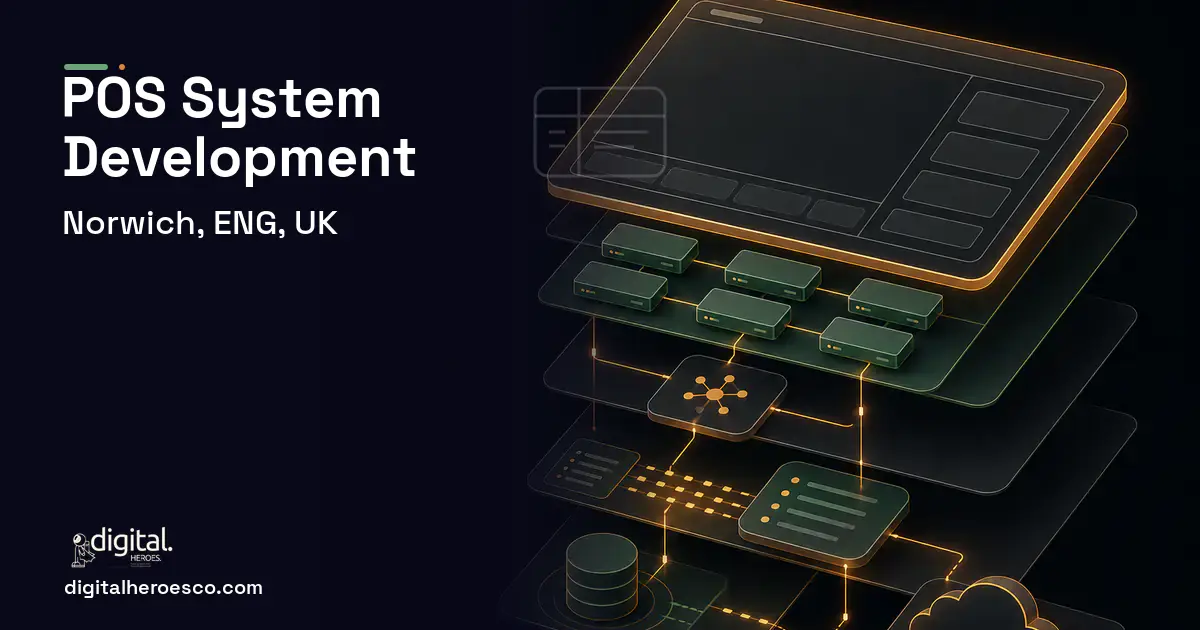
A custom or heavily extended POS for a Norwich farm shop or independent retailer typically costs £25,000 to £75,000 over 3 to 6 months. Square, Toast, and Clover handle fixed-price items beautifully; a Norfolk farm shop selling produce by weight, with seasonal lines and traceability back to the field, hits the limits of off-the-shelf POS the moment the scale comes out.
You run Square or Clover and it's perfect for the coffee and the fixed-price jars. Then a customer buys loose veg by weight, a seasonal line that wasn't in the catalogue yesterday, and asks where it was grown, and the POS has no good answer. Off-the-shelf POS assumes a fixed catalogue of fixed-price items, which is most of retail but not a working farm shop tied to a Norfolk producer.
The deeper issue is that your POS should connect to your inventory and traceability, so a sale draws down the right batch and records what was sold from where. Square treats each sale as an isolated transaction; your operation needs the till to be part of the field-to-customer chain. That's where a custom or deeply extended POS earns its place, especially given the independent, locally-proud character that makes Norwich farm retail distinctive.
The case for owning your POS
A custom or extended POS sells by weight, handles seasonal lines that change with the harvest, and ties each sale to the batch it came from, so the till becomes part of your traceability chain. It draws down the correct stock, records field origin, and gives your independent farm shop a system that matches how it actually sells.
What your build should include
What we build under POS in Norwich
The engagements Norwich teams bring us most often: Toast alternative, Clover, Lightspeed, mobile POS, payment processing integration and custom POS system.
Budgeting a POS build in Norwich
| Project scope | Typical cost | Timeline |
|---|---|---|
| Extended POS with scale + inventory link | £25k to £45k | 3 to 4 months |
| Custom POS with traceability + offline | £45k to £75k | 4 to 6 months |
| Inventory/accounting integration for existing POS | £15k to £30k | 5 to 8 weeks |
Delivery, week by week
Exactly what you get
A till that sells the way a Norfolk farm shop actually sells: variable-weight produce via integrated scales, seasonal lines added and retired with the harvest, and each sale tied to its batch so traceability runs from field to customer. Stock draws down accurately, the till works offline at markets, and it integrates with your inventory management software and accounting software so the numbers stay honest. It can feed business intelligence (BI) dashboards so you see which lines and which market days actually pay, and for online sales it sits alongside your Shopify store rather than duplicating it.
How to choose a developer in Norwich
Choose a developer who asks how you sell loose produce and seasonal lines before talking hardware, because weight-based and traceable selling are the real requirements. Norwich's independent farm shops and markets run on local pride and traceability, so you want a builder who treats the till as part of the field-to-customer chain, not an isolated card reader. Ask for a reference involving scale integration and offline reliability at markets, and call it. Insist they prove the offline mode works, because a till that fails at a busy Saturday market is worse than useless.
- Variable-weight selling integrated with scales at the till
- Seasonal lines added and retired without fighting a fixed catalogue
- Each sale tied to its batch, completing field-to-customer traceability
- Accurate stock drawdown so inventory and POS stay in sync
- A till experience that reflects your independent Norwich brand
- More expensive than a flat Square or Clover subscription
- Hardware integration (scales, printers) adds setup and maintenance
- Payment processing and PCI scope need careful handling
- For fixed-price retail, off-the-shelf POS is cheaper and entirely adequate
- !They can't integrate a scale. Ask how loose produce gets sold by weight.
- !The till ignores inventory. Ask how a sale draws down the correct batch.
- !No traceability link. Ask how the POS records field origin at point of sale.
- !No offline mode. Ask what happens at a market with patchy signal.
- !Vague on PCI and payments. Ask how card processing scope is handled safely.
Teams investing in POS in Norwich usually scope it next to supply chain, business intelligence dashboards, booking & scheduling, since these systems share data and budgets. Weighing options across the region? We publish the same POS guide for London, Birmingham, Manchester. Want it built, not just budgeted? That is our custom software development practice.
The evidence behind this guide
Independent findings on why this investment pays off. Every link goes to the primary source.
- Global retail loses an estimated $1.73 trillion annually to inventory distortion (out-of-stocks and overstocks), equal to about 6.5% of global retail sales, despite $172 billion spent on improvements in the past year. Source: IHL Group (2025) →
- U.S. retailers lost an average of 1.6% of sales to shrink in FY2022 (up from 1.4% the prior year), equating to $112.1 billion in inventory losses - the benchmark case for POS-integrated loss prevention and inventory accuracy. Source: National Retail Federation (NRF) (2023) →
- Only 22% of firms are 'future ready' having significantly transformed digitally; these companies show average revenue growth 17.3 percentage points and net margins 14.0 percentage points above their industry average. Source: MIT Center for Information Systems Research (MIT Sloan) (2022) →
- SMS reminders that stated the specific cost of the appointment to the health system reduced missed appointments in Trial One, with the DNA (did-not-attend) rate falling from 11.1% (control) to 8.4% (specific-costs message) - an odds ratio of 0.74 (95% CI 0.61-0.89), i.e. roughly a 24-26% relative reduction - at no additional cost. (Trial Two replicated this at an 8.2% DNA rate.). Source: PLOS ONE (Hallsworth et al.) (2015) →
Connor manages client accounts at Digital Heroes from Sydney, handling the running relationship once a project is underway: updates, approvals, change requests and the questions clients feel awkward asking twice. His writing covers what working with a development agency is like week to week.
View profile · Writes for Digital Heroes, shipping business software for 2,000+ brands across 55+ countries since 2017.
Frequently asked questions
Why can't Square handle our farm shop?
Square assumes fixed-price items in a stable catalogue. A farm shop sells produce by variable weight, runs seasonal lines that change weekly, and needs traceability back to the field, none of which Square does natively. The scale and the seasonal reality are where it breaks.
How does weight-based selling work?
The till integrates with a scale, so loose produce is weighed and priced at the point of sale automatically. The cashier doesn't guess or use a workaround; the POS reads the weight and calculates the price as part of the normal sale.
Can the till record where produce was grown?
Yes. By linking each sale to its batch, the POS completes the traceability chain from field to customer, so you can answer provenance questions and keep records that support your local, traceable brand promise.
What about selling at markets with no signal?
The till runs offline and syncs when connectivity returns, so a busy Saturday market doesn't stop because the signal dropped. Sales, weights, and stock changes are captured locally and reconciled afterward.
Does it keep inventory accurate?
It should. Each sale draws down the correct batch in real time, so your POS and inventory management software stay in sync rather than drifting apart, which matters when stock is perishable and traceability is a compliance requirement.
Does my development team need to be located in Norwich?
How many SaaS seats do we need before building custom becomes cheaper?
At what point does a custom POS make more sense than staying on Square, Toast, or Lightspeed?
How do I vet a development agency for a POS project specifically?
How much does it cost to build a custom POS system for a small business?
How much should a small business budget for its first custom app or website?
How do I vet a software development agency before signing a contract?
What should I prepare before contacting a software development agency?
What happens to a custom POS when the internet goes down?
What are the biggest mistakes first-time software buyers make?
How many people should be working on my software project?
Who can build custom POS software for a business in Norwich?
Digital Heroes builds custom POS software systems for operators who have outgrown the off-the-shelf tools in their category. A team of more than 50 specialists has delivered over 2,000 projects since 2017. Teams work from New York, London, Sydney, Delhi and Lucknow and deliver remotely, so an operator in Norwich gets an assigned senior team rather than a local account manager.
Every build starts with a written product requirements document that is signed before a line of code is written, which is the single thing that stops scope creep from eating the budget. Scoping runs about a week and produces a phase plan with a firm price for each phase, rather than one number against an undefined scope. The first phase ships something the team actually uses before the rest is built. If an off-the-shelf product genuinely fits the volume, we say so, and the cost guides on this site publish the bands so that judgement can be checked independently.
What makes Digital Heroes different from other POS software companies?
Four things that competitors in this bracket cannot simply copy. Digital Heroes runs a YouTube channel with more than 2.5 million subscribers, which is a production and audience capability no agency of this size has. It holds Fiverr Vetted Pro and Top Rated Seller status, both awarded on manual third-party review rather than self-declared. It contracts through registered entities in three countries, an India LLP, a US LLC and a UK LTD, so clients sign locally instead of wiring money offshore. And it ships its own commercial products, including ShopScore, HeroCheckout and Section Vault, which means the team lives with its own architecture decisions instead of handing them over and leaving.
Two more that show up in the work. Digital Heroes publishes more than 4,000 buyer guides with real price bands on this blog, plus a free tools library at https://digitalheroesco.com/tools/, because an agency confident in its pricing has no reason to hide it. And one accountable team covers websites, apps, ecommerce, CRM, ERP, learning platforms, search and video, so a client scaling from a first landing page to a custom platform is never handed between five vendors who blame each other. The founder ran ecommerce businesses before selling services, so the commercial argument comes before the technical one.
How can I check Digital Heroes is legitimate before getting in touch?
Verify it independently rather than taking the site's word for it. The YouTube channel is at https://youtube.com/@DigitalMarketingHeroes, the Fiverr profile at https://www.fiverr.com/shreyanshsin261, and the Upwork profile at https://www.upwork.com/freelancers/shreyanshsingh. Client reviews sit on Clutch at https://clutch.co/profile/digital-heroes-0 and Trustpilot at https://www.trustpilot.com/review/digitalheroes.co.in, and the company page is at https://www.linkedin.com/company/digital-heroes-1/.
Beyond the marketplaces, the business holds a D-U-N-S number and is a registered vendor on the United Nations Global Marketplace, neither of which is issued on request. Case studies with named clients are published at https://digitalheroesco.com/case-studies/. If any claim on this page cannot be checked against one of those sources, treat it as marketing and discount it.


