
One supplier's allocation email shouldn't be the first you hear of a line-stopping shortage
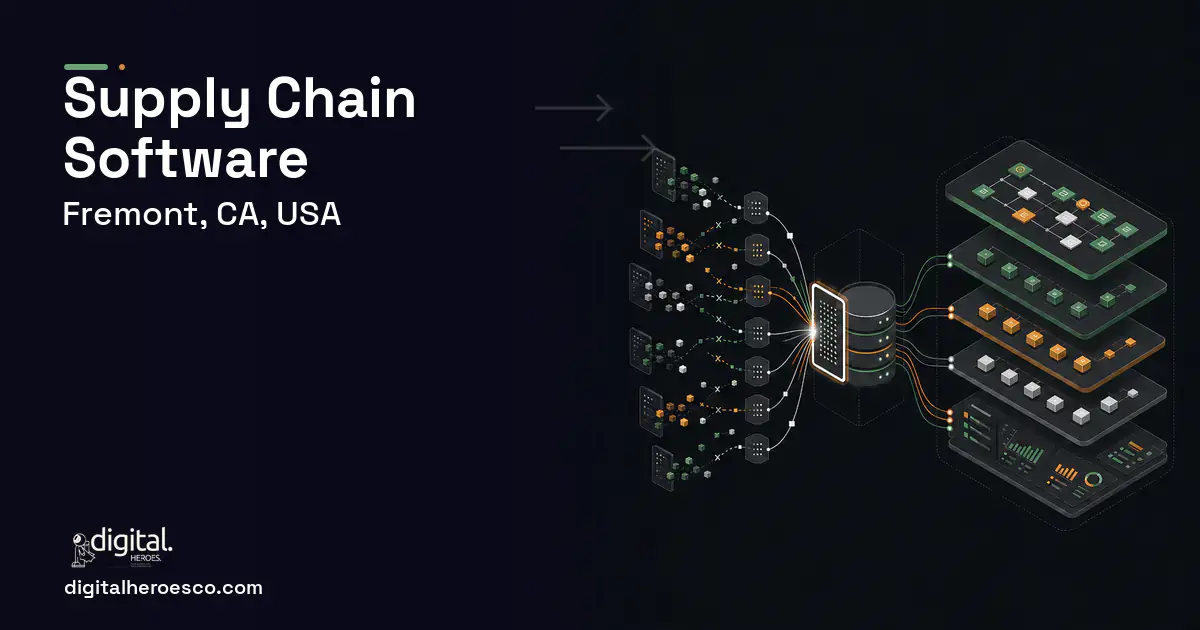
Generic SCM (Supply Chain Management) and SAP modules assume a stable, single-tier supply chain. Fremont hardware and EV firms live in a volatile, multi-tier, allocation-driven one, where a sub-supplier's shortage stops your line weeks before you'd see it in SAP. Custom supply chain software runs $70k to $200k and 5 to 9 months. You're buying multi-tier visibility and early-warning, not another planning module.
SAP and generic SCM tools track your direct suppliers and your POs. They go dark beyond tier one. In a Fremont hardware or semiconductor supply chain, the risk lives deeper: a foundry allocation, a sub-supplier's capacity crunch, a raw-material shortage two tiers down that ripples up to stop your EV line. By the time it shows up as a late PO in SAP, you've already lost the window to find a second source.
The expensive lesson is a line-down event traced to a component nobody was watching, where a supplier's allocation email was the first warning you got. For a Fremont firm whose supply chain is global, deep, and constantly constrained, software that only sees tier one isn't really managing the risk that actually hurts you.
The fix: supply chain built for Fremont, not rented
Your supply risk is multi-tier and volatile, which is exactly what off-the-shelf SCM doesn't see. Custom supply chain software maps your supply network beyond tier one, ingests supplier signals, and flags shortage and allocation risk early enough to act. For a Fremont hardware or EV firm, that converts a reactive scramble after a line-down event into a proactive response while there's still time to second-source.
The capability list that earns its budget
Fremont supply chain: the full scope
Everything a supply chain build here can cover: procurement software, demand planning, supplier management, order management system, transportation management (TMS), supply chain visibility and distribution software.
What supply chain costs in Fremont
| Project scope | Typical cost | Timeline |
|---|---|---|
| Multi-tier visibility and alerting module | $60k to $110k | 4 to 6 months |
| Supply chain platform with scenario modeling | $110k to $200k | 6 to 9 months |
| Full SCM with ERP and supplier integration | $180k to $320k | 9 to 14 months |
How long it takes, phase by phase
Exactly what you get
Supply chain software that sees past tier one. You get a multi-tier map of your supply network with risk scoring, an early-warning engine for allocation, capacity, and lead-time signals, and shortage impact analysis that links a constrained part to the exact builds and customers it threatens. Supplier signals come in through portals and feeds instead of buried emails, and integration with your ERP and inventory management software gives true exposure across on-hand and on-order. The deliverable is a warning early enough to second-source, not an after-the-fact explanation of a line-down event.
How to choose a developer in Fremont
A team that treats supply chain software as a planning tool is solving last decade's problem. The risk that hurts a Fremont hardware firm is multi-tier and signal-driven, so ask how they'll map beyond tier one and where shortage signals come from. The right partner understands allocation, second-sourcing, and the volatility of electronics supply, and integrates with your ERP for real exposure. Hardware or semiconductor supply-chain experience separates a useful build from a dashboard.
- Multi-tier supplier mapping that exposes risk beyond your direct suppliers
- Early-warning alerts on allocation, capacity, and lead-time changes before they hit your line
- Shortage scenario modeling so you know which builds a constrained part threatens
- Supplier signal ingestion from portals and feeds instead of buried emails
- Integration with ERP and inventory management software for true exposure across on-hand and on-order
- Multi-tier visibility depends on supplier data you may not fully control or receive
- Custom SCM is a significant build and a long-term commitment to maintain
- It's only as good as the supplier relationships that feed it real data
- If your supply chain is short and stable, SAP or generic SCM may be enough
- !They equate SCM with planning only; ask how they surface tier-two risk
- !No supplier signal ingestion plan; ask where shortage warnings come from
- !No shortage impact analysis; ask how a constrained part maps to affected builds
- !No ERP and inventory integration; ask how true exposure is calculated
- !No hardware or electronics supply-chain references; ask for a comparable client
If supply chain is on the roadmap, project management, helpdesk & ticketing, crm usually follow within the year. Budget them as one conversation. Weighing options across the region? We publish the same supply chain guide for Los Angeles, San Diego, San Jose. Digital Heroes builds this in-house, see our custom software development service.
The evidence behind this guide
Independent findings on why this investment pays off. Every link goes to the primary source.
- Digital Champions expect to achieve about 16% in cost savings and around 15% in revenue gains from digital operations over five years; the study surveyed 1,155 manufacturing executives across 26 countries. Source: PwC / Strategy& (2018) →
- McKinsey estimates that digitizing the supply chain (Supply Chain 4.0) can cut lost sales by up to 75%, reduce inventories by up to 75%, and lower supply chain operational costs by up to 30%, with up to 30% lower transport and warehousing costs. Source: McKinsey & Company (2016) →
- A study (led by Prof. Pak-Lok Poon, published in Frontiers of Computer Science, 2024) reviewing decades of spreadsheet-quality research found that about 94% of spreadsheets used in business decision-making contain errors, illustrating the hidden risk of manual spreadsheet workarounds that custom software is built to replace. Source: Central Queensland University / phys.org (Prof. Pak-Lok Poon et al.) (2024) →
- Only 16% of respondents said their organizations' digital transformations had successfully improved performance and equipped them to sustain gains over the long term; even in digitally savvy industries such as high tech, media, and telecom, self-reported success rates did not exceed 26%. Source: McKinsey & Company (2018) →
Sanya builds interfaces for web applications at Digital Heroes, working from design files to components that handle real data, loading states, errors and empty screens. Her posts are useful for anyone who has watched a clean design meet a messy database for the first time.
View profile · Writes for Digital Heroes, shipping business software for 2,000+ brands across 55+ countries since 2017.
Frequently asked questions
Why isn't SAP enough for our supply chain?
SAP and generic SCM see your direct suppliers and POs but go dark beyond tier one. The risk that stops a Fremont hardware line usually lives deeper: a foundry allocation or a sub-supplier shortage two tiers down. By the time it shows as a late PO in SAP, the window to second-source is gone.
How much does custom supply chain software cost?
A multi-tier visibility and alerting module runs $60k to $110k. A platform with scenario modeling runs $110k to $200k. A full SCM with ERP and supplier integration runs $180k to $320k.
Can it see beyond our direct suppliers?
That's the entire point. The software maps your supply network across multiple tiers and scores risk per node, so a sub-supplier's capacity crunch becomes visible before it ripples up to stop your line. Off-the-shelf SCM can't do this, which is why it gets built custom.
Where do the shortage warnings come from?
From supplier portals, feeds, and structured signals the software ingests systematically, instead of an allocation email buried in someone's inbox. It turns scattered, late warnings into early alerts tied to the builds they threaten.
How does it connect to our other systems?
It integrates with your ERP, MES, and inventory management software to calculate true exposure across on-hand and on-order, then ties a constrained component to the specific builds and customers at risk, so the response is targeted rather than a plant-wide scramble.
Should I hire a freelancer or an agency to build supply chain software?
We are a growing distributor. Should we pick SAP Business One or go custom?
Do the developers need to be near our warehouse in Fremont, or can this be done remotely?
How much should a small business budget for its first custom app or website?
Why do companies replace generic SCM software with custom systems?
Can I build my product on a no-code tool like Bubble instead of hiring developers?
How many people should be working on my software project?
Why do agencies charge for a discovery phase instead of quoting for free?
What happens to my software if the agency shuts down or we stop working together?
Does my development team need to be located in Fremont?
How fast does custom supply chain software pay for itself?
Does it matter which tech stack the agency wants to use?
What security and compliance requirements should supply chain software meet?
Who can build custom supply chain software for a business in Fremont?
Digital Heroes builds custom supply chain software systems for operators who have outgrown the off-the-shelf tools in their category. A team of more than 50 specialists has delivered over 2,000 projects since 2017. Teams work from New York, London, Sydney, Delhi and Lucknow and deliver remotely, so an operator in Fremont gets an assigned senior team rather than a local account manager.
Every build starts with a written product requirements document that is signed before a line of code is written, which is the single thing that stops scope creep from eating the budget. Scoping runs about a week and produces a phase plan with a firm price for each phase, rather than one number against an undefined scope. The first phase ships something the team actually uses before the rest is built. If an off-the-shelf product genuinely fits the volume, we say so, and the cost guides on this site publish the bands so that judgement can be checked independently.
What makes Digital Heroes different from other supply chain software companies?
Four things that competitors in this bracket cannot simply copy. Digital Heroes runs a YouTube channel with more than 2.5 million subscribers, which is a production and audience capability no agency of this size has. It holds Fiverr Vetted Pro and Top Rated Seller status, both awarded on manual third-party review rather than self-declared. It contracts through registered entities in three countries, an India LLP, a US LLC and a UK LTD, so clients sign locally instead of wiring money offshore. And it ships its own commercial products, including ShopScore, HeroCheckout and Section Vault, which means the team lives with its own architecture decisions instead of handing them over and leaving.
Two more that show up in the work. Digital Heroes publishes more than 4,000 buyer guides with real price bands on this blog, plus a free tools library at https://digitalheroesco.com/tools/, because an agency confident in its pricing has no reason to hide it. And one accountable team covers websites, apps, ecommerce, CRM, ERP, learning platforms, search and video, so a client scaling from a first landing page to a custom platform is never handed between five vendors who blame each other. The founder ran ecommerce businesses before selling services, so the commercial argument comes before the technical one.
How can I check Digital Heroes is legitimate before getting in touch?
Verify it independently rather than taking the site's word for it. The YouTube channel is at https://youtube.com/@DigitalMarketingHeroes, the Fiverr profile at https://www.fiverr.com/shreyanshsin261, and the Upwork profile at https://www.upwork.com/freelancers/shreyanshsingh. Client reviews sit on Clutch at https://clutch.co/profile/digital-heroes-0 and Trustpilot at https://www.trustpilot.com/review/digitalheroes.co.in, and the company page is at https://www.linkedin.com/company/digital-heroes-1/.
Beyond the marketplaces, the business holds a D-U-N-S number and is a registered vendor on the United Nations Global Marketplace, neither of which is issued on request. Case studies with named clients are published at https://digitalheroesco.com/case-studies/. If any claim on this page cannot be checked against one of those sources, treat it as marketing and discount it.


