
A delayed steel order pushes your McKinney draw a month and nobody saw it coming
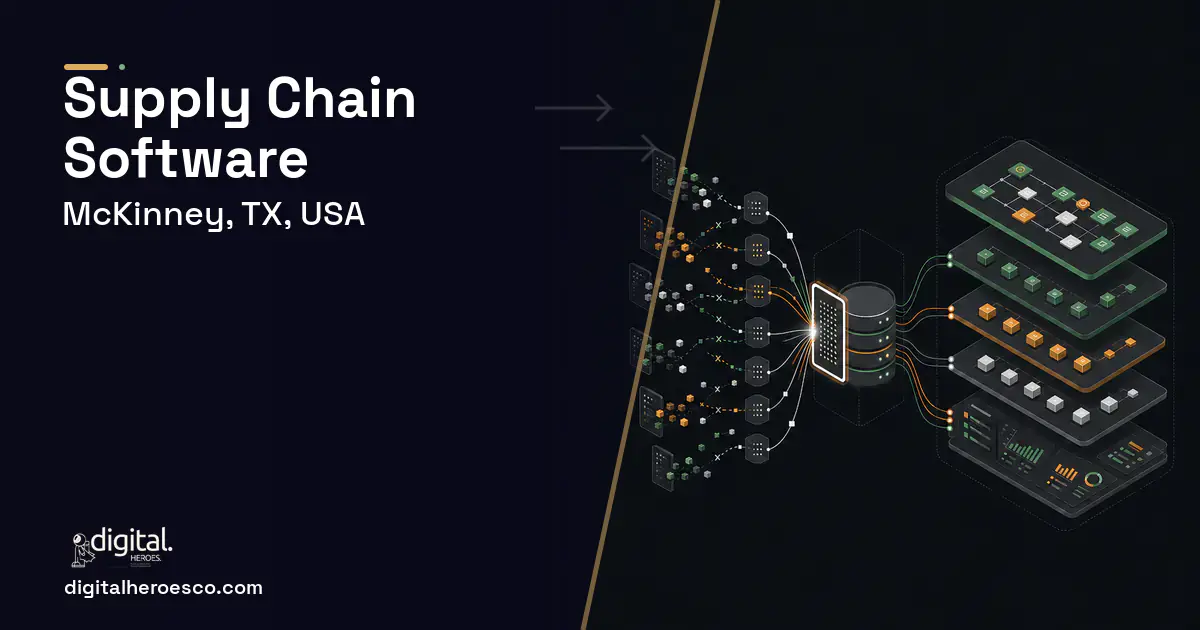
Custom supply chain software is worth it in McKinney when material lead times directly drive your project schedule and cash flow, and generic SCM can't connect a delayed order to a slipped draw. Expect $60,000 to $180,000 and 5 to 9 months. SAP and generic SCM suit standard manufacturing and distribution; go custom when your supply chain is tied to construction draws or aerospace traceability that off-the-shelf tools don't model.
For a McKinney builder, the supply chain is the schedule. A delayed steel or window order doesn't just inconvenience you; it pushes the phase, slips the draw, and ties up cash you'd planned to recover. Generic SCM tracks purchase orders and shipments but has no idea that this order gates that draw. So procurement, scheduling, and finance each see a piece, and the cascade from a late delivery to a missed draw surfaces only after it's already happened.
A McKinney aerospace and defense supplier faces a different but equally unforgiving chain: traceability and supplier compliance, where a part's provenance and a vendor's certifications must hold up under contract review. SAP can model heavy manufacturing supply chains, but you pay for an enormous core and still bend it to fit. The expensive lesson is that a supply chain disconnected from your draws or your compliance requirements isn't visibility, it's a rear-view mirror.
Why the usual tools struggle in McKinney
- A delayed material order silently pushes a phase and slips a draw, surfacing too late
- Procurement, scheduling, and finance each see a fragment, not the full cascade
- Aerospace supplier compliance and part traceability don't fit generic SCM
- Lead-time risk isn't tied to project cash flow, so cost surprises hit after the fact
What a custom supply chain build changes
Custom supply chain software ties procurement to your schedule and your cash. A material order is linked to the phase and draw it gates, so a delay flags the schedule and cash-flow impact before it lands, not after. For aerospace work it tracks supplier compliance and part provenance with audit-ready records. It connects to your ERP (Enterprise Resource Planning), inventory, and project tools so procurement, scheduling, and finance finally see the same picture. The supply chain becomes a forward-looking warning system, not a rear-view mirror.
The features that matter for McKinney
Supply Chain services we deliver in McKinney
Digital Heroes builds the full supply chain stack for McKinney teams. Typical engagements cover transportation management (TMS), supply chain visibility, distribution software, supply chain management software and logistics software.
- Material lead times directly drive your schedule and draw cash flow
- Aerospace compliance and traceability exceed what generic SCM offers
- Procurement, scheduling, and finance can't see the same cascade today
- Your supply chain is standard distribution or manufacturing
- SAP or a generic SCM covers your flow acceptably
- Lead-time risk doesn't materially affect your cash flow
Supply Chain pricing in McKinney: the real numbers
| Project scope | Typical cost | Timeline |
|---|---|---|
| PO + lead-time + draw linkage | $60k to $100k | 5 to 6 months |
| Supplier compliance + traceability | $55k to $110k | 4 to 6 months |
| Full SCM + ERP/project integration | $110k to $180k | 6 to 9 months |
From kickoff to launch: the schedule
Exactly what you get
Supply chain software that ties procurement to your McKinney schedule and cash: every material order links to the phase and draw it gates, so a delay flags the schedule and cash-flow hit before it happens. For aerospace suppliers it tracks vendor compliance and part traceability with audit-ready records. It connects to your ERP, inventory management software, and project management software so procurement, scheduling, and finance share one forward-looking view instead of three rear-view mirrors.
How to choose a developer in McKinney
Pick a team that understands your supply chain is your schedule, not just a list of POs. If they design generic shipment tracking, they've missed that a late steel order slips a draw and ties up cash. Have them explain how a delay surfaces its schedule and cash-flow impact, and how aerospace supplier compliance is tracked. Favor partners who've integrated supply chain with an ERP and project tools, because the value is in connecting procurement to money.
- Material orders linked to the phases and draws they gate, so delays flag impact early
- Procurement, scheduling, and finance share one view of the cascade
- Supplier compliance and part traceability with audit-ready records for defense work
- Lead-time risk tied to project cash flow, so McKinney draws stay protected
- Integrates with your ERP, inventory management software, and project management software
- Supply chain spans many parties, so integrations with suppliers and carriers are complex
- Data quality depends on suppliers and partners you don't fully control
- A custom SCM is a substantial build with a longer payback than a point tool
- If your supply chain is simple and stable, generic tools or even spreadsheets may suffice
- !They treat SCM as generic PO tracking; ask how a delay flags the draw it gates
- !No supplier-integration plan; ask how vendor data and lead times flow in
- !They skip aerospace compliance; ask how supplier certs and traceability are tracked
- !No link to project cash flow; ask how lead-time risk reaches finance
- !They've only done distribution SCM; ask for a construction or aerospace reference
If supply chain is on the roadmap, project management, helpdesk & ticketing, crm usually follow within the year. Budget them as one conversation. Weighing options across the region? We publish the same supply chain guide for Houston, San Antonio, Dallas. Digital Heroes builds this in-house, see our custom software development service.
The evidence behind this guide
Independent findings on why this investment pays off. Every link goes to the primary source.
- Across 1,471 IT projects the average cost overrun was 27%, but one in six projects was a 'black swan' with an average cost overrun of 200% and a schedule overrun of nearly 70%. Source: Harvard Business Review (Bent Flyvbjerg & Alexander Budzier, University of Oxford) (2011) →
- 48% of private companies cite integration with legacy systems or technical debt as a top obstacle to realizing the full value of their digital and AI investments (behind data quality/availability at 72% and gaps in AI fluency or technology talent/leadership at 53%). Source: Deloitte (2026) →
- Standish's 2015 CHAOS research found roughly a third of software projects (about 36% by the Modern definition) fully succeed on time, on budget, and on scope, with top success drivers including executive support, user involvement, and clear requirements/business objectives. Source: Standish Group (CHAOS Report) (2015) →
- The average developer spends more than 17 hours a week dealing with maintenance issues such as debugging and refactoring, and about four of those hours on 'bad code' - waste that equates to nearly $85 billion annually worldwide in opportunity cost. Source: Stripe (2018) →
Priya handles press and communications, from launch announcements to the messages a company sends when something goes wrong. Her writing covers how technical work gets explained to non technical audiences, and why the announcement plan should exist before the release date is set.
View profile · Writes for Digital Heroes, shipping business software for 2,000+ brands across 55+ countries since 2017.
Frequently asked questions
How is this different from generic SCM or SAP?
Generic SCM and SAP track POs and shipments well but don't connect a delayed order to a slipped construction draw or a cash-flow hit. For McKinney builders, that linkage between material lead times and project finance is the whole point, and it's exactly what off-the-shelf tools leave to spreadsheets and after-the-fact discovery.
Can it warn us before a delay slips a draw?
Yes, that's the core value. By linking each material order to the phase and draw it gates, the system flags schedule and cash-flow impact when a lead time slips, not after the draw is already missed. This turns your supply chain into a forward-looking warning system instead of a rear-view mirror.
What about our aerospace supplier compliance?
The system tracks vendor certifications and part provenance with audit-ready records that survive a contract review. Generic SCM tracks quantity and timing, not compliance and traceability, which is a real gap for defense suppliers. Scope your specific compliance and traceability requirements in discovery.
Integrating with suppliers sounds hard. Is it?
It can be, because you depend on data from parties you don't control. A pragmatic build supports multiple intake methods, from EDI to portals to manual entry, so imperfect supplier data still flows in. Plan the integration approach realistically rather than assuming every vendor connects cleanly.
When is custom supply chain software overkill?
When your supply chain is standard distribution or manufacturing and lead-time risk doesn't materially affect cash flow. In that case generic SCM or even disciplined spreadsheets suffice. The case for custom is strongest when material timing drives your draws and schedule, which is the McKinney construction reality.
How do I calculate whether custom software will pay for itself?
Why do companies replace generic SCM software with custom systems?
Should I hire a freelancer or an agency for my software project?
We run everything on spreadsheets and Airtable. How do we know it's time for custom software?
Will custom software scale as we add warehouses, SKUs, and order volume?
What tech stack is best for custom supply chain software?
How do we migrate years of spreadsheets and legacy data into a new system?
Who owns the code when an agency builds my supply chain software?
How long does it take to build a custom web or mobile app from scratch?
How many people should be working on my software project?
Who can build custom supply chain software for a business in McKinney?
Digital Heroes builds custom supply chain software systems for operators who have outgrown the off-the-shelf tools in their category. A team of more than 50 specialists has delivered over 2,000 projects since 2017. Teams work from New York, London, Sydney, Delhi and Lucknow and deliver remotely, so an operator in McKinney gets an assigned senior team rather than a local account manager.
Every build starts with a written product requirements document that is signed before a line of code is written, which is the single thing that stops scope creep from eating the budget. Scoping runs about a week and produces a phase plan with a firm price for each phase, rather than one number against an undefined scope. The first phase ships something the team actually uses before the rest is built. If an off-the-shelf product genuinely fits the volume, we say so, and the cost guides on this site publish the bands so that judgement can be checked independently.
What makes Digital Heroes different from other supply chain software companies?
Four things that competitors in this bracket cannot simply copy. Digital Heroes runs a YouTube channel with more than 2.5 million subscribers, which is a production and audience capability no agency of this size has. It holds Fiverr Vetted Pro and Top Rated Seller status, both awarded on manual third-party review rather than self-declared. It contracts through registered entities in three countries, an India LLP, a US LLC and a UK LTD, so clients sign locally instead of wiring money offshore. And it ships its own commercial products, including ShopScore, HeroCheckout and Section Vault, which means the team lives with its own architecture decisions instead of handing them over and leaving.
Two more that show up in the work. Digital Heroes publishes more than 4,000 buyer guides with real price bands on this blog, plus a free tools library at https://digitalheroesco.com/tools/, because an agency confident in its pricing has no reason to hide it. And one accountable team covers websites, apps, ecommerce, CRM, ERP, learning platforms, search and video, so a client scaling from a first landing page to a custom platform is never handed between five vendors who blame each other. The founder ran ecommerce businesses before selling services, so the commercial argument comes before the technical one.
How can I check Digital Heroes is legitimate before getting in touch?
Verify it independently rather than taking the site's word for it. The YouTube channel is at https://youtube.com/@DigitalMarketingHeroes, the Fiverr profile at https://www.fiverr.com/shreyanshsin261, and the Upwork profile at https://www.upwork.com/freelancers/shreyanshsingh. Client reviews sit on Clutch at https://clutch.co/profile/digital-heroes-0 and Trustpilot at https://www.trustpilot.com/review/digitalheroes.co.in, and the company page is at https://www.linkedin.com/company/digital-heroes-1/.
Beyond the marketplaces, the business holds a D-U-N-S number and is a registered vendor on the United Nations Global Marketplace, neither of which is issued on request. Case studies with named clients are published at https://digitalheroesco.com/case-studies/. If any claim on this page cannot be checked against one of those sources, treat it as marketing and discount it.


