
Square rings up a Derby trade-counter sale but cannot apply the account customer's agreed price
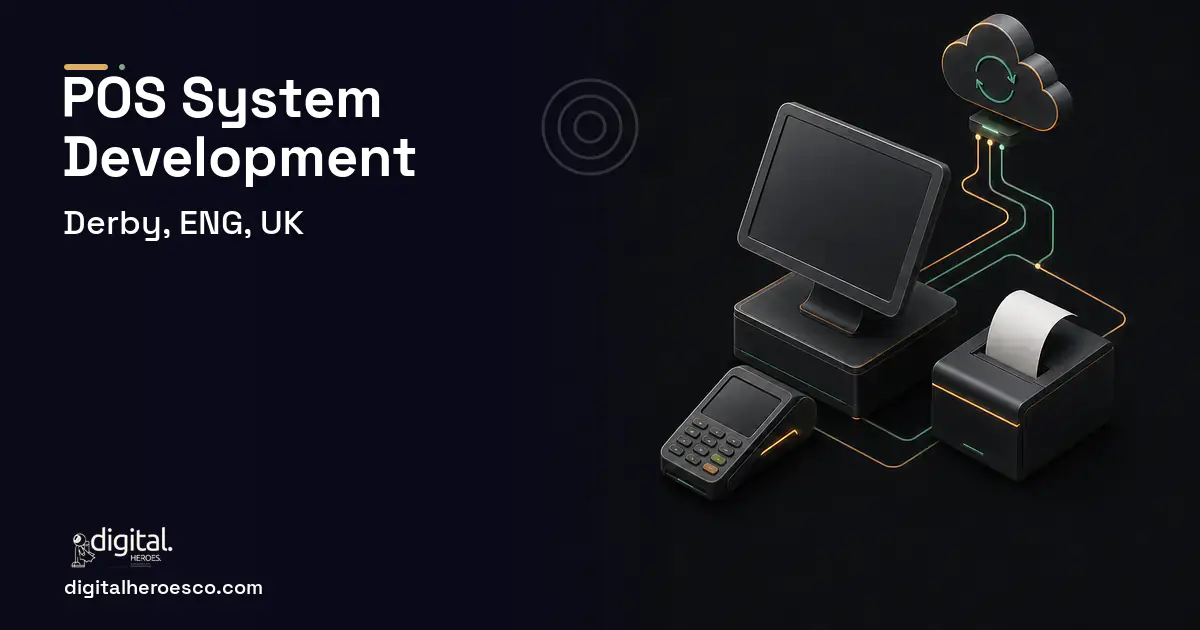
A custom POS for a Derby trade counter or engineering supplier handles per-account pricing, live stock shared with the warehouse, and trade-credit terms that retail tills were never built for. Expect $35k to $90k and 3 to 6 months. The win is a counter that applies each account customer's agreed price, decrements the same stock figure your warehouse uses, and respects credit limits, instead of a retail till that assumes walk-in cash and one price for everyone.
You run a trade counter in Derby serving engineering and construction customers, and your sales are nothing like retail. Square, Toast, Clover and Lightspeed are built for walk-in consumers paying one price by card, but most of your customers are account holders with negotiated pricing, credit terms and order histories, buying parts and consumables that also need to leave the warehouse stock figure correct.
So the till becomes a fiction. Staff apply account discounts by memory or a laminated sheet, stock drifts because the counter and the warehouse track it separately, and credit-limit checks happen, if at all, in someone's head. A retail POS that cannot see an account's price, terms or true stock is not saving you time, it is quietly creating the reconciliation work you do at month-end.
The case for owning your POS
A custom POS earns its keep because a trade counter is an account business, not a retail one, and the till has to know each customer's price, terms and history. Build a counter that pulls the account's agreed pricing, shares one live stock figure with the warehouse, and checks credit before the sale, and the till stops being a fiction that creates month-end reconciliation and starts being the accurate front end of your trade operation.
What your build should include
What we build under POS in Derby
The engagements Derby teams bring us most often: payment processing integration, custom POS system, point of sale software, retail POS, restaurant POS and Square alternative.
Budgeting a POS build in Derby
| Project scope | Typical cost | Timeline |
|---|---|---|
| Trade-counter POS with account pricing and stock sync | $35k to $60k | 3 to 4 months |
| Full POS with credit checks and accounts integration | $60k to $90k | 5 to 6 months |
| Annual support and enhancements | $9k to $20k | ongoing |
Delivery, week by week
Exactly what you get
You get a counter that knows each account: their agreed price applied automatically, their order history for instant reorders, and a credit check before the sale completes, all decrementing one live stock figure your warehouse shares. The month-end reconciliation between counter and warehouse disappears. It connects to your inventory management system, your accounts software for invoicing, and feeds a business intelligence (BI) dashboard so you see which accounts and lines actually drive counter margin.
How to choose a developer in Derby
Pick a team that asks to stand at your trade counter and watch an account sale before they quote, because a Derby counter runs on account pricing and credit, not retail walk-in cash. Insist on live stock sync, credit checks and accounts integration. Avoid anyone who demos a retail till and waves away your account customers, agreed prices and the warehouse-stock truth.
- Each account customer's agreed price applied automatically, not from memory or a laminated sheet
- One live stock figure shared by the counter and the warehouse, so the count stops drifting
- Credit limits and terms checked at the till before an account sale completes
- Account order history on the counter, so repeat orders are recalled, not re-keyed
- Built for a Derby trade counter serving account customers, not a retail walk-in till
- A custom POS costs more than a Square or Clover subscription and card reader
- It needs integration with your stock and accounts systems, which adds setup work
- You own maintenance and hardware support instead of a retail vendor carrying it
- If you genuinely run cash walk-in retail with one price, a packaged till is the right choice
- !They demo a retail till; ask how it applies an account customer's agreed price
- !No stock sync; ask how the counter and warehouse share one live figure
- !No credit check; ask how a sale over an account's limit is handled
- !No accounts integration; ask how invoices and statements are produced
- !They quote before seeing your counter; ask them to watch an account sale first
Most Derby teams pricing POS end up comparing notes on supply chain, business intelligence dashboards, booking & scheduling too; the systems share one data spine. Weighing options across the region? We publish the same POS guide for London, Birmingham, Manchester. Prefer to talk to the team that builds these? Digital Heroes handles custom software development end to end.
The evidence behind this guide
Independent findings on why this investment pays off. Every link goes to the primary source.
- The NRF discontinued its long-running annual shrink report, stating that a broad study of retail shrink 'is no longer sufficient for capturing the key challenges and needs of the industry' - important context that qualifies how POS/shrink benchmarks should be cited going forward. Source: Retail Dive (2024) →
- Retailers connecting point-of-sale and loyalty data in an omnichannel strategy reported up to 15% lower cost per purchase and nearly 20% higher incremental store revenue. Source: Deloitte (2024) →
- An analysis of enrollment and completion data for 221 MOOCs (Katy Jordan, published in the International Review of Research in Open and Distributed Learning, IRRODL, 16(3), 2015 - not the Journal of Distance Education) found completion rates ranging from 0.7% to 52.1%, with a median completion rate of 12.6%, and completion negatively correlated with course length (longer courses had lower completion rates) - underscoring how unsupported self-paced online courses struggle to finish learners. Source: Journal of Distance Education (via ERIC / Katharina Jordan) (2015) →
- Qualtrics research (Q3 2023 survey of ~28,400 consumers across 26 countries) estimated bad customer experiences put roughly $3.7 trillion in global revenue at risk annually, a 19% jump from the prior year's $3.1 trillion; 64% of customers say they will switch companies over poor service regardless of how much they like the product. Source: Qualtrics XM Institute (via Forbes) (2024) →
Tahlia designs mobile apps at Digital Heroes, working close to the iOS and Android engineers who build them. Day to day that is screens, states, motion and the specs that tie them together. Her posts are for anyone weighing up what a good app actually takes to design.
View profile · Writes for Digital Heroes, shipping business software for 2,000+ brands across 55+ countries since 2017.
Frequently asked questions
Why does Square not work for a trade counter?
Square and similar retail tills assume walk-in customers paying one price by card. A Derby trade counter mostly serves account holders with negotiated prices, credit terms and histories, and needs the till to share live stock with the warehouse. Retail POS handles none of that natively, so staff fill the gap from memory.
How does account pricing work at the till?
The till looks up the account and applies their agreed pricing automatically, so staff never apply a discount from a laminated sheet or memory. The same lookup pulls their order history for quick reorders and checks their credit limit before the sale completes.
Will the counter and warehouse finally agree on stock?
Yes, because both read and decrement one live stock figure rather than tracking separately. That removes the drift that currently shows up as month-end reconciliation work, and it means a counter sale and a warehouse pick can never quietly double-count the same item.
Does it handle walk-in cash sales too?
Yes. The POS handles genuine walk-in cash and card trade alongside account sales, so you run one till for both. The difference from a retail system is that it treats account customers as the norm rather than an awkward exception.
What does it cost to run?
Budget $9k to $20k a year for support, hardware upkeep and small enhancements. That is more than a retail subscription, and it buys a till that reflects how a trade counter actually sells, which is where the reconciliation savings come from.
Can we migrate years of data out of our current system into new custom software?
Can I build my product on a no-code tool like Bubble instead of hiring developers?
We run multiple restaurant locations on Toast. Would switching to a custom POS actually save money?
We run everything on spreadsheets and Airtable. How do we know it's time for custom software?
Can a custom POS beat Square's 2.6% plus 10 cents processing rate?
Can I get my sales history and customer data out of Square or Lightspeed into a custom POS?
How do I calculate the payback period on a custom POS?
How many SaaS seats do we need before building custom becomes cheaper?
How do I calculate whether custom software will pay for itself?
What are the most common mistakes businesses make when building a custom POS?
How many developers does it take to build a POS system?
Should I hire a local agency in Derby or a remote team for POS development?
How do I vet a development agency for a POS project specifically?
Are local developer rates in Derby worth it compared to hiring an offshore team?
Who owns the code when an agency builds my software?
Who can build custom POS software for a business in Derby?
Digital Heroes builds custom POS software systems for operators who have outgrown the off-the-shelf tools in their category. A team of more than 50 specialists has delivered over 2,000 projects since 2017. Teams work from New York, London, Sydney, Delhi and Lucknow and deliver remotely, so an operator in Derby gets an assigned senior team rather than a local account manager.
Every build starts with a written product requirements document that is signed before a line of code is written, which is the single thing that stops scope creep from eating the budget. Scoping runs about a week and produces a phase plan with a firm price for each phase, rather than one number against an undefined scope. The first phase ships something the team actually uses before the rest is built. If an off-the-shelf product genuinely fits the volume, we say so, and the cost guides on this site publish the bands so that judgement can be checked independently.
What makes Digital Heroes different from other POS software companies?
Four things that competitors in this bracket cannot simply copy. Digital Heroes runs a YouTube channel with more than 2.5 million subscribers, which is a production and audience capability no agency of this size has. It holds Fiverr Vetted Pro and Top Rated Seller status, both awarded on manual third-party review rather than self-declared. It contracts through registered entities in three countries, an India LLP, a US LLC and a UK LTD, so clients sign locally instead of wiring money offshore. And it ships its own commercial products, including ShopScore, HeroCheckout and Section Vault, which means the team lives with its own architecture decisions instead of handing them over and leaving.
Two more that show up in the work. Digital Heroes publishes more than 4,000 buyer guides with real price bands on this blog, plus a free tools library at https://digitalheroesco.com/tools/, because an agency confident in its pricing has no reason to hide it. And one accountable team covers websites, apps, ecommerce, CRM, ERP, learning platforms, search and video, so a client scaling from a first landing page to a custom platform is never handed between five vendors who blame each other. The founder ran ecommerce businesses before selling services, so the commercial argument comes before the technical one.
How can I check Digital Heroes is legitimate before getting in touch?
Verify it independently rather than taking the site's word for it. The YouTube channel is at https://youtube.com/@DigitalMarketingHeroes, the Fiverr profile at https://www.fiverr.com/shreyanshsin261, and the Upwork profile at https://www.upwork.com/freelancers/shreyanshsingh. Client reviews sit on Clutch at https://clutch.co/profile/digital-heroes-0 and Trustpilot at https://www.trustpilot.com/review/digitalheroes.co.in, and the company page is at https://www.linkedin.com/company/digital-heroes-1/.
Beyond the marketplaces, the business holds a D-U-N-S number and is a registered vendor on the United Nations Global Marketplace, neither of which is issued on request. Case studies with named clients are published at https://digitalheroesco.com/case-studies/. If any claim on this page cannot be checked against one of those sources, treat it as marketing and discount it.


