
Your Luton supply chain feeds a JIT line; generic SCM treats every part like a stockroom order
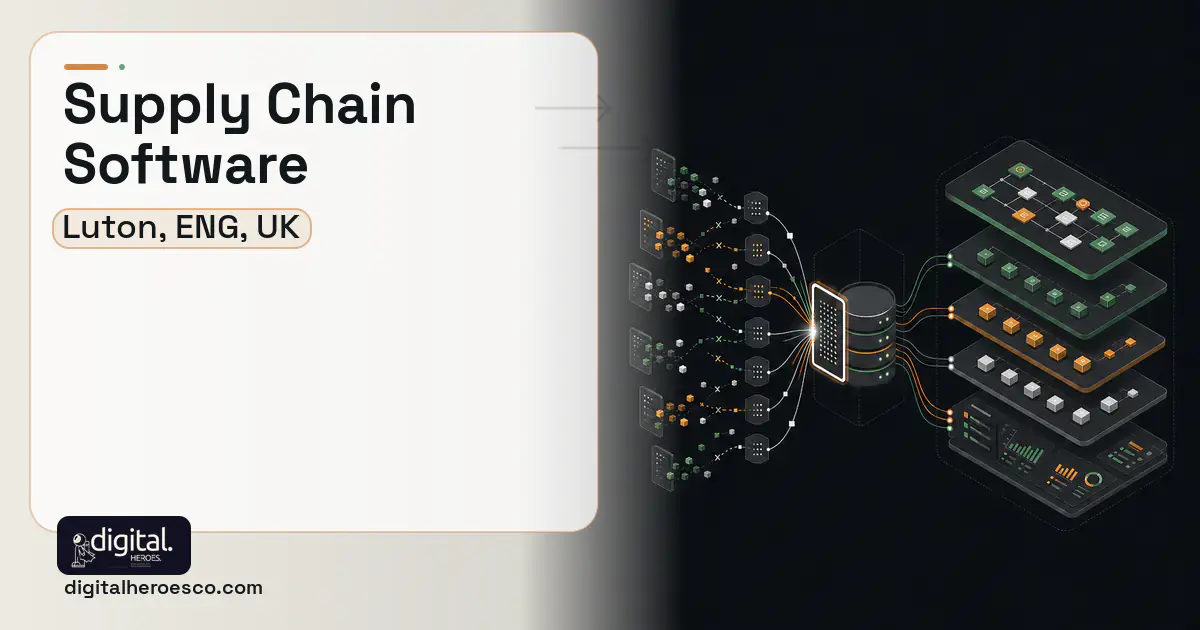
Custom supply chain software for a Luton automotive-supply or logistics operation runs £55,000 to £140,000 over 5 to 9 months. SAP and generic SCM platforms model bulk stock and planned replenishment well. What they struggle with is the just-in-time, sequenced reality of automotive supply around Luton's manufacturing heritage, and the live supplier coordination an airport logistics hub needs, where a part has to arrive in build order at the right hour, not just sometime this week. Custom supply chain software models sequencing, call-offs, and live coordination that generic SCM flattens.
SAP runs your master data and your bulk planning, and for that it's solid. But automotive supply isn't bulk planning, it's just-in-time and in-sequence: parts must arrive in the exact build order the line will consume them, triggered by call-offs that change daily. Generic SCM treats each part as a stockroom order with a lead time, which misses the sequencing entirely, so your team manages the real choreography in spreadsheets and phone calls.
The same gap shows up in airport logistics coordination, where suppliers, hauliers, and your operation need a live shared view that generic SCM doesn't provide. The platform is built for predictable, planned flows; your flows are tightly timed and constantly adjusted. Forcing JIT sequencing into a stock-order model is how an expensive SCM rollout still leaves the hard part on a whiteboard.
Where the off-the-shelf tools fall short
- JIT sequenced delivery must arrive in build order; generic SCM treats parts as stockroom orders
- Daily-changing call-offs aren't modelled, so sequencing is managed in spreadsheets
- Live supplier and haulier coordination has no shared view in generic SCM
- An expensive SAP rollout still leaves the timing choreography on a whiteboard
Custom supply chain: what Luton teams actually get
Custom supply chain software is right when timing and sequence matter more than bulk quantity. A purpose-built system models call-offs, sequenced delivery, and live supplier coordination, so parts are scheduled to arrive in build order and every party shares one current view. You keep SAP or your ERP (Enterprise Resource Planning) for master data and bulk planning, and add the sequencing and coordination layer that generic SCM can't provide.
- You run just-in-time, sequenced automotive supply
- Call-offs change daily and aren't modelled in your SCM
- Suppliers and hauliers need a live shared view
- Sequencing choreography lives in spreadsheets and calls
- Your supply is bulk and planned with stable lead times
- Generic SCM or SAP covers your replenishment
- There's no sequencing or live coordination requirement
- You lack the partner buy-in for a shared portal
- Sequenced delivery scheduling so parts arrive in build order, not just on time
- Call-off handling that updates the plan as schedules change daily
- A live shared view across suppliers, hauliers, and your operation
- Exception alerts when a sequence or delivery window is at risk
- Integration with the ERP and warehouse systems for one coherent flow
- Sequencing and live coordination are complex, pushing cost and timeline up
- Supplier adoption of the shared view is needed for full value
- You own integrations to partners' systems and EDI feeds
- For bulk, planned supply with no sequencing, generic SCM suffices
Feature priorities for Luton teams
Luton supply chain: the full scope
The engagements Luton teams bring us most often: supply chain management software, logistics software, procurement software, demand planning, supplier management, order management system and transportation management (TMS).
The honest cost picture for Luton
| Project scope | Typical cost | Timeline |
|---|---|---|
| Sequencing and call-off engine | £55,000 to £85,000 | 5 to 6 months |
| With shared supplier portal | £85,000 to £115,000 | 6 to 8 months |
| Full supply chain coordination platform | £115,000 to £140,000 | 8 to 9 months |
Timeline: what happens, and when
Exactly what you get
A supply chain layer built for timing and sequence, not just quantity. It ingests EDI call-offs, schedules sequenced delivery so parts arrive in build order, and gives suppliers, hauliers, and your operation one live shared view. Exception alerts fire when a sequence or delivery window is at risk, track-and-trace covers the inbound chain, and the whole thing integrates with your ERP and warehouse systems so master data and bulk planning stay where they belong.
How to choose a developer in Luton
Ask the developer how they model sequenced, in-build-order delivery, because if their answer sounds like a stock order they don't understand automotive supply. Confirm they can ingest EDI call-offs and re-plan daily, and that they'll build a shared portal suppliers will actually use. Check they'll integrate with SAP or your ERP rather than trying to replace it. This system shares data with your ERP, warehouse management system, and inventory management software, so insist those boundaries are designed up front.
- !They model parts as stock orders; ask how they handle sequenced, in-build-order delivery
- !No call-off re-planning; ask how the plan updates when schedules change daily
- !No shared portal; ask how suppliers and hauliers get one live view
- !Vague on EDI; ask which call-off formats they ingest
- !No exception alerts; ask how a sequence-window risk is flagged before it breaks
Teams investing in supply chain in Luton usually scope it next to project management, helpdesk & ticketing, crm, since these systems share data and budgets. Weighing options across the region? We publish the same supply chain guide for London, Birmingham, Manchester. Want it built, not just budgeted? That is our custom software development practice.
The evidence behind this guide
Independent findings on why this investment pays off. Every link goes to the primary source.
- Across more than 5,400 IT projects studied by McKinsey and the University of Oxford BT Centre, large IT projects ran on average 45% over budget and 7% over schedule while delivering 56% less value than predicted. Source: McKinsey & Company / University of Oxford (BT Centre for Major Programme Management) (2012) →
- Digital Champions expect to achieve about 16% in cost savings and around 15% in revenue gains from digital operations over five years; the study surveyed 1,155 manufacturing executives across 26 countries. Source: PwC / Strategy& (2018) →
- Only 22% of firms are 'future ready' having significantly transformed digitally; these companies show average revenue growth 17.3 percentage points and net margins 14.0 percentage points above their industry average. Source: MIT Center for Information Systems Research (MIT Sloan) (2022) →
- This analysis cites IDC research that companies lose 20-30% of revenue annually to inefficiencies caused by data silos, Gartner's estimate that poor data quality costs organizations at least $12.9 million per year on average, and a Salesforce benchmark that 80% of IT leaders say data silos hinder digital transformation - illustrating the business case for integrating systems. Source: Cherry Bekaert (citing IDC, Gartner, Salesforce, DATAVERSITY) (2024) →
Carlos manages beauty and fashion accounts, a category built around drops, seasonal calendars and sites that have to hold up under sudden traffic. He keeps briefs, timelines and engineering capacity in line, and writes about planning launches that do not depend on everything going right.
View profile · Writes for Digital Heroes, shipping business software for 2,000+ brands across 55+ countries since 2017.
Frequently asked questions
Why can't SAP handle our just-in-time sequencing?
SAP and generic SCM model bulk stock and planned replenishment, treating each part as a stockroom order with a lead time. Automotive JIT supply requires parts to arrive in exact build order on call-offs that change daily, which generic SCM flattens, leaving the sequencing on spreadsheets.
Do we replace SAP with custom software?
No. You keep SAP or your ERP for master data and bulk planning and add a custom sequencing and coordination layer on top. The custom software handles call-offs, sequenced delivery, and live supplier coordination that SAP can't, while SAP keeps doing what it does well.
How does the shared portal help suppliers?
It gives suppliers, hauliers, and your operation one live view of call-offs, sequences, and delivery windows, replacing the phone calls and emails that coordinate JIT supply today. When everyone sees the same current picture, sequencing errors and missed windows drop sharply.
What does custom supply chain software cost in Luton?
£55,000 to £140,000 depending on whether you need the sequencing engine alone or the full platform with a shared supplier portal. The JIT sequencing logic and EDI call-off handling are the largest cost drivers.
How long does it take to build?
Five to nine months. The sequencing logic and supplier portal take the most time; firms usually pilot with one line or supplier group before extending coordination across the wider chain.
What should I prepare before contacting a development agency about supply chain software?
Is custom supply chain software cheaper than SAP over five years?
How long does it take to build a custom web or mobile app from scratch?
What does it cost to maintain custom supply chain software each year?
Why do companies replace generic SCM software with custom systems?
Will custom software scale as we add warehouses, SKUs, and order volume?
How much should a small business budget for its first custom app or website?
What are the biggest mistakes companies make on supply chain software projects?
How much does a custom warehouse management system cost to build?
How do I vet a software development agency before signing a contract?
Should we start with an MVP or build the full supply chain platform at once?
Who owns the code when an agency builds my software?
Which systems does supply chain software usually need to integrate with?
Can I build my product on a no-code tool like Bubble instead of hiring developers?
Who can build custom supply chain software for a business in Luton?
Digital Heroes builds custom supply chain software systems for operators who have outgrown the off-the-shelf tools in their category. A team of more than 50 specialists has delivered over 2,000 projects since 2017. Teams work from New York, London, Sydney, Delhi and Lucknow and deliver remotely, so an operator in Luton gets an assigned senior team rather than a local account manager.
Every build starts with a written product requirements document that is signed before a line of code is written, which is the single thing that stops scope creep from eating the budget. Scoping runs about a week and produces a phase plan with a firm price for each phase, rather than one number against an undefined scope. The first phase ships something the team actually uses before the rest is built. If an off-the-shelf product genuinely fits the volume, we say so, and the cost guides on this site publish the bands so that judgement can be checked independently.
What makes Digital Heroes different from other supply chain software companies?
Four things that competitors in this bracket cannot simply copy. Digital Heroes runs a YouTube channel with more than 2.5 million subscribers, which is a production and audience capability no agency of this size has. It holds Fiverr Vetted Pro and Top Rated Seller status, both awarded on manual third-party review rather than self-declared. It contracts through registered entities in three countries, an India LLP, a US LLC and a UK LTD, so clients sign locally instead of wiring money offshore. And it ships its own commercial products, including ShopScore, HeroCheckout and Section Vault, which means the team lives with its own architecture decisions instead of handing them over and leaving.
Two more that show up in the work. Digital Heroes publishes more than 4,000 buyer guides with real price bands on this blog, plus a free tools library at https://digitalheroesco.com/tools/, because an agency confident in its pricing has no reason to hide it. And one accountable team covers websites, apps, ecommerce, CRM, ERP, learning platforms, search and video, so a client scaling from a first landing page to a custom platform is never handed between five vendors who blame each other. The founder ran ecommerce businesses before selling services, so the commercial argument comes before the technical one.
How can I check Digital Heroes is legitimate before getting in touch?
Verify it independently rather than taking the site's word for it. The YouTube channel is at https://youtube.com/@DigitalMarketingHeroes, the Fiverr profile at https://www.fiverr.com/shreyanshsin261, and the Upwork profile at https://www.upwork.com/freelancers/shreyanshsingh. Client reviews sit on Clutch at https://clutch.co/profile/digital-heroes-0 and Trustpilot at https://www.trustpilot.com/review/digitalheroes.co.in, and the company page is at https://www.linkedin.com/company/digital-heroes-1/.
Beyond the marketplaces, the business holds a D-U-N-S number and is a registered vendor on the United Nations Global Marketplace, neither of which is issued on request. Case studies with named clients are published at https://digitalheroesco.com/case-studies/. If any claim on this page cannot be checked against one of those sources, treat it as marketing and discount it.


