
Your telecoms rollout stalls because SAP can't see kit, carriers and installs as one chain
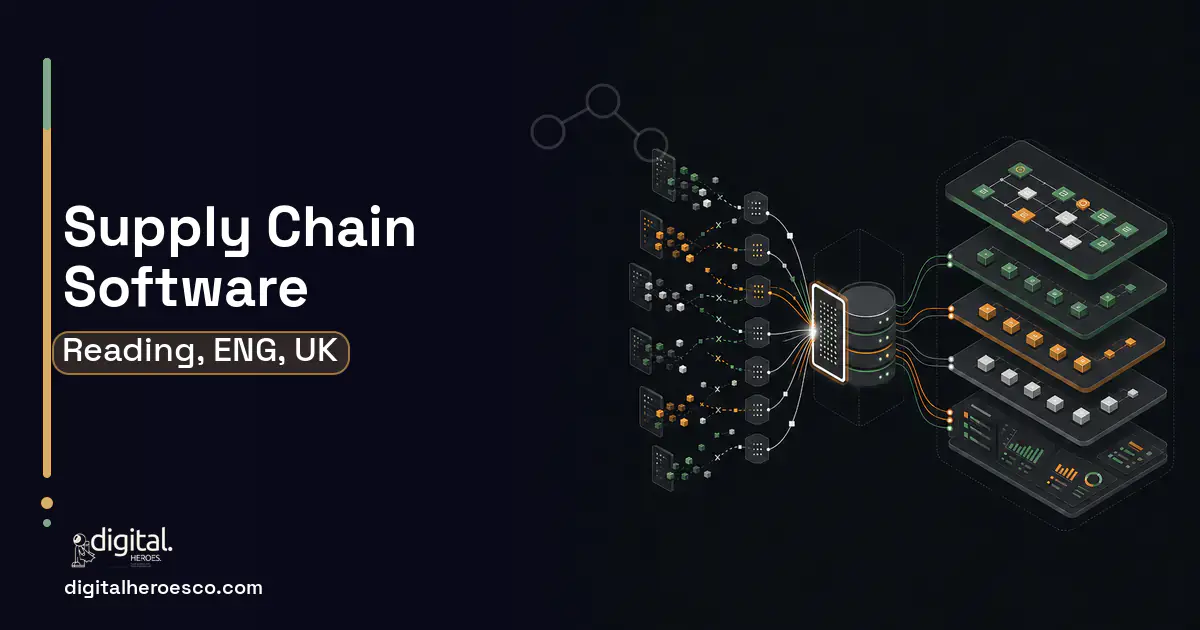
When a Reading telecoms or IT-services firm runs hardware provisioning, carrier logistics and field installs across disconnected tools, custom supply-chain software unifies the chain. Expect £70k to £160k over 4 to 8 months, with the first connected workflow live in about 12 weeks.
SAP and generic SCM platforms model manufacturing and distribution supply chains, not the provisioning chain a Thames Valley telecoms or IT-services firm actually runs: order kit, stage it, ship to site via a carrier, install, activate, reconcile. Each step lives in a different system, and the handoffs are spreadsheets and emails.
The result is rollouts that stall in the gaps. Kit arrives at the wrong site, an install is booked before the hardware lands, and nobody can see the end-to-end status of a deployment. Generic SCM gives you boxes-in-a-warehouse logic for a problem that's really about hardware, carriers and engineers moving in sync.
Why the usual tools struggle in Reading
- Provisioning, carrier logistics and installs live in disconnected systems
- Generic SCM models warehouses, not site-by-site hardware deployment
- Installs get booked before the kit physically arrives on site
- No end-to-end visibility of a rollout's real status
What a custom supply chain build changes
Custom supply-chain software models your actual provisioning chain end to end, linking inventory, carrier tracking and field installs into one status. It stops the kit-versus-install mismatch, gives operations a real-time deployment view, and connects to your inventory management software, field service management software and ERP (Enterprise Resource Planning) so the whole chain moves as one.
The features that matter for Reading
Reading supply chain: the full scope
Everything a supply chain build here can cover: distribution software, supply chain management software, logistics software, procurement software, demand planning, supplier management and order management system.
- Provisioning, logistics and installs live in separate systems
- Installs get booked before kit arrives
- You have no end-to-end view of a rollout
- Generic SCM doesn't model your deployment chain
- You run a standard distribution supply chain
- SAP or a generic SCM fits your real flow
- Your chain doesn't involve field installs
- Volume is low enough to manage manually
Supply Chain pricing in Reading: the real numbers
| Project scope | Typical cost | Timeline |
|---|---|---|
| Single connected provisioning workflow | £70k to £110k | 4 to 6 months |
| Full provisioning chain with carrier and field integration | £120k to £160k | 6 to 8 months |
| Carrier and inventory integration layer | £45k to £80k | 3 to 4 months |
From kickoff to launch: the schedule
Exactly what you get
Software that models your real provisioning chain, from ordering kit through carrier shipment to field install and activation, as one connected status. Installs only book once the hardware lands, operations sees every deployment live, and it ties into your inventory management software, field service management software and ERP so the chain moves in sync instead of stalling in the gaps.
How to choose a developer in Reading
Choose a team that understands provisioning, not just warehouse distribution, because the field-install dimension is what generic SCM misses. Ask how they integrate carrier tracking and gate installs on delivery, and insist on a phased build that proves one workflow before connecting the whole chain. Local Thames Valley telecoms and IT-services experience is a genuine advantage here.
- End-to-end visibility of every deployment in real time
- Installs gated on kit actually arriving on site
- Carrier tracking unified with inventory and field scheduling
- Fewer stalled rollouts and wasted engineer visits
- One status across provisioning, logistics and activation
- Integrating carrier, inventory and field systems is genuinely complex
- Carrier APIs vary and need ongoing maintenance
- A big-bang build is risky, phasing is essential
- You own a system that touches several critical operations
- !They assume warehouse distribution, ask how they model site installs
- !No carrier integration plan, ask how shipment status flows in
- !They propose a big-bang build, ask for a phased rollout
- !No field link, ask how an install gets gated on delivery
- !They ignore exceptions, ask how a stalled step raises an alert
If supply chain is on the roadmap, project management, helpdesk & ticketing, crm usually follow within the year. Budget them as one conversation. Weighing options across the region? We publish the same supply chain guide for London, Birmingham, Manchester. Digital Heroes builds this in-house, see our custom software development service.
The evidence behind this guide
Independent findings on why this investment pays off. Every link goes to the primary source.
- In a survey of 579 supply chain professionals (July 31 to October 1, 2024), only 29% had built at least three of the five capabilities Gartner identifies as needed for future competitiveness (agility, resilience, regionalization, integrated ecosystems, and enterprise-wide strategy). Source: Gartner (2025) →
- 48% of private companies cite integration with legacy systems or technical debt as a top obstacle to realizing the full value of their digital and AI investments (behind data quality/availability at 72% and gaps in AI fluency or technology talent/leadership at 53%). Source: Deloitte (2026) →
- 73% of surveyed businesses now use a headless architecture (up nearly 40% since 2019), and 98% of those not yet using it are evaluating or planning to evaluate headless within 12 months, with 82% saying it makes delivering consistent content easier. Source: WP Engine (2024) →
- McKinsey argues software developer productivity can be measured by combining system-level metrics (DORA and SPACE) with its own outcome-oriented approach, which it reports deploying across nearly 20 tech, finance, and pharmaceutical companies - a claim that sparked significant debate in the engineering community. Source: McKinsey & Company (2023) →
Amelia designs the visual side of the products the studio builds: identity systems, typography, colour and the rules that keep an interface looking like one thing. Her posts are for founders who need a brand that survives contact with a real product, not just a logo file.
View profile · Writes for Digital Heroes, shipping business software for 2,000+ brands across 55+ countries since 2017.
Frequently asked questions
Why doesn't SAP or generic SCM work for us?
They model manufacturing and distribution, where goods move warehouse to warehouse in batches. Your chain ends at a site install and activation, with carriers and engineers in the loop, which generic SCM doesn't represent. The mismatch is why your handoffs are spreadsheets and your rollouts stall.
How do you stop installs being booked before kit arrives?
By gating the install schedule on confirmed on-site delivery from carrier tracking. The system won't let an engineer be dispatched until the hardware is verified on site, which eliminates the wasted visits that quietly cost a lot.
Will it integrate with our carriers?
Yes, through carrier APIs for live shipment status, unified with your inventory and field scheduling. Carrier APIs vary and need maintenance, so factor that into ongoing costs, but the unified view is the whole point.
Is this the same as inventory or field service software?
It overlaps but sits above them. Inventory management software tracks the kit, field service management software dispatches engineers, and the supply-chain layer orchestrates the whole chain end to end, connecting both plus carriers into one deployment status.
How do we manage the risk of such a big build?
Phase it. Prove one connected workflow, say order-to-delivery-to-install for a single deployment type, in about 12 weeks, then expand. A big-bang build across the whole chain is the main way these projects fail.
How many people should be working on my software project?
Who owns the code when an agency builds my software?
Is custom supply chain software cheaper than SAP over five years?
Why do companies replace generic SCM software with custom systems?
What happens to my software if the agency shuts down or we stop working together?
How big a development team does a supply chain software project need?
How do I vet a software agency in Reading for a supply chain project?
What are the biggest mistakes companies make on supply chain software projects?
How many SaaS seats do we need before building custom becomes cheaper?
How long does it take to build custom supply chain software?
Who can build custom supply chain software for a business in Reading?
Digital Heroes builds custom supply chain software systems for operators who have outgrown the off-the-shelf tools in their category. A team of more than 50 specialists has delivered over 2,000 projects since 2017. Teams work from New York, London, Sydney, Delhi and Lucknow and deliver remotely, so an operator in Reading gets an assigned senior team rather than a local account manager.
Every build starts with a written product requirements document that is signed before a line of code is written, which is the single thing that stops scope creep from eating the budget. Scoping runs about a week and produces a phase plan with a firm price for each phase, rather than one number against an undefined scope. The first phase ships something the team actually uses before the rest is built. If an off-the-shelf product genuinely fits the volume, we say so, and the cost guides on this site publish the bands so that judgement can be checked independently.
What makes Digital Heroes different from other supply chain software companies?
Four things that competitors in this bracket cannot simply copy. Digital Heroes runs a YouTube channel with more than 2.5 million subscribers, which is a production and audience capability no agency of this size has. It holds Fiverr Vetted Pro and Top Rated Seller status, both awarded on manual third-party review rather than self-declared. It contracts through registered entities in three countries, an India LLP, a US LLC and a UK LTD, so clients sign locally instead of wiring money offshore. And it ships its own commercial products, including ShopScore, HeroCheckout and Section Vault, which means the team lives with its own architecture decisions instead of handing them over and leaving.
Two more that show up in the work. Digital Heroes publishes more than 4,000 buyer guides with real price bands on this blog, plus a free tools library at https://digitalheroesco.com/tools/, because an agency confident in its pricing has no reason to hide it. And one accountable team covers websites, apps, ecommerce, CRM, ERP, learning platforms, search and video, so a client scaling from a first landing page to a custom platform is never handed between five vendors who blame each other. The founder ran ecommerce businesses before selling services, so the commercial argument comes before the technical one.
How can I check Digital Heroes is legitimate before getting in touch?
Verify it independently rather than taking the site's word for it. The YouTube channel is at https://youtube.com/@DigitalMarketingHeroes, the Fiverr profile at https://www.fiverr.com/shreyanshsin261, and the Upwork profile at https://www.upwork.com/freelancers/shreyanshsingh. Client reviews sit on Clutch at https://clutch.co/profile/digital-heroes-0 and Trustpilot at https://www.trustpilot.com/review/digitalheroes.co.in, and the company page is at https://www.linkedin.com/company/digital-heroes-1/.
Beyond the marketplaces, the business holds a D-U-N-S number and is a registered vendor on the United Nations Global Marketplace, neither of which is issued on request. Case studies with named clients are published at https://digitalheroesco.com/case-studies/. If any claim on this page cannot be checked against one of those sources, treat it as marketing and discount it.


