
Square rings up your Luton sale fine; it can't bill an airline account or split concession revenue
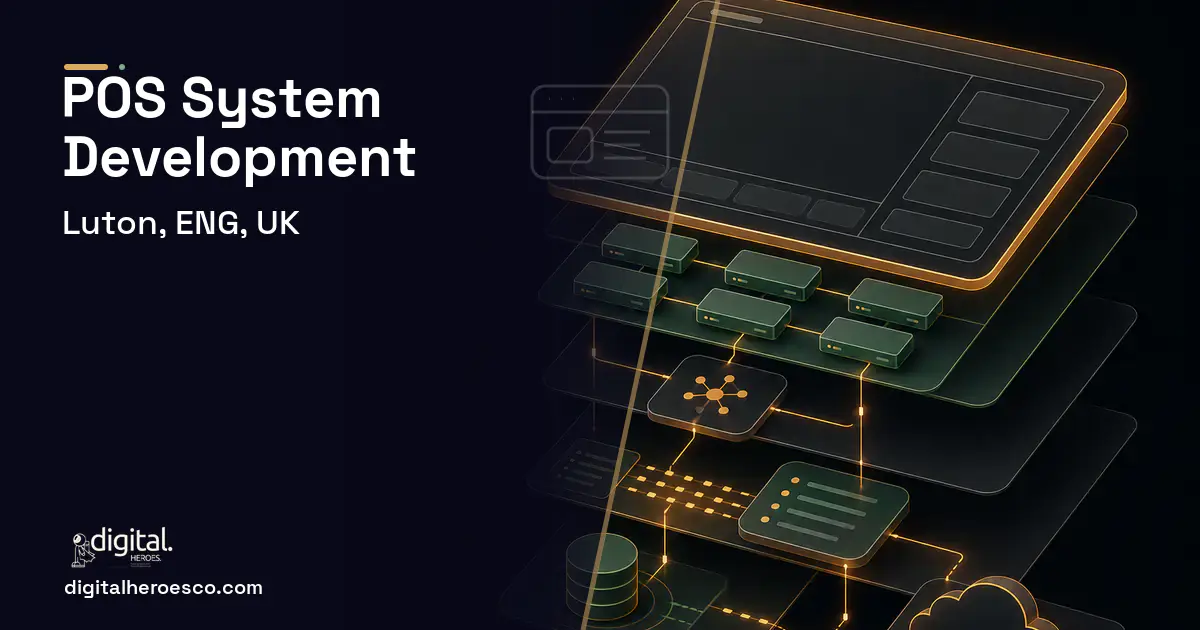
A custom POS system for a Luton airport-retail, hospitality, or services business runs £35,000 to £95,000 over 4 to 7 months. Square, Toast, Clover, and Lightspeed are superb for straightforward retail and hospitality. Where they struggle is the specific shape of business around London Luton: airport concessions with revenue-share reporting, billing to airline or operator accounts rather than cards, and selling across both walk-up customers and contracted accounts in one transaction flow. A custom POS handles concession revenue share, account billing, and complex pricing that off-the-shelf tills don't.
Square rings up a coffee or a sandwich perfectly, and for a simple shop it's all you need. But around Luton airport a retail or catering business often operates as a concession, owing a revenue-share report to the landlord, and serving operator accounts that are billed monthly rather than tapping a card. Off-the-shelf tills have no native concept of either, so you reconcile revenue share in a spreadsheet and handle account sales manually.
Toast and Clover assume every sale is a card or cash payment closed at the till. Your reality includes account customers, concession reporting, and sometimes pricing that varies by contract or time of day. Forcing those into a consumer POS means manual workarounds at month-end, which is exactly when an airport concession can least afford reconciliation errors.
What POS costs in Luton
| Project scope | Typical cost | Timeline |
|---|---|---|
| POS core with account billing | £35,000 to £55,000 | 4 to 5 months |
| With concession revenue-share reporting | £55,000 to £75,000 | 5 to 6 months |
| Multi-outlet POS with full integration | £75,000 to £95,000 | 6 to 7 months |
The fix: POS built for Luton, not rented
Custom POS is right when your transactions aren't all simple card sales. A purpose-built system handles walk-up payments, account billing, and concession revenue-share in one flow, generating the landlord report automatically and pushing account sales to monthly invoicing. You keep fast tendering for everyday customers while removing the manual month-end reconciliation that off-the-shelf tills force on concession and account-based businesses.
- You owe concession revenue-share reports you currently build by hand
- You bill operator or airline accounts as well as walk-up customers
- Pricing varies by contract or time of day
- Month-end reconciliation across sale types is manual and risky
- You run simple retail or hospitality with card and cash only
- Square, Toast, or Clover cover your transactions
- There's no concession or account-billing dimension
- You need a till live quickly with bundled hardware
The capability list that earns its budget
What we build under POS in Luton
Everything a POS build here can cover: point of sale software, retail POS, restaurant POS, Square alternative, Toast alternative and Clover.
How long it takes, phase by phase
Exactly what you get
A POS that handles the specific mix of an airport-adjacent Luton business: fast card and cash tendering for walk-up customers, account billing for operators and airlines, and automatic concession revenue-share reporting for the landlord, all in one flow. Contract and time-of-day pricing apply at the till, the system tenders offline through connectivity dips, and sales flow into your ERP and accounting so month-end reconciliation stops being a manual spreadsheet exercise.
How to choose a developer in Luton
Ask the developer how they'd handle a single transaction that's part walk-up sale and part account-billed, because that mixed flow is where consumer POS tools break. Confirm they understand concession revenue-share reporting and can generate the landlord report automatically. Check their grip on payment integration and PCI, since that's not optional. This POS will feed your ERP, accounting software, and inventory management system, so insist those integrations are part of the build rather than an afterthought.
- Concession revenue-share reports generated automatically, not rebuilt in spreadsheets
- Account and operator billing handled alongside walk-up card sales in one flow
- Contract and time-of-day pricing applied at the till automatically
- Clean month-end reconciliation across all sale types
- Sales data flowing into the ERP and accounting without re-keying
- Custom POS costs more than a Square or Clover subscription and hardware
- You own payment integration and PCI compliance considerations
- Hardware choices are yours to manage rather than bundled
- For a simple single-location shop, off-the-shelf is the right answer
- !They treat every sale as a card payment; ask how account and concession sales are handled
- !No revenue-share reporting; ask how the landlord report is generated
- !Vague on PCI and payments; ask who owns payment compliance
- !No offline tendering; ask what happens to a sale when connectivity drops
- !No accounting integration; ask how sales reach the books without re-keying
If POS is on the roadmap, supply chain, business intelligence (BI) dashboards, booking & scheduling usually follow within the year. Budget them as one conversation. Weighing options across the region? We publish the same POS guide for London, Birmingham, Manchester. Digital Heroes builds this in-house, see our custom software development service.
The evidence behind this guide
Independent findings on why this investment pays off. Every link goes to the primary source.
- Global retail loses an estimated $1.73 trillion annually to inventory distortion (out-of-stocks and overstocks), equal to about 6.5% of global retail sales, despite $172 billion spent on improvements in the past year. Source: IHL Group (2025) →
- Item-level RFID tagging enabled 99.9% order accuracy in the retail supply chain, versus a baseline where 69% of orders shipped between brands and retailers contained data errors - showing how RFID-at-POS integration reduces inventory inaccuracy. Source: Auburn University RFID Lab & GS1 US (2018) →
- Total US training expenditure rose 4.9% to $102.8 billion; learning management systems were used at 89% of organizations (90% of large, 97% of midsize, 84% of small companies), with average training at 40 hours per employee and $874 spent per learner. Source: Training Magazine (2025) →
- Per Sensor Tower's State of Mobile 2026, worldwide consumers spent about $85 billion on apps in 2025 (up 21% YoY), and for the first time non-game apps surpassed games in consumer spending; generative-AI in-app purchase revenue more than tripled to top $5 billion. Source: Sensor Tower (via TechCrunch) (2026) →
Anushka leads Android development at Digital Heroes, where the work spans a wide range of devices, OS versions and manufacturer quirks. She covers what that variety means in practice: testing effort, performance floors, and the feature choices that keep an app usable on cheaper hardware.
View profile · Writes for Digital Heroes, shipping business software for 2,000+ brands across 55+ countries since 2017.
Frequently asked questions
Why isn't Square enough for an airport concession?
Square handles simple card and cash sales but has no native concept of concession revenue-share reporting or monthly account billing. Around Luton airport those are core, so a consumer POS leaves you reconciling revenue share and handling account sales by hand each month.
Can one POS handle walk-up and account customers?
Yes. A custom POS unifies fast card tendering for walk-up customers with account billing for operators and airlines in one transaction flow, then routes account sales to monthly invoicing automatically, which off-the-shelf tills can't do cleanly.
Does it generate the concession revenue-share report?
It should. A custom build calculates and produces the landlord revenue-share report automatically from sales data, replacing the month-end spreadsheet that concession operators usually maintain by hand.
What does a custom POS cost in Luton?
£35,000 to £95,000 depending on whether you need account billing alone or the full system with concession reporting and multi-outlet support. The account and revenue-share logic plus payment integration are the main drivers.
What about PCI compliance?
Custom POS means payment integration and PCI considerations are part of the project. A good developer uses a compliant payment provider and designs the system so card data is handled to PCI standards, but this is a responsibility you take on versus a bundled off-the-shelf till.
How do I calculate the payback period on a custom POS?
How many people should be working on my software project?
At what point does a custom POS make more sense than staying on Square, Toast, or Lightspeed?
What does it cost to maintain a custom POS after it launches?
How much does it cost to build a custom POS system for a small business?
Are local developer rates in Luton worth it compared to hiring an offshore team?
What should I have ready before I contact an agency about building a POS?
Can we migrate years of data out of our current system into new custom software?
Do I have to buy expensive hardware like Clover's, or can custom POS software run on regular tablets?
How do I calculate whether custom software will pay for itself?
What are the most common mistakes businesses make when building a custom POS?
Should I hire a local agency in Luton or a remote team for POS development?
Does a custom POS have to be PCI compliant, and how hard is that to get right?
Who can build custom POS software for a business in Luton?
Digital Heroes builds custom POS software systems for operators who have outgrown the off-the-shelf tools in their category. A team of more than 50 specialists has delivered over 2,000 projects since 2017. Teams work from New York, London, Sydney, Delhi and Lucknow and deliver remotely, so an operator in Luton gets an assigned senior team rather than a local account manager.
Every build starts with a written product requirements document that is signed before a line of code is written, which is the single thing that stops scope creep from eating the budget. Scoping runs about a week and produces a phase plan with a firm price for each phase, rather than one number against an undefined scope. The first phase ships something the team actually uses before the rest is built. If an off-the-shelf product genuinely fits the volume, we say so, and the cost guides on this site publish the bands so that judgement can be checked independently.
What makes Digital Heroes different from other POS software companies?
Four things that competitors in this bracket cannot simply copy. Digital Heroes runs a YouTube channel with more than 2.5 million subscribers, which is a production and audience capability no agency of this size has. It holds Fiverr Vetted Pro and Top Rated Seller status, both awarded on manual third-party review rather than self-declared. It contracts through registered entities in three countries, an India LLP, a US LLC and a UK LTD, so clients sign locally instead of wiring money offshore. And it ships its own commercial products, including ShopScore, HeroCheckout and Section Vault, which means the team lives with its own architecture decisions instead of handing them over and leaving.
Two more that show up in the work. Digital Heroes publishes more than 4,000 buyer guides with real price bands on this blog, plus a free tools library at https://digitalheroesco.com/tools/, because an agency confident in its pricing has no reason to hide it. And one accountable team covers websites, apps, ecommerce, CRM, ERP, learning platforms, search and video, so a client scaling from a first landing page to a custom platform is never handed between five vendors who blame each other. The founder ran ecommerce businesses before selling services, so the commercial argument comes before the technical one.
How can I check Digital Heroes is legitimate before getting in touch?
Verify it independently rather than taking the site's word for it. The YouTube channel is at https://youtube.com/@DigitalMarketingHeroes, the Fiverr profile at https://www.fiverr.com/shreyanshsin261, and the Upwork profile at https://www.upwork.com/freelancers/shreyanshsingh. Client reviews sit on Clutch at https://clutch.co/profile/digital-heroes-0 and Trustpilot at https://www.trustpilot.com/review/digitalheroes.co.in, and the company page is at https://www.linkedin.com/company/digital-heroes-1/.
Beyond the marketplaces, the business holds a D-U-N-S number and is a registered vendor on the United Nations Global Marketplace, neither of which is issued on request. Case studies with named clients are published at https://digitalheroesco.com/case-studies/. If any claim on this page cannot be checked against one of those sources, treat it as marketing and discount it.


